How to Get Ahead of Building Material Price Trends in 2025: 5 Key Insights

Real estate developers have a long to-do list right now.
Keeping up to speed with the latest building material price trends in 2025 is likely to be near the top of it, thanks to a fast-moving and volatile market.
If you’re one of them, you’ll be familiar with the following challenges:
- Not having the time to keep up with changes in building material prices in a fast-moving real estate industry
- Uncertainty around building costs, which makes budgeting much more difficult
- Struggling to find the finances to cope with sudden material price rises.
Fluctuations in construction and financing costs have been one of the most pressing commercial real estate trends for some time now, with high interest rates driving up the building costs on new units.
The average expense per unit has risen by 27.4% across the United States and Canada in the four years ending August 2024, according to PwC.
As a developer, this means you’ll need to go through your construction costs with a fine-tooth comb, including the latest material price trends that are likely to impact them.
Read on to find out the latest building material price trends in 2025, and what developers can do to navigate them.
Rising costs mean funding for CRE developers is more important than ever. Contact Duckfund to find out how we can help you make your next project a success.
5 building material price trends to take note of in 2025
Factoring in the cost of building materials in 2025 is a crucial part of any commercial property appraisal, whether building new homes or reforming property into multi-family blocks.
As a developer, you’ll need to keep track of the latest building material price trends in 2025 to do this well.
Here’s a closer look at five that are affecting the real estate market right now.
1. High US tariffs will make home building more expensive across the world
High tariffs were the last thing a construction sector already struggling with rising material prices needed, so the sweeping duties announced by the US government in April 2025 were a hammer blow to developers.
“Even the threat of tariffs creates an uncertain business climate,” says Alex Strong, Senior Director, Federal Legislative at NAHB. “In effect, they act as a tax on American builders, home buyers and consumers.”

Import taxes on building goods dramatically add to costs for US developers because they made up 7% of all residential construction materials in 2024, according to the NAHB. These include lumber from Canada, gypsum (Mexico), and steel and aluminum (China).
Other countries, too, feel the ripple effects of these price hikes as they grapple with increased competition for scarcer, more expensive resources.
As a developer, inflated material prices will impact your construction budget and eat into your profit margins, so preparing yourself for this is a smart idea.
There are also likely to be delays in lease signings and project approvals from suppliers as businesses hesitate in the face of rising costs.
Tenant viability is likely to suffer, too, with the tariffs expected to increase costs for a typical U.S. household by $1,200 a year, according to CBRE.
Despite the bad news for developers, there is likely to be some relief as countries make deals with the US government to mitigate the worst effects, yet trade uncertainty remains.
2. Inflation, still above pre-pandemic levels, will continue to push prices up
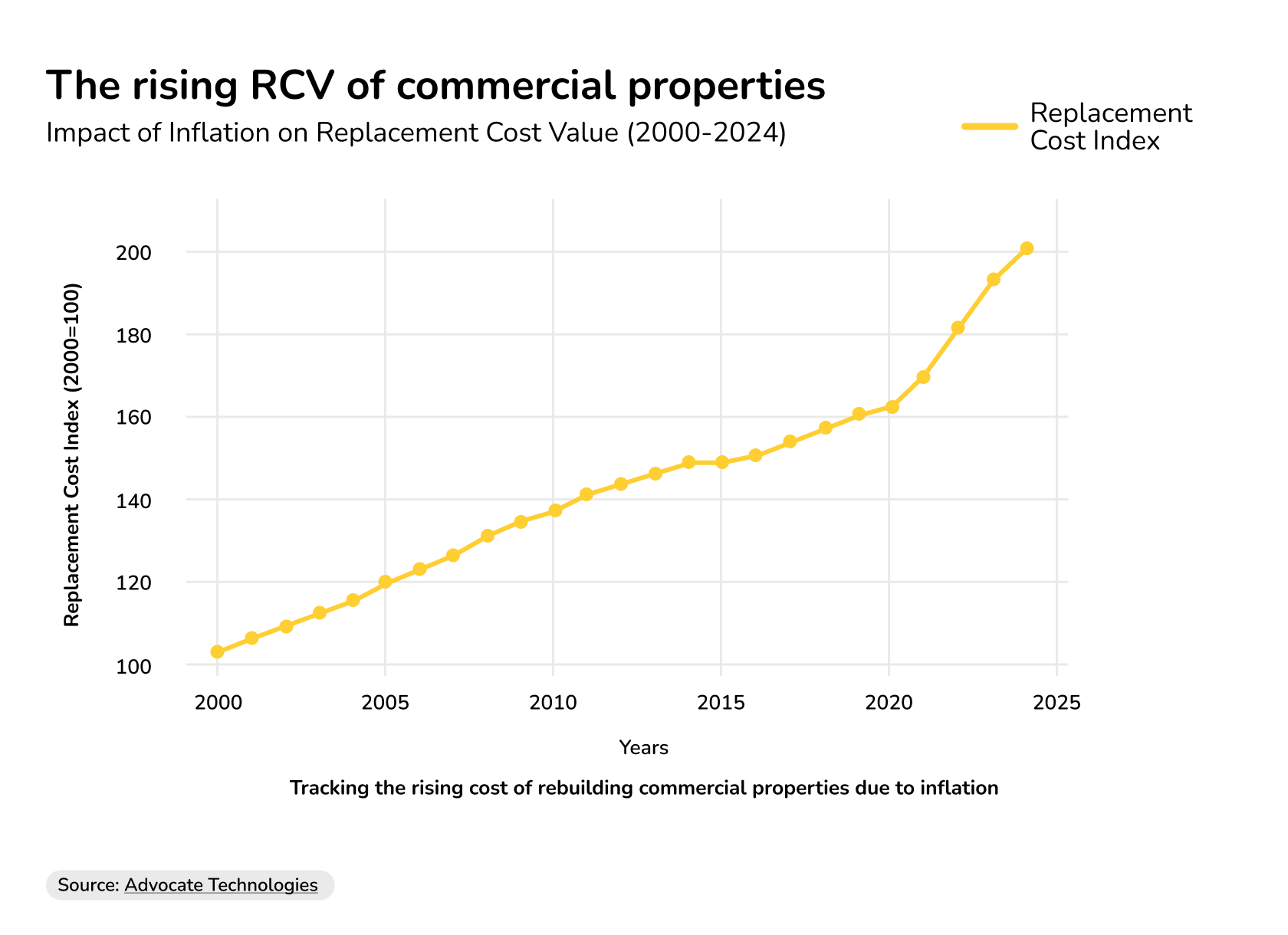
Inflation continues to impact CRE by adding to material price increases for construction projects.
These inflationary pressures are one of the driving forces behind the rising Replacement Cost Value (RCV), the cost to rebuild from scratch, thanks to pricier steel, lumber, and labor.
Source: Advocate Technologies
However, many senior construction industry figures believe we may have navigated the worst of the inflationary storm.
Pedro Guazo, representing the UN's $95.3 billion pension fund, expressed 'cautious optimism' for the fund's performance in 2025.
“The question we ask internally is, ‘Did the trendline reverse?’ rather than, ‘Is this the absolute bottom?’,” he wrote via email. “In that respect, we believe we are near the cycle’s bottom.”

CRE developers must bear in mind that we’re not in the clear of inflationary pressures just yet, so proactive management is a smart way of mitigating its bite. This might include:
- Locking in long-term contracts with suppliers to secure current construction material prices.
- Diversifying portfolios to include inflation-resistant asset types, like multifamily housing.
- Investing in energy-efficient upgrades to reduce operating costs and avoid leftover building supplies.
All are proven methods that help keep your CRE portfolio robust against the pressures of inflation.
3. Supply chain disruptions are easing, but global demand remains high
Global supply chains are returning to their pre-pandemic levels but they haven’t thrown off the shackles entirely.
Material deliveries are still unpredictable across the world: uncertainty that throws off project budgets and timelines. Continued high demand for materials means key challenges include:
- Delays and bottlenecks lead to shortages, which drive up prices
- Late deliveries drag out projects, adding to labor costs and cutting into profits. They can also lead to legal issues.
- Fuel prices and logistics problems are making it more expensive to move materials, adding to the bottom line.
To deal with this, construction firms are building stronger relationships with building supplies stores for better prices and reliability.
They’re also using multiple suppliers to diversify their risk, or even developing an interior building supply chain, which allows them to obtain building materials at cheap prices.
Even with these fixes, supply chain issues will likely keep pushing up construction costs in 2025, so developers need to be ready to adjust budgets and timelines.
4. Material price hikes to vary by sector
Construction material cost rises have hit various sectors in different ways, with some suffering more than others.
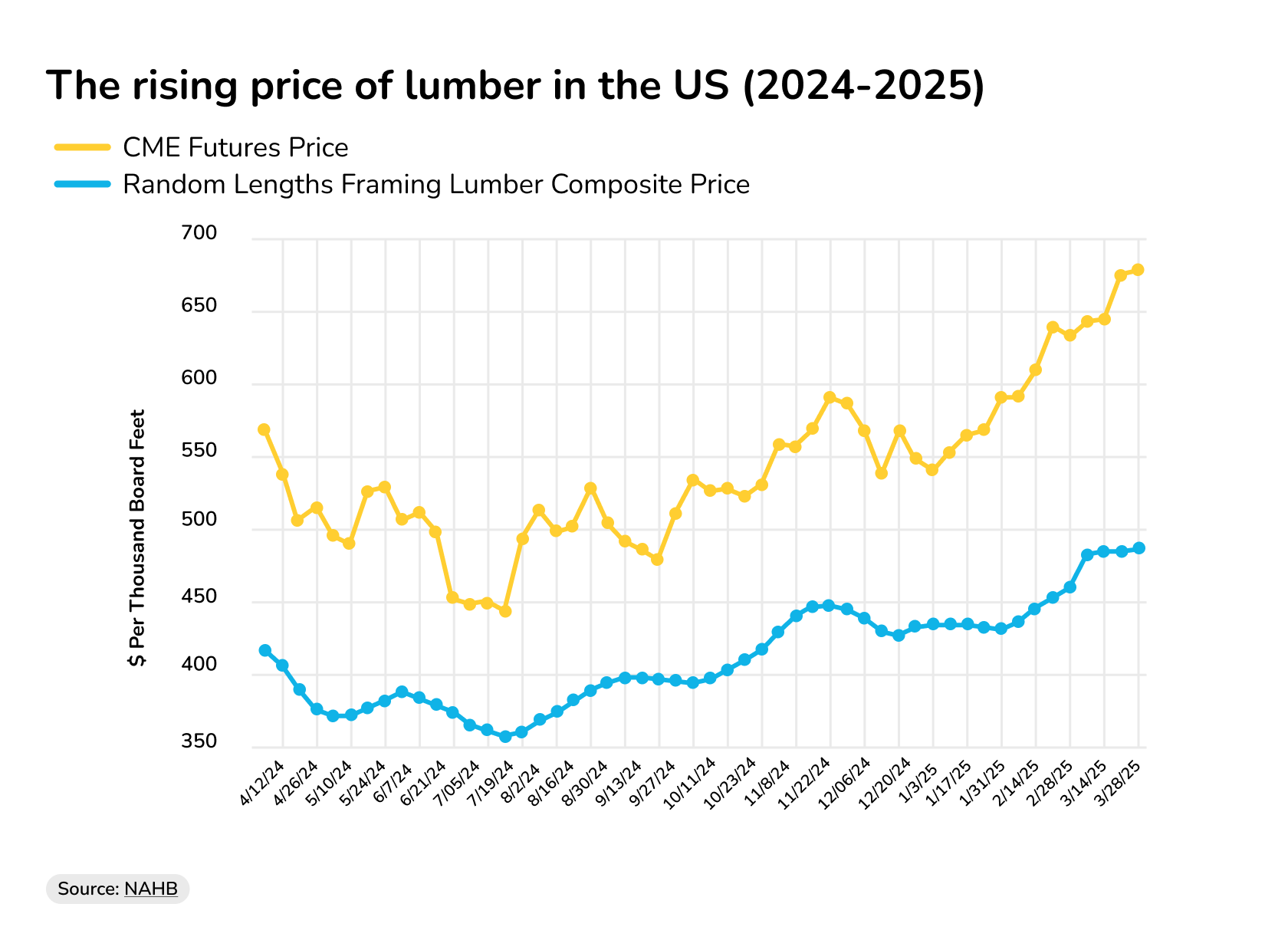
In the US market, lumber prices experienced a 15.6% year-over-year increase as of March 2025, coming in at $488 per 1,000 board feet. With the average single-family home requiring 15,000 board feet of framing lumber, this translates to an increase of almost $1,000 in the space of 12 months for developers.
Source: NAHB
Aluminum and steel prices also climbed close to recent peaks following the trade war between the U.S. and Canada.
U.S. Midwest aluminum premium reached a record 45 cents/lb, then settled at 41 cents/lb. Its price has risen by 70% since the start of the year, according to Reuters.
Metal supplies have been diverted to other countries as a result, and these have seen lower prices. In Europe, for example, the aluminum premium dropped to $230/metric ton, down over 35% since early 2025.
Gypsum is a rising commodity in the real estate industry, with the market set to grow at a Combined Annual Growth Rate of 13% by 2029.
In the U.S., calcined gypsum prices were $63 per ton in 2024, up by 5% year-on-year. The figure more than doubled decade-on-decade from US$27/t in 2014, which also explains a sustained drywall increase over this time, with gypsum being its prime component.
Copper, however, has been the exception to the raw material price increases. Prices sharply declined to $4.839 per lb. ($10,645/tonne) – marking a 10% decline from its March 2025 high – due to fears that April’s tariffs would reduce industrial demand and create a building supply surplus. Copper futures fell, and major producers' stocks plummeted. Analysts predict further price drops.
Tariffs, including those from China and the EU, also add to the market uncertainty.
5. Increase in financing costs offset by a growing number of alternative lenders
For CRE developers in 2025, the financing market is a tightrope walk.
High interest rates, the U.S. Fed's inflation-fighting weapon, have become a double-edged sword, even after coming down recently.
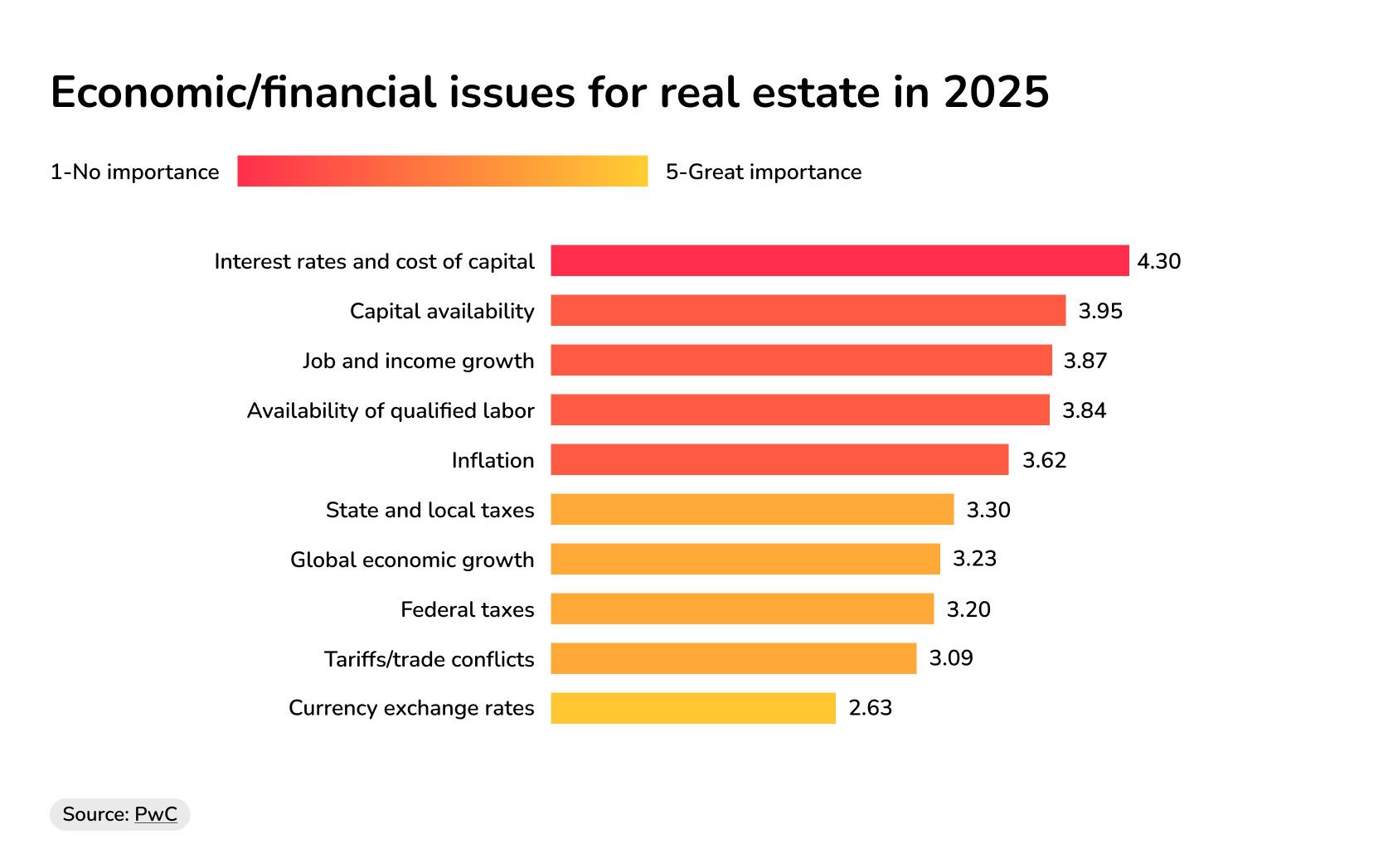
The high cost of borrowing, along with the availability of capital, is the most pressing issue for real estate developers in 2025, according to PwC data.
Source: PwC
The Fed's moves, while aimed at cooling inflation, have choked the home resale market, pushing prices higher. This and soaring construction costs — averaging a hefty 7.5% for loans — discourage new builds. All of this adds to a feeling of a drying pipeline for developers and investors, leaving many scrambling for materials in a supply-constrained market.
The Fed's inflation gauge, relying on outdated rental data, might also be prolonging the pain. Many argue inflation's already tamed, but financing remains pricey. As a developer, this means your projects, already battling rising material costs (steel alone hit $709/ton), face even steeper borrowing hurdles.
While a slight interest rate dip is forecasted for 2025, reaching the mid-5% range, it's a drop in the ocean. The Fed's rate, expected to hit 3.5%, offers a glimmer of hope, but high rates continue to squeeze profit margins, making material procurement a financial minefield.
In short, the lack of accessible, affordable financing isn't just a trend, but a reality reshaping development strategies.
Duckfund: Close deals faster with solid EMD funding
The building material price trends in 2025 paint a troubling picture for developers who are already battling tightening budgets and project cost increases.
And that’s before we even consider the cost of financing the deposits that secure prime real estate, like earnest money.
Duckfund’s Earnest Money Deposit (EMD) financing is designed to smooth the wheels of your deal without tying up your capital or losing you valuable time.
You gain the leverage to offer larger earnest money deposits, securing better terms and closing deals faster because our financing is built on three core principles:
- Speed: 24-hour approvals and 48-hour fund transfers.
- Flexibility: Terms to suit you, including reduced interest rates from the fourth month onwards.
- Bidding power: Secure more deals with institutional-backed funding.
You don’t need to provide any collateral, and you can manage multiple projects simultaneously, giving you the power to compete and win.
Think of it as a strategic advantage, allowing you to focus on securing equity and debt partners without the immediate pressure of large capital outlays.
We've helped developers acquire over $1.5 billion in properties, and we're ready to help you too. Don't let higher costs and tight liquidity hold you back.
Let Duckfund be your financial partner, turning market challenges into strategic wins.
Want to see how Duckfund can help make your next project a success? Contact us today to see how you can secure a new development property with no capital or upfront costs.
Real Estate
Financing

- Approval within 24 hours
- Fund multiple properties at once
- No full deposit upfront — soft deposit only
- Apply in under 2 minutes
Secure your next commercial property acquisition — zero upfront capital required.
Start with Duckfund’s EMD financing program.- No capital commitment
- Close faster
- Scale with confidence