How to Integrate Coworking into Your 2025 CRE Strategy

Anyone paying attention to the coworking real estate market will know that it’s flying at the moment.
Estimates predict the sector to almost triple by 2034, which explains why investment firm CBRE recently announced its $800M acquisition of Industrious, a flexible workplace company.
If you’re a commercial real estate (CRE) investor looking to move into this growing industry, you might be considering ways to overcome major doubts, including not knowing:
- Whether coworking real estate presents a profitable long-term investment
- Which coworking opportunities are the best ones to go for right now
- How to secure funding once you decide to make the move into coworking investment.
This guide looks at how CRE entrepreneurs can benefit from coworking real estate opportunities right now, including the challenges and financing involved in doing so.
Make sure you don’t miss out on hot coworking real estate because of a lack of funding. Contact Duckfund to find out how we can help you make your next project a success.
How coworking is growing
Coworking real estate marks a shift from traditional offices to shared, open-plan office environments.
Instead of housing just one company, these spaces bring together employees and freelancers from various businesses into one place, which means more flexibility and cost savings for all concerned.
These benefits are fueling coworking space growth. By the end of 2024, the US had 7,695 coworking spaces, growing 2% from the previous quarter.
Globally, the coworking spaces market is growing at an impressive annual rate of 14%.
Such figures offer clear proof that the coworking concept is continuing to gain serious traction.
The benefits of coworking spaces for investors
Post-pandemic life has led today's professionals to want flexibility and community in their work lives.
These are just two areas where real estate coworking spaces really shine, breaking free from the rigidity of traditional office space while providing the communal environment that remote work lacks.
From an investor’s perspective, there are several major benefits that coworking real estate can offer.
1. Sky-high demand
The high demand for co-working spaces from businesses makes them a hot prospect for investors.
Coworking spaces typically offer short-term leases, which frees businesses from long commitments and hefty upfront costs. Startups, in particular, find this arrangement extremely useful.
These spaces also come loaded with essentials like high-speed internet, well-equipped meeting rooms, and event spaces — all typically included in the membership fee.
Businesses in expensive urban areas, particularly in California, can save up to 70% in office lease costs by replacing them with coworking, according to a recent report from Coworking Cafe. In Sunnyvale, CA, a coworking space for 10 workers provides a six-figure saving compared to office real estate leasing.
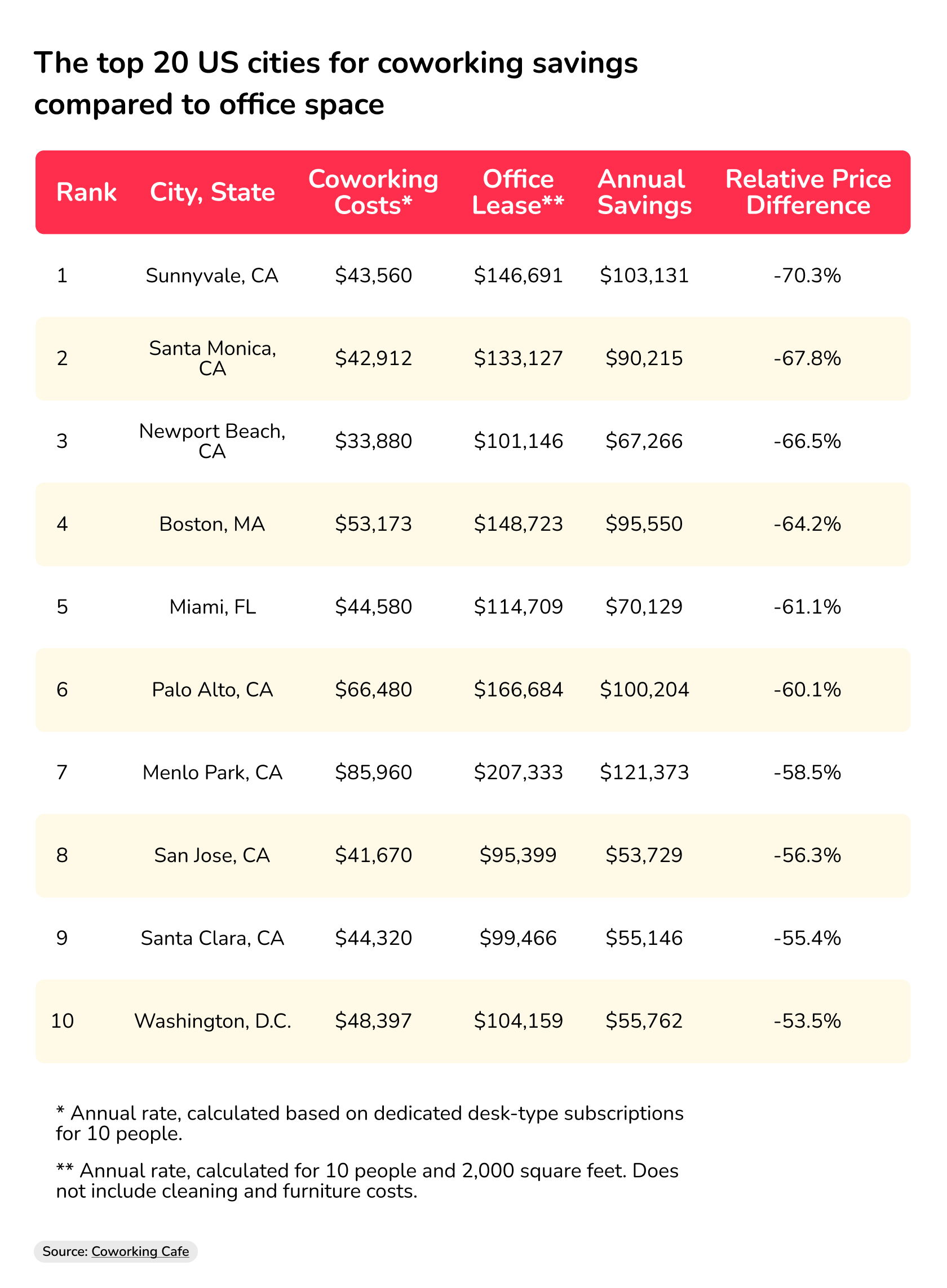
Source: Coworking Cafe
Coworking spaces give companies exactly what they want – flexible leases and no big upfront costs — and it’s driving the high demand that’s making investors see these properties as a promising money-making opportunity.
2. High occupancy rate
It’s no good investing in coworking real estate if you can’t fill it with tenants.
The good news for would-be investors is that coworking space enjoys a high occupancy rate. In the US, popular locations California and Texas enjoy an average of 86% occupancy between them. Tech-focused spaces reach as high as 92% in the Golden State.
High occupancy means consistent and predictable revenue streams, which is also good news for investors.
3. Future-proof flexibility
Coworking spaces offer a high level of adaptability which helps to future-proof them against economic and social changes.
Their very structure – smaller, modular units and shared facilities – gives developers several options (like changeable unit sizes or potential event space) to make use of right now.
Also, should the pendulum swing back towards traditional office models, these spaces can be easily reconfigured compared to buildings locked into long-term leases with single, large occupants.
Which types of coworking spaces are most successful?
One of the major differences between most types of commercial real estate and coworking is that the latter can be easily molded into different types, ranging from an industrial coworking space to high-end office spaces.
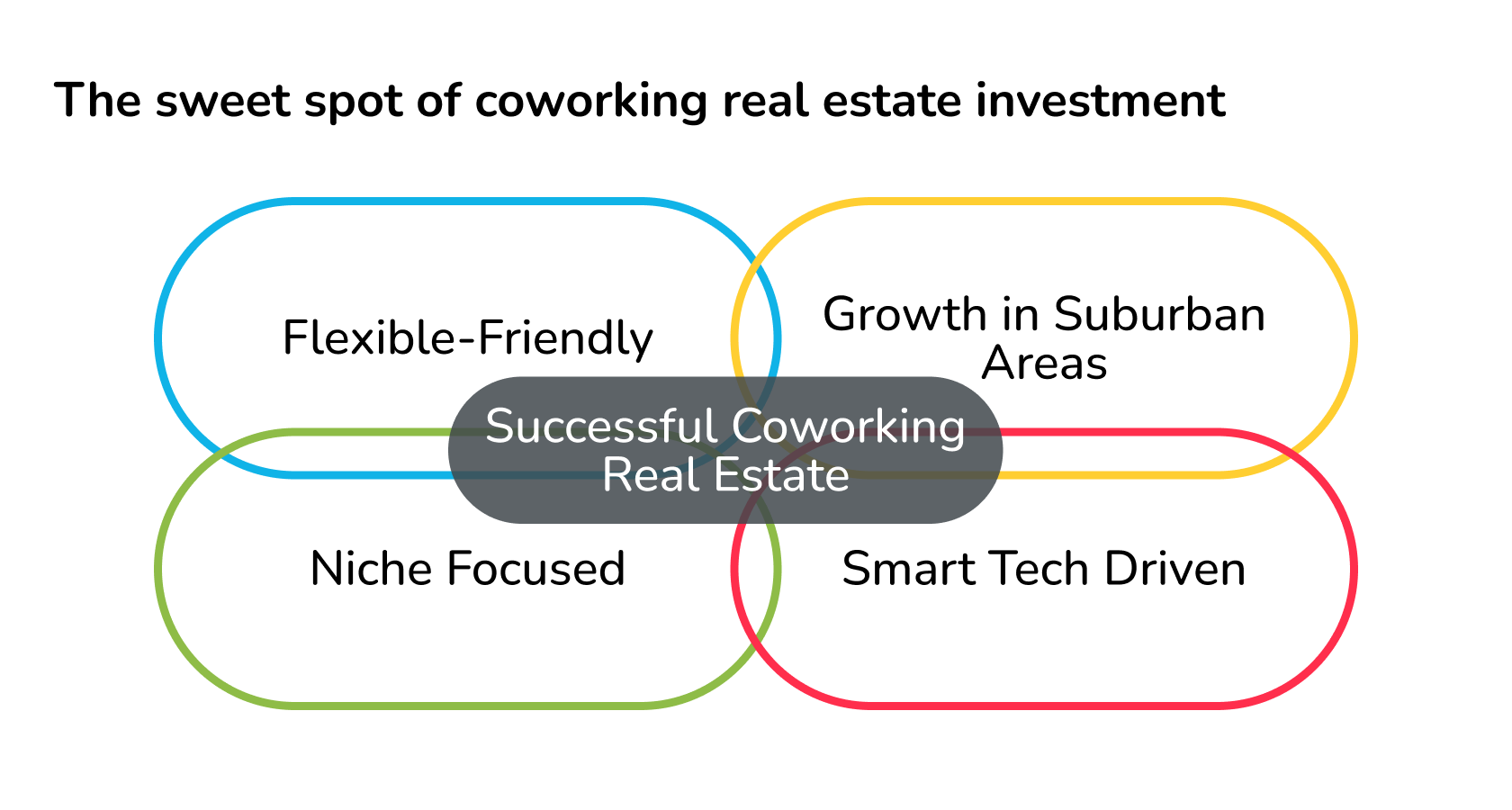
Here’s a look at some of the most successful types of coworking models for investors.
1. Flexible-friendly
Many coworking spaces are adapting their offerings to the growing use of hybrid work models.
A 2024 WeWork Business Leader Survey found that 72% of companies plan to expand their offices in the next two years, with almost three-quarters of these investing in flexible spaces.

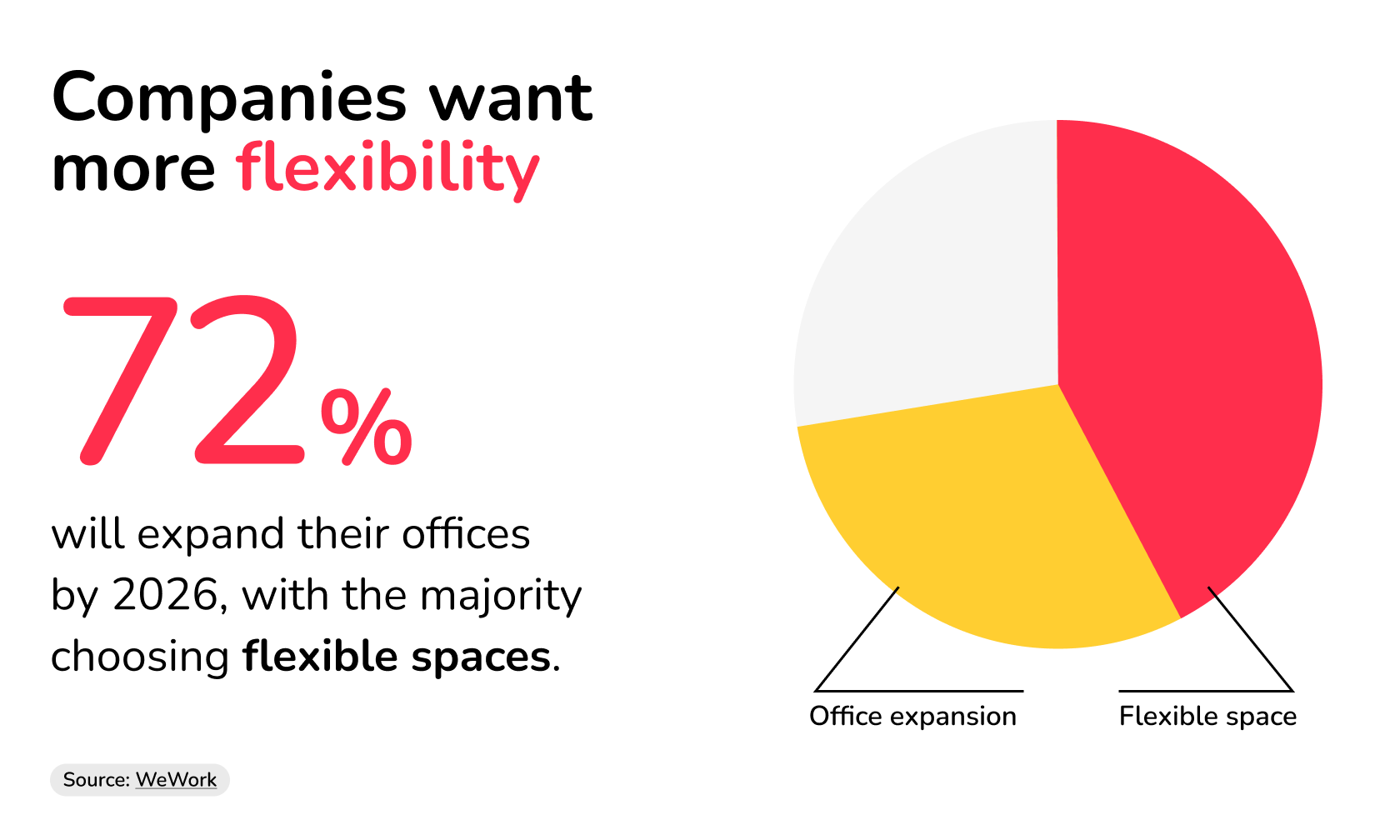
Source: WeWork
This will mean coworking spaces needing to support both individual-focused work and team collaboration, including a mix of:
- Private offices
- Flexible desks
- Meeting rooms are equipped with advanced video conferencing technology
- Collaboration zones.
Coworking investors that can show this versatility will position themselves well for the influx of businesses looking to expand into flexible spaces.
2. Growth in suburban areas
Location is also key.
Suburban (or secondary) areas have seen impressive growth in coworking inventory as hybrid workers choose to work closer to home and avoid long commutes.
In the United States, New Jersey is the stand-out example, experiencing a 36% year-on-year increase from 2024, according to Cushman & Wakefield’s 2025 flexible office outlook.
Suburbia, with its more localized setting and tendency toward a better work-life balance, may be a key factor in the future of coworking.
“No longer is the office defined solely by skyscrapers and downtown cores,” says Jason Anderson, President of Vast Coworking Group, writing for Forbes. “Instead, we’re witnessing the rise of suburban coworking spaces — flexible environments that bring professional opportunity closer to home, strengthen local economies, and forge a more balanced relationship between work and daily life.”

3. Niche is the new normal
Niche offerings are growing as coworking spaces look for a way to stand out from a growing number of rivals.
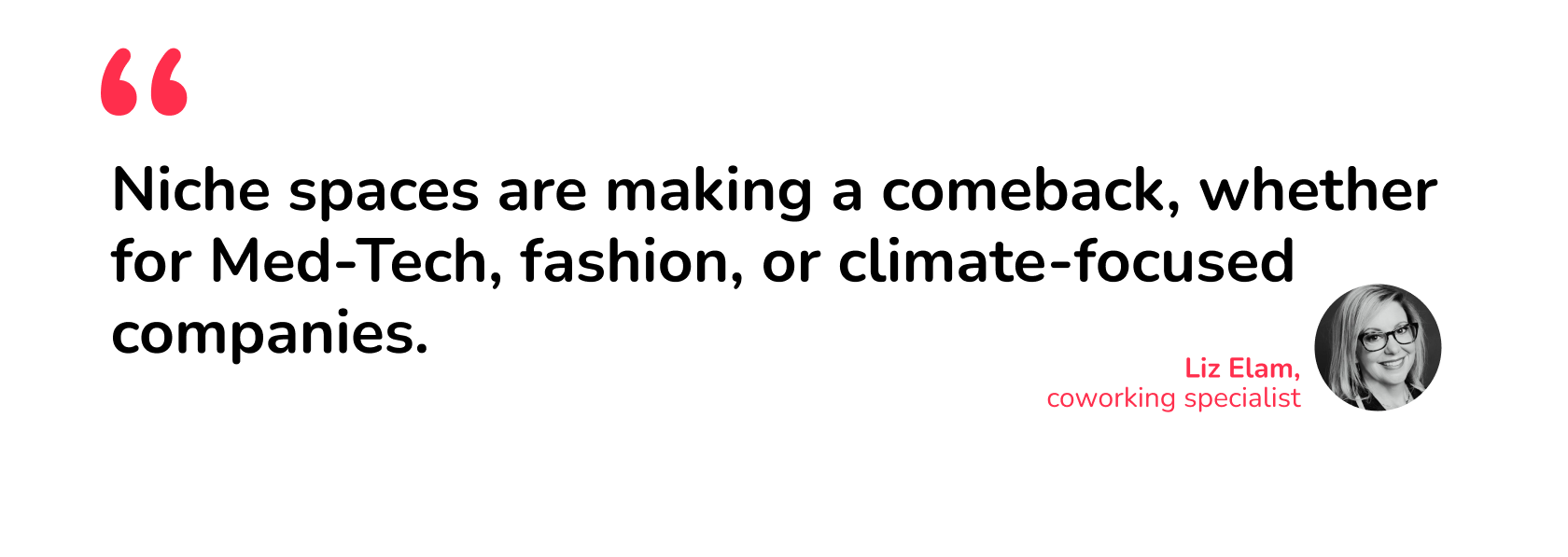
“Niche spaces are making a comeback, whether for Med-Tech, fashion, or climate-focused companies, “ says coworking specialist Liz Elam in her 2025 Coworking Megatrends report. “These hyper-specialized spaces foster networking and collaboration within industries.”
Coworking investors will need to avoid cookie-cutter workspaces to adjust to this new demand. This might include eco-friendly buildings for climate-focused tenants, or photo studios for fashion spaces.
4. Smart tech is a central offering
Tech-focused workspaces are also proving extremely popular, in two meanings of the phrase.
Workspaces that host tech employees enjoy the highest occupancy rates, as mentioned previously.
Some coworking companies have even reshaped their entire operations around AI. Companies like Uniti and Flexspace AI are leading the charge, improving sales processes and making use of advancements in analytics.
Expect AI to drive data-driven personalization and for AI to streamline the member experience.
Smart technology will be the other side of the tech coin. The likes of smart lighting, temperature control systems, high-tech conference rooms, and touchless entry are becoming increasingly important in attracting new tech-oriented companies.
How to evaluate coworking real estate potential
Every commercial property investment should be built on extensive research, and coworking is no different.
If we see hot coworking opportunities as gold, then an evaluation framework is the detector that leads you to them.
Here’s one such example, backed up by expert advice.
1. Location analysis
We mentioned popular locations earlier – and how suburban coworking is growing the fastest – but if your space doesn’t have great access to major highways, public transport, or parking, then it doesn’t matter if it’s in California or Connecticut, it probably won’t be profitable.
Rival spaces, too, may already have established a foothold in the local area and might be a big barrier to entry. If they’re full, however, then there’s a chance for a new space to draw in some of their waiting list.
Location is also important for member benefits. Surrounding amenities that members can make use of, including restaurants, cafes, gyms, and retail areas, are crucial.
2. Income potential
Location will also affect the income potential of a coworking space.
As an investor, the average subscription cost affects your return on investment, whether you’re charging it to members directly or via the amount of rent you can charge the coworking operator.
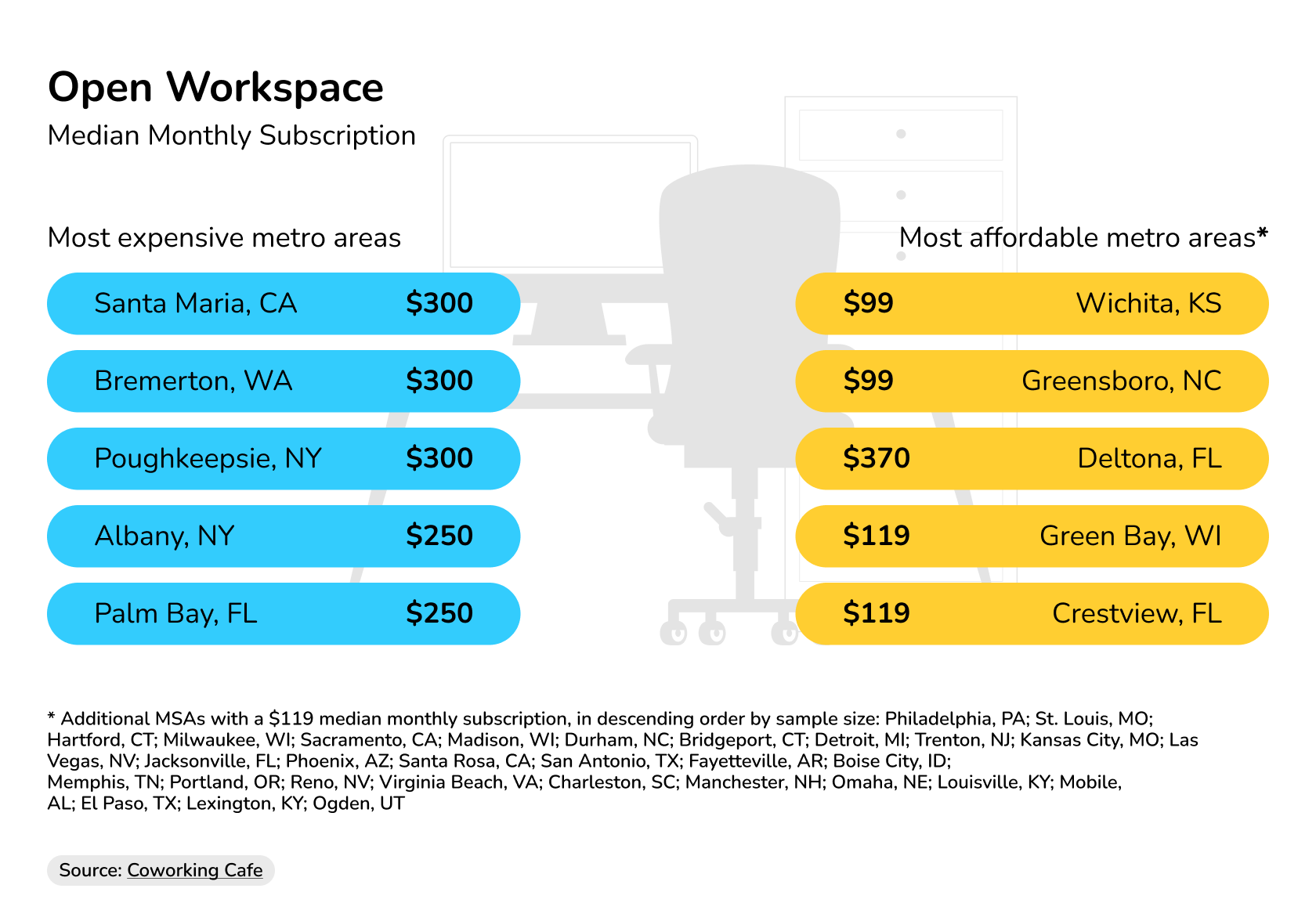
In the U.S., the national median hovers around $149, but there’s a huge disparity between most expensive metro areas like Santa Maria, CA, Bremerton, WA, and Poughkeepsie, NY, which command an average of $300 per month for a hot desk, and Wichita, KS, and Greensboro, NC, that offer dip below a third of that.
The range of workplace monthly subscriptions (US)
Source: Coworking Cafe
While cheaper markets may present lower barriers to entry, investors need to focus on achieving higher occupancy rates and potentially diversifying revenue streams to make sure they turn a healthy profit.
Beyond basic memberships, coworking spaces generate income from private offices, meeting rooms, events, and services like printing and mail.
Just like membership fees, the pricing for these extra offerings will mirror the local market's affordability, meaning pricier cities can typically command higher rates across the board.
3. Design considerations
The most successful spaces can adapt to different team sizes and usage patterns, including private offices, flexible desks, and team suites.
They also have an excellent capacity for high-speed internet, security systems, and smart office features like keyless entry and automated lighting.
Amenities like conference rooms, phone booths, and even wellness areas (not to mention a management structure to run it) can also make a big difference to how well the space fares.
4. Risk assessment
Every investment has risk, but how well we prepare for it makes the difference.
Market volatility and its potential to affect demand is the obvious thing to look out for, but the potential for new competitors should also be an ongoing concern.
Regulatory factors, including zoning, occupancy, and building code requirements, are also important to keep a close eye on.
5. Financial calculations
Finance is perhaps the most obvious area for a would-be coworking industry investor to look at.
A commercial property appraisal and cost analysis is the most accurate way of measuring how much finance you need. This might be summed up as follows:
- Initial investment requirements, including property costs, renovation expenses, furnishings, and equipment installation.
- Revenue projections, comprising realistic membership forecasts based on local market demand
- Operational costs, such as staff, utilities, maintenance, cleaning, and ongoing technology expenses
- A break-even timeline, which tells you how long it’ll take you to achieve operational profitability
- An ROI analysis, or the expected returns of your investment, to be more specific.
The challenges of coworking real estate
Coworking real estate may be booming, but there are several important challenges that you should consider carefully before making an investment decision.
1. High upfront costs
Buying coworking real estate comes with large upfront capital requirements to buy the property and renovate it into the flexible working space you’re looking for.
Commercial office buildings trade at an average of $37 per square foot across the U.S.
Coworking management app Archie puts the average US co-working space at between 8,600 and 16,000 square feet, which translates to a capital investment of between $300,000 and $600,000.
2. Market volatility
The coworking real estate market isn't immune to economic bumps in the road.
When the economy slows or uncertainty rises, small businesses and individuals might rethink their workspace and encourage more remote work. This might lead to empty desks and fluctuating income.
Smart investors plan for this by setting up their finances thoughtfully. Structuring loan payments to match realistic occupancy levels, for example, especially when you're just starting out or during quieter times of the year, gives you breathing room and helps weather any unexpected economic storms in the flexible workspace sector.
3. Keeping up with tech
Today's coworking members expect more than just Wi-Fi. They're looking for the latest technology, from fast internet to smart building features.
The challenge for investors is keeping up with these demands without breaking the bank. A smart move is to think about your tech investments separately from the core property costs.
Financing things like advanced meeting room equipment and smart access systems on their own terms means you can upgrade as needed without messing with your main property financing.
4. Finding your edge
The coworking real estate market is booming, but that also means more choices for potential members.
Simply offering desks isn't always enough to grab their attention. Investors need to think about what makes their space different.
Think stylish furniture, unique common areas, or specialized facilities. These distinctive touches can be a magnet for members, helping the space stand out in a tough market.
5. Financing
We’ve looked at the capital that a coworking space requires, but if you don’t have this to hand, then securing the right financing can be problematic.
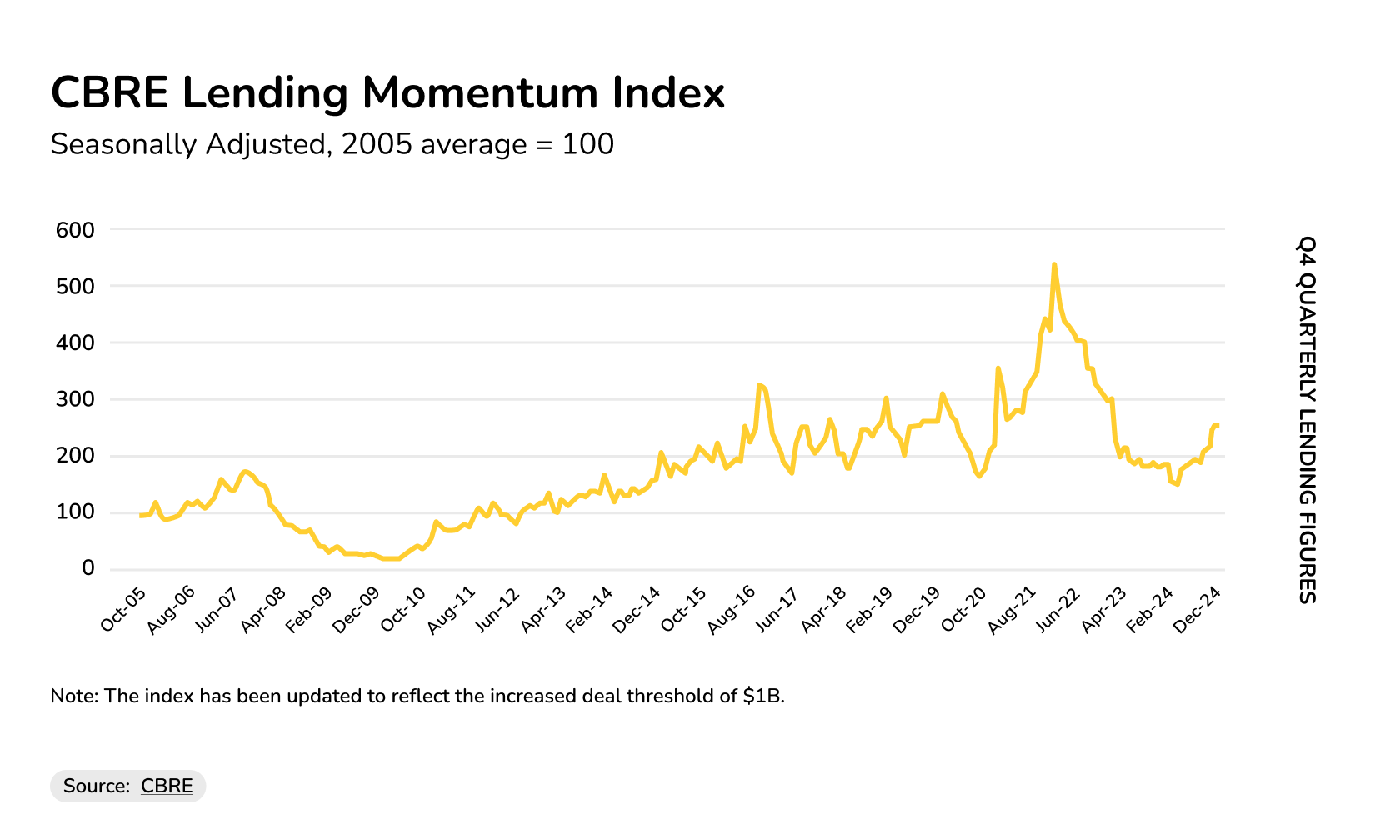
The commercial real estate market lending has suffered since the pandemic, the CBRE’s lending momentum index showing a sustained decline, despite a rebound in late 2024.
The post-pandemic slump in CRE lending
Source: CBRE
This environment can complicate funding for coworking real estate. Lenders may be wary of the flexible membership business model, preferring the security of longer traditional office leases. They will also scrutinize your business plan and credit history.
However, securing robust financing can help you with this.
With ready capital, you can act swiftly on promising opportunities before competitors with slower funding processes. Putting down a higher earnest money deposit, for example, can put you in a much stronger bargaining position.
Sign Now, Pay Later: Secure prime coworking real estate with Duckfund
The growing demand for coworking real estate means there is a lot of competition between investors, especially in prime locations like New York and California.
A successful deal often comes down to the edge your bid has over competitors, including the size of the earnest money deposit you can put down.
Duckfund's “Sign Now, Pay Later” model has helped investors like you secure over $1.5 billion in commercial real estate via:
✅ Access to an institutionally-backed funding reserve within 24 hours
✅ Low and transparent lending costs
✅ No collateral requirements.
Our model allows you to manage multiple projects at the same time and secure larger EMDs for better negotiation with buyers, giving you everything you need to secure your ideal coworking space.
Don’t miss out on prime coworking real estate? Sign up to Duckfund and find out how we can make sure you have the funding to make it happen right now.
Real Estate
Financing

- Approval within 24 hours
- Fund multiple properties at once
- No full deposit upfront — soft deposit only
- Apply in under 2 minutes
Secure your next commercial property acquisition — zero upfront capital required.
Start with Duckfund’s EMD financing program.- No capital commitment
- Close faster
- Scale with confidence