How to Buy Distressed Commercial Property (Without Turning It Into a Money Pit)

The best CRE investors know how to buy distressed commercial property without sinking a fortune into it, yet a looming maturity wall and higher interest rates make this complicated.
If you're looking for distressed commercial property to buy, you’ve probably seen:
- Discounted deals that look great at first glance but contain deeper problems
- Foreclosure and REO timelines moving faster than your capital processes
- Liquidity tied up in one deposit while other better-priced deals pass you by.
That’s why your acquisition playbook needs an update. This guide is written for CRE investors and developers who already know how to underwrite a standard value‑add deal, but need a sharper approach for today’s distressed commercial real estate.
By the end, you’ll have a clearer sense of when to lean in, when to pass, and how to lock up the right distressed deals before someone else does.
We cover how to buy distressed commercial property quickly and effectively, including:
- What is a distressed property in commercial real estate?
- Distressed CRE and the maturity wall in 2026
- What is the difference between a distressed property and a foreclosure?
- How do you finance a distressed commercial property acquisition?
- How to buy distressed commercial property in 6 simple steps
- Florida 2026: Where distressed CRE opportunities are emerging
- Move quickly on distressed deals with Duckfund
Looking for fast EMD financing to move quickly on distressed property? Contact Duckfund to find out how you can capitalize on investment opportunities.
Fund your next real estate deal
- Access fast financing
- Grow your real estate portfolio

What is a distressed property in commercial real estate?
A distressed commercial property is one where pressure on the owner or lender makes a sale, restructuring, or foreclosure more likely than a refinance.
From a sponsor’s point of view, most distressed commercial property falls into four (often overlapping) categories:
Physical distress
The asset has physical issues, including storm or water damage, fire impact, failing roofs or building systems, or years of deferred maintenance now contravening tighter building codes.
Legal distress
This is where the capital structure has spilled into formal processes – foreclosure filings, receivership, or bankruptcy – where courts or special servicers, rather than the sponsor, control key decisions.
Operational distress
This is when the building’s income engine is underperforming. That might mean high vacancy rates, poor tenant mix, weak leasing, or outdated layouts that no longer fit tenant demand. For example, older office buildings that have lost tenants to higher‑quality space.
Financial distress
The property cannot comfortably service its debt or other obligations at current rates. You’ll see:
- Weak debt‑service coverage ratios
- Maturing loans that no longer refinance on like‑for‑like terms
- Tax delinquencies
- Short‑fuse “extend and pretend” structures from 2025 now running out of runway
Distressed CRE and the maturity wall in 2026
In 2026, “distressed” commercial real estate is not just about boarded‑up buildings. Distress in current market conditions means CRE investments are often built on a capital structure that no longer works at today’s interest rates.
An estimated $875 billion of commercial and multifamily mortgage debt – about 17% of roughly $5 trillion outstanding – is scheduled to mature in 2026, according to The Mortgage Bankers Association.
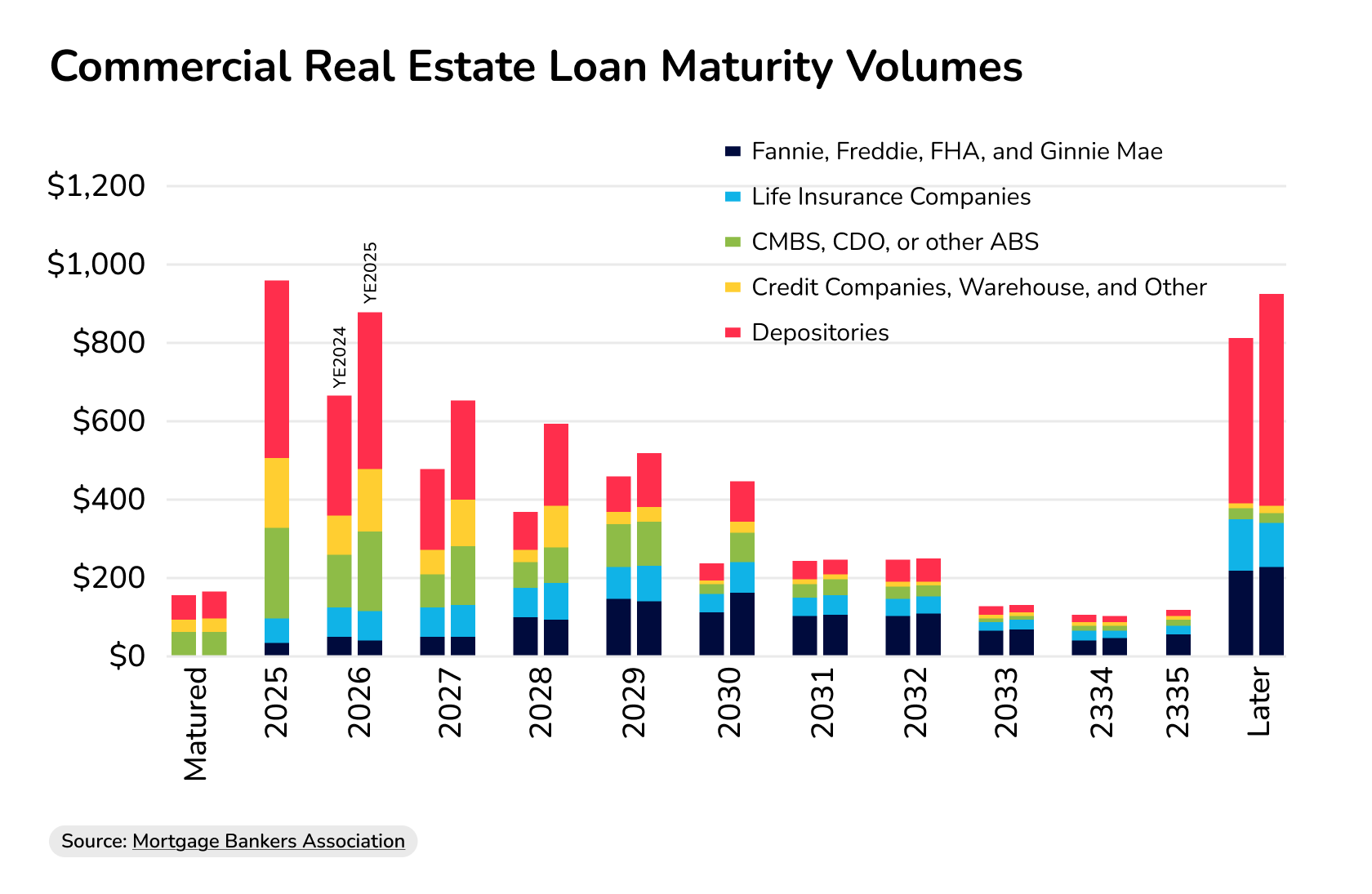
Source: Mortgage Bankers Association
Many of the loans that are facing refinancing originated when borrowing costs sat closer to 3–4%, CRE firm Matthews estimates. New loans are now being written in the 6–7% range. That gap changes the math on a massive share of the commercial real estate market.
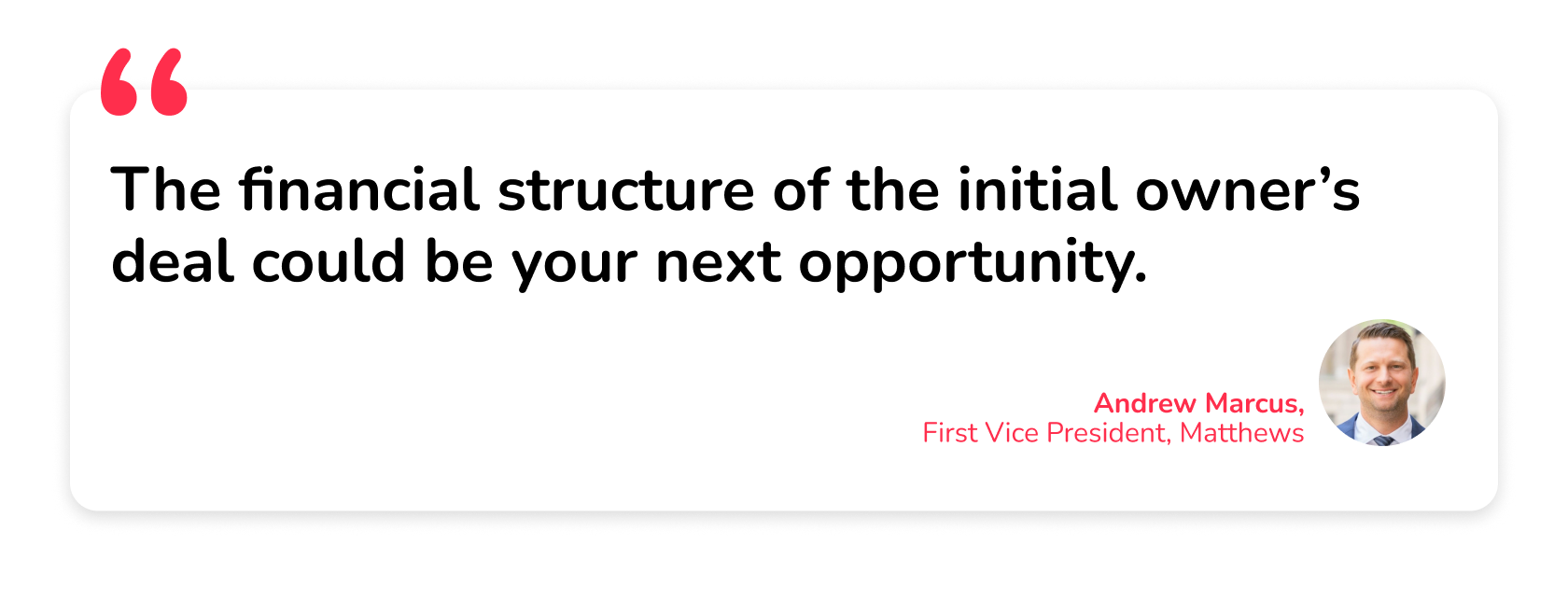
Andrew Marcus, first vice president at the firm, notes that unless rents have grown enough to offset higher debt service, refinancing owners are forced to inject equity, restructure, or sell.
As Marcus frames the current cycle, “what everyone needs to remember is these are financial market problems… [the] asset itself may be great, but the financial structure of the initial owner’s deal could be your next opportunity.”
That’s a crucial distinction for sponsors evaluating today’s distressed commercial real estate for sale.
Some assets are distressed because their capital stack is broken – not because the real estate is. In those cases, a new owner with fresh equity, better management, and realistic debt can often restore market value.
Other assets face deeper challenges – like structural demand shifts in a submarket, severe physical problems, or entangled legal issues – that make dealing with distressed real estate assets much harder.
The rest of this guide will help you separate those two groups. First, we’ll look at where foreclosure fits into this picture, and why not every foreclosure business property is the kind of distress you want to own as a CRE sponsor.
What is the difference between a distressed property and a foreclosure?
If a distressed commercial property is any asset under serious financial, legal, operational, or physical pressure, then foreclosure is just one legal path that pressure can lead to.
Once an asset becomes distressed, lenders and borrowers may negotiate loan workouts, forbearance, or short‑term extensions. Only when those options fail do many lenders move into commercial property foreclosure, often with a court‑appointed receiver involved.
If no resolution is found at or before the foreclosure auction, the asset can end up as a bank-owned commercial property, better known as a commercial REO property (real estate owned).
From a sponsor’s perspective, all stops on that path – pre‑foreclosure, foreclosure business property, and commercial REO properties for sale – are opportunities for buying distressed commercial property.
But smart buyers don’t just rush into foreclosed properties. They know that the legal process of foreclosure creates risks on top of the underlying business plan. These risks include:
- Surviving liens and claims: Tax liens, mechanics’ liens, or other encumbrances that aren’t wiped out by the foreclosure and still attach to the asset.
- Title and permit issues: Breaks in the chain of title, disputed ownership, or operating permits and licenses that don’t automatically transfer to a new owner.
- Litigation and timeline risk: Contested foreclosures, borrower lawsuits, or challenges from other creditors.
- Debt‑priority surprises: Senior and junior lenders with different rights and remedies, where a buyer of a junior position can be wiped out by a senior lender.
That’s why it helps to understand where the distressed asset sits in the foreclosure pipeline and what extra legal or timing risk comes with that stage – before underwriting and structuring a bid.
How do you finance a distressed commercial property acquisition?
Financing a distressed property transaction is not like raising capital for commercial real estate. Senior lenders see higher risk in distressed assets, so they often respond with lower leverage, wider spreads, tighter covenants, and more structure.
So is it harder to get a loan for distressed property? Yes, because the same net operating income (NOI) supports less debt at a higher cost. Some banks simply prefer to let specialized CRE bridge loans or private lenders take the first bite.
Most serious sponsors use some combination of capital. The key is to balance financing options between financing the acquisition and financing the deposit. Sponsors can often line up bridge and equity commitments, but still lose distressed or REO deals because they can’t post a large, fast, refundable earnest money deposit on the seller’s or lender’s timetable.
That’s where soft deposit financing solutions like Duckfund come in: Duckfund funds the refundable earnest money into escrow via an LLC, typically within 48 hours of approval, so you can strengthen your offer and pursue multiple distressed opportunities at once without locking up your own equity in deposits. We structure fees as LP soft costs, passed through at closing, with competitive rates that decrease for larger deposits.
How to buy distressed commercial property in 6 simple steps
Sponsors who consistently win good deals follow a repeatable process that starts before the LOI and runs all the way through closing and takeover. Here’s a six‑step framework you can adapt to your own strategy.
1. Find the distressed property
If you're not sure how to find distressed property, the search starts where distress shows up: notices of default, lis pendens, tax and code cases, CMBS and special‑servicer reports, and bank or broker lists of commercial REO properties for sale.
Combine those with local broker relationships and off‑market calls to track down distressed commercial property for sale before the competition.
2. Clarify the type of distress and your edge
Are you experiencing financial/legal distress, operational distress like occupancy rate, physical distress in need of renovations, or a mix? You should only think about buying distressed commercial property when you can comfortably deal with that type of distress.
3. Shape your letter of intent (LOI) or bid around the distress stage
An owner in pre‑foreclosure has different flexibility than a lender selling a foreclosure business property or bank‑owned commercial properties. Tailor price, contingencies, and closing timeline to where the asset sits in the process so your offer feels realistic and executable to the counterparty.
4. Structure the earnest money deposit intelligently
Decide how large an earnest money deposit you can commit, when it goes “hard,” and which contingencies you truly need. In distressed commercial real estate for sale, sellers and lenders often want larger, earlier deposits to test your seriousness. Using soft deposit financing lets you post stronger deposits on multiple distressed commercial property for sale opportunities without tying up your own liquidity.
5. Run a focused diligence sprint
Distressed timelines are usually compressed, especially around foreclosure sales and REO. In your due diligence, prioritize title and lien checks, zoning and permit review, key leases and tenant health, and a targeted physical inspection so you don’t inherit hidden legal or operational landmines after property evaluation.
6. Lock the capital stack
Once diligence confirms the story, finalize your capital stack — whether it’s a bridge loan, equity, any preferred or mezzanine — so leverage and reserves match the true level of distress. At closing, step into any LLC vehicle used for soft deposit financing, take control of the asset, and immediately move into your stabilization or repositioning plan.
If you want to minimize cash in while still locking up deals, it helps to understand how to buy commercial property with no money down and how those structures translate to distressed acquisitions.
Used consistently, this six‑step approach makes investing in distressed commercial real estate an executable strategy, lets you filter out problem assets early, and identify the real opportunities.
Florida 2026: where distressed CRE opportunities are emerging
Florida shows how “distress” in 2026 can hide good real estate trapped in bad capital structures. Commercial real estate in the Sunshine State is facing a $130.5 billion debt wall through 2030, based on Mortgage Bankers Association data analyzed by Michael R. Linton of Linton Global Solutions. Nearly half of those loans mature by the end of 2027, according to Linton's analysis, with refinancing gaps of 20–35% on many office and older multifamily assets.
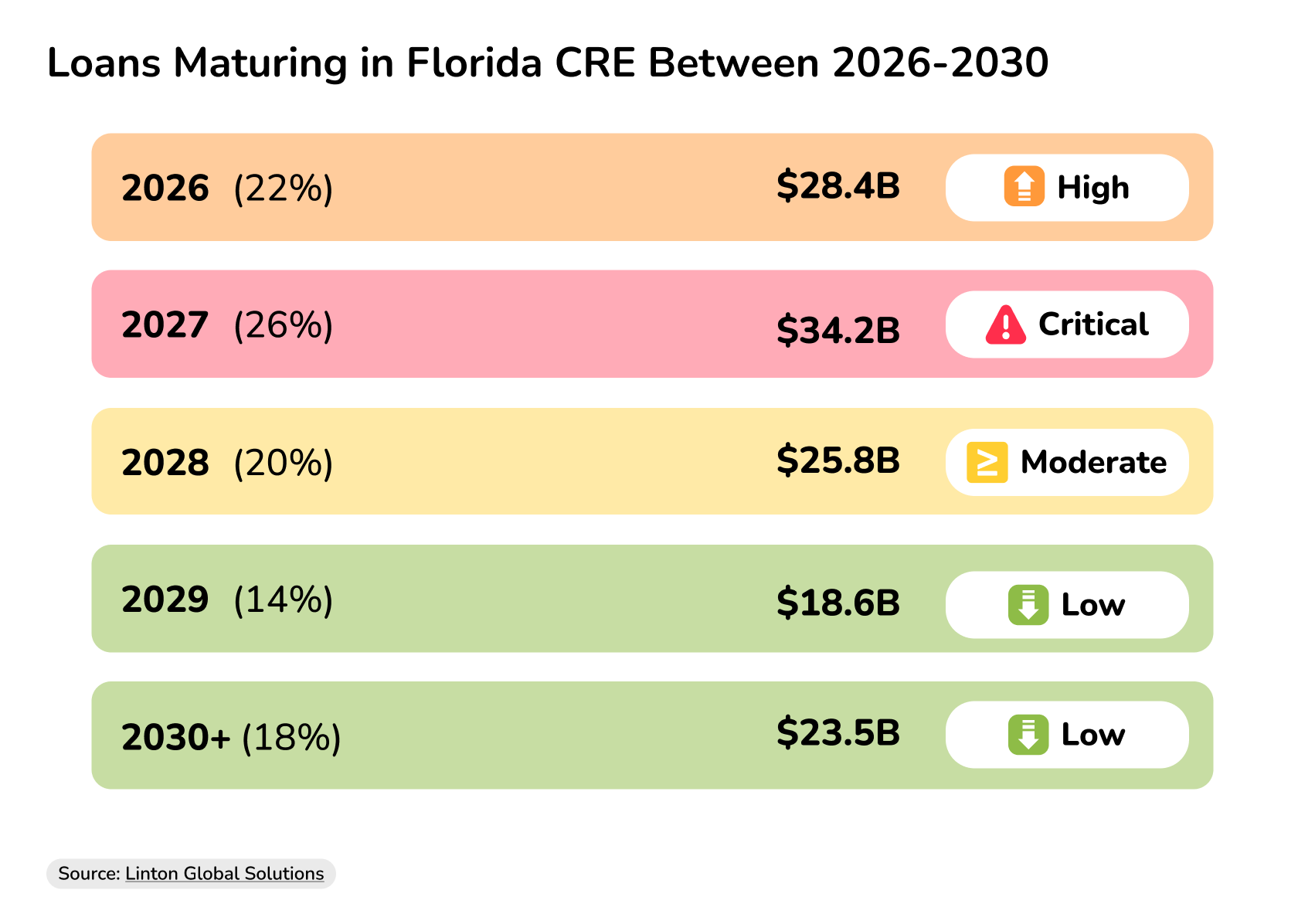
Source: Linton Global Solutions
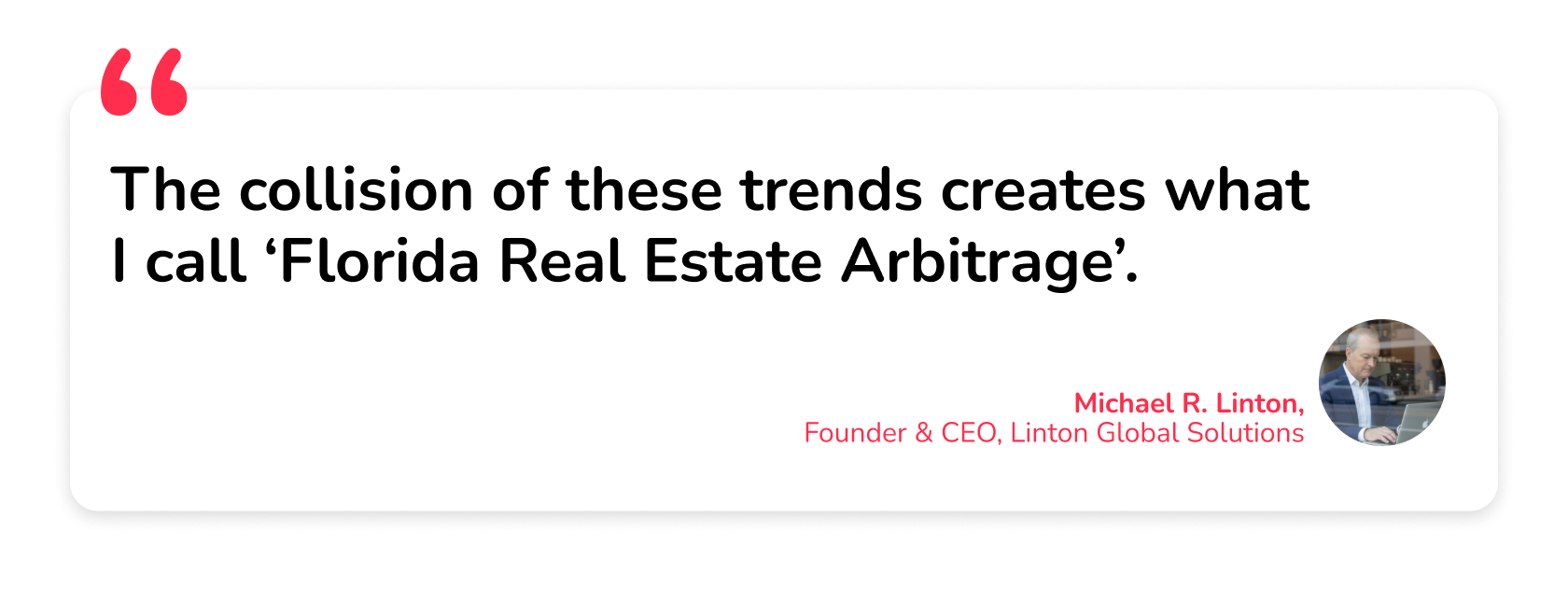
But there’s a bigger play for smart buyers. Linton sees the Florida CRE loan distress and foreclosures in 2026 colliding with another bigger CRE trend to create what he calls the most asymmetric opportunity since the 2008 crisis.
This is the “Wall Street South” migration, as Linton calls it: more than 120 financial firms – including Citadel, Elliott Management, Blackstone, and Apollo – have shifted headcount into South Florida since 2020, driving demand for Class A+ office in Miami, Tampa, and Fort Lauderdale, plus luxury housing and the retail and hospitality that follow those tenants.
“The collision of these trends creates what I call ‘Florida Real Estate Arbitrage’ – the ability to acquire distressed commercial assets in Tampa and Orlando at 60–70% lower prices than Miami, while positioning for identical demand drivers from the Wall Street South migration,” Linton writes.
For sponsors, the best move is to use the debt maturity data to target loans and assets where:
- The submarket demand story is tied into that same financial and corporate migration,
- The capital stack is broken, and
- Leasing and capex issues are fixable.
That’s where buying distressed commercial property in Florida offers Miami‑level demand drivers at secondary‑market pricing, rather than just a generic discounted acquisition cost.
Move quickly on distressed deals with Duckfund
Distress in 2026 is less about quickly flipping underpriced real estate and more about understanding the capital stack and story behind each deal.
If you know how to buy distressed commercial property — by sizing the real risks, targeting the right markets, and structuring capital intelligently — you can turn someone else’s maturity problem into your next long‑term hold.
If you’re looking at distressed commercial real estate for sale and want to strengthen your offers without freezing your own equity in deposits, soft deposit financing can help. You bring the deal, underwriting, and execution plan. Duckfund helps you move first on the earnest money.
Fund your next earnest money deposit without worrying about your cash flow. Apply for EMD financing with Duckfund and get funded within 24 hours.
Frequently Asked Questions
1. How do I find distressed commercial property for sale?
To find distressed property before the competition, start by going through notices of default, lis pendens, tax and code cases, CMBS and special‑servicer reports, and bank or broker lists of commercial REO properties for sale. Then bring in local broker relationships and start off-market outreach.
2. How do I acquire distressed properties?
Most sponsors combine targeted sourcing, a tailored LOI or bid around the distress stage, fast but focused due diligence, and a capital stack sized to the real risk. In competitive situations, strong, well‑structured earnest money deposits are often what win distressed commercial property deals.
3. What are the risks of buying distressed property?
Key risks include hidden liens, title or permit issues, litigation around the foreclosure, and structural problems with the location, tenants, or building. If you underestimate these or over‑leverage the deal, a discounted purchase price can quickly turn into a capital and time sink
Real Estate
Financing

- Approval within 24 hours
- Fund multiple properties at once
- No full deposit upfront — soft deposit only
- Apply in under 2 minutes
Secure your next commercial property acquisition — zero upfront capital required.
Start with Duckfund’s EMD financing program.- No capital commitment
- Close faster
- Scale with confidence