Retail Real Estate Market Report: Top Cities and Trends to Watch in 2025

This insider retail real estate market report reveals record-low vacancy rates and surprising growth opportunities for savvy CRE investors navigating today's hot retail landscape.
The retail apocalypse narrative has dominated headlines for years, painting a picture of store closures and abandoned shopping centers nationwide. But while that was certainly true during the pandemic, the latest retail real estate market report paints a different picture – one that experienced commercial real estate investors are already capitalizing on.
If you're a commercial real estate investor eyeing retail opportunities, you've probably run into these frustrating roadblocks:
- Conflicting market signals make it difficult to distinguish genuine investment opportunities from market noise
- Limited access to prime properties due to intense competition and the need for fast earnest money deposits
- ROI uncertainty about which markets and property types will deliver sustainable returns in a quickly evolving CRE landscape
Overcoming these challenges separates successful retail portfolio builders from those left chasing overpriced properties. Because the most profitable real estate investors don't just follow market trends – they position themselves ahead of them.
This detailed retail real estate market report cuts through the noise with hard data and real-world trends. Discover actionable intelligence on emerging trends, which markets are set for growth, and how to structure deals that capitalize on retail's ongoing transformation.
Read on to find out where the real opportunities lie in 2025 and beyond.
[Secure prime real properties faster with Duckfund's soft deposit financing solutions. Borrow up to $100 million for debt and equity deals across all property types.]
How are retail and the broader CRE market doing?
Halfway through 2025, we’re looking at a CRE market in limbo. Key economic indicators, including job growth and wage increases, continue to outpace inflation rates, with Moody's forecasting steady GDP expansion through 2025 without anticipating a recession. US retail sales saw a 5.2% increase year-on-year, an April Colliers Retail Market Intelligence Report found.
But while that’s encouraging on paper, the reality proves more complicated. With hawkish Federal Reserve policy and political headwinds (tariff uncertainty), interest rates have plateaued after the rate cuts began last year. So far, the new administration hasn't delivered the lower borrowing costs the capital markets and CRE investors hoped for.
While office properties struggle with high vacancy rates and the industrial sector continues to enjoy its darling status, retail properties have shown to be a resilient asset, defying the broader market and enjoying stable fundamentals compared to other asset classes.
Overall availability rates in the retail sector have held steady at 4.8% through Q1 2025, data from the CBRE shows – only a marginal increase from the previous year's historic lows. That’s because net absorption was negative for the first time in nearly 5 years, as retailers reconsidered expansion plans amid economic uncertainty.
At the same time, development of new retail space remains near all-time lows, with only 4.5 million square feet delivered in Q1 of 2025 – well below historic norms.
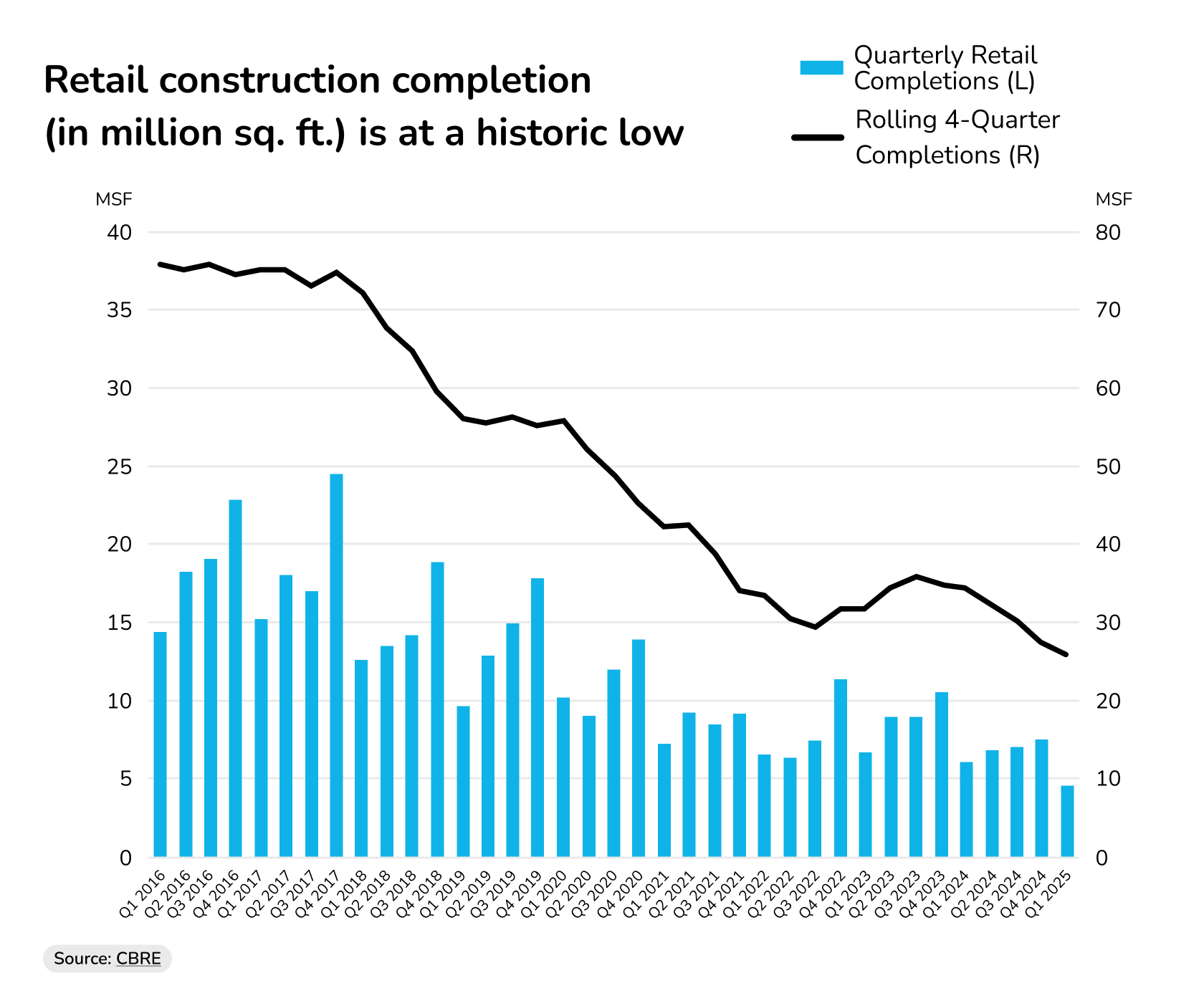
Source: CBRE
With little available space or new construction on one hand and continued consumer spending on the other, the gap between demand and new supply continues to widen. This is especially the case in high-growth areas where quality space around suburban areas is scarce. These pressures contribute to rising asking rents, increasing an average of 1.9% year-over-year, and strong competition.
3 Retail real estate trends (and how to capitalize on them)
With this overview of the retail market, let’s dive into 3 key trends driving retail and how CRE investors can act on them.
1. Mixed-use development momentum reshapes suburban markets
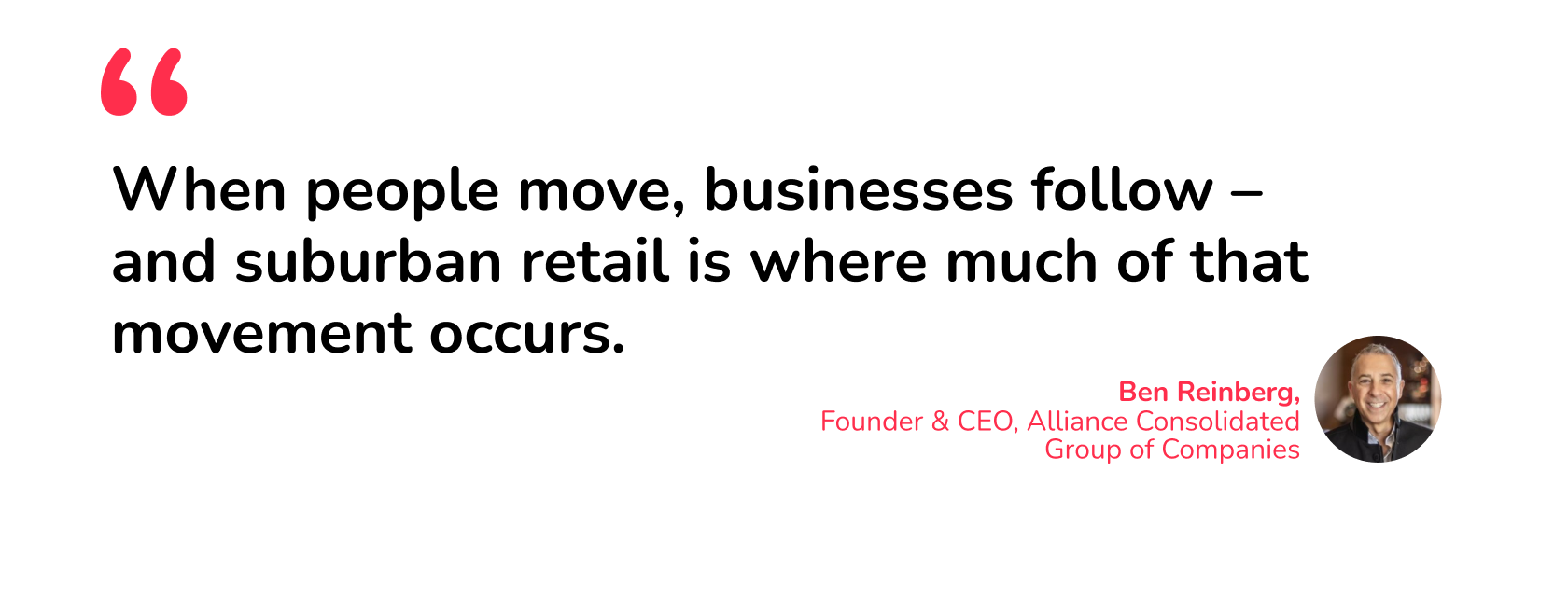
The real estate adage that “retail follows rooftops” holds, even in the era of e-commerce and last-mile distribution. “When people move, businesses follow – and suburban retail is where much of that movement occurs,” notes retail strategist Ben Reinberg, a high-profile CRE investor who built +$500M in real estate wealth, highlighting how demographic shifts are creating sustained demand for suburban retail properties.
With more people working permanently from home and moving to residential areas, suburban retail centers could witness a 50% increase in tenant demand compared to urban locations, real estate firm Retail Specialists predicts. Mixed-use developments are popping up across suburban areas to accommodate these consumers' preference to shop closer to home.
Investor Takeaway
Rather than invest in new shopping centers and other new constructions, look for underperforming suburban retail centers in high-growth areas with redevelopment potential for mixed-use conversion. Traditional strip centers within walkable distances from suburban communities are ideal for repositioning into live-work-play environments that combine retail, multifamily, office, and entertainment components.
2. Secondary high-growth markets create value opportunities
While primary markets like downtown New York and Los Angeles face intense competition and premium pricing for retail space, secondary markets are the new goldmine for retail real estate investment.
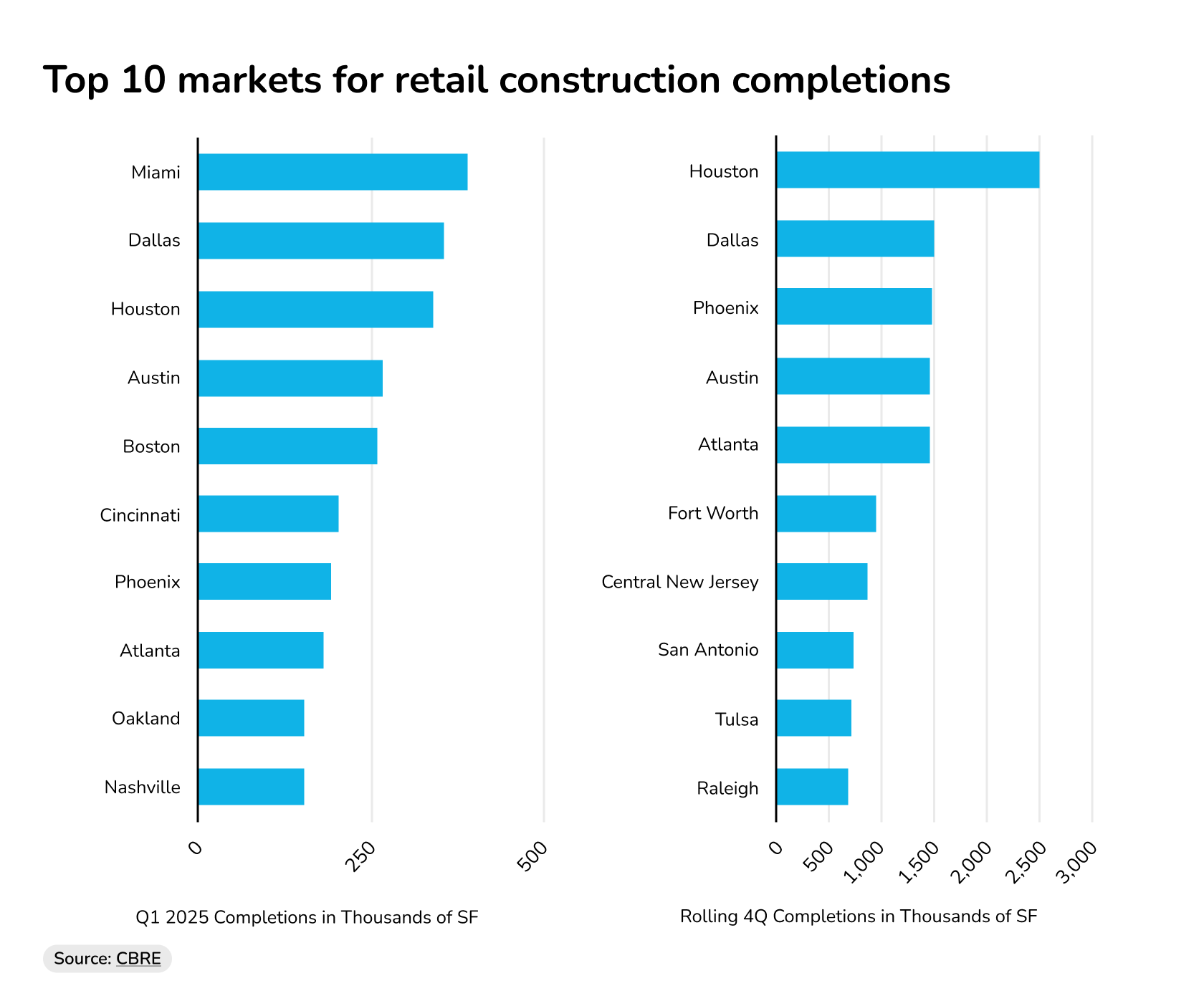
The Southwest and Southeast regions are leading this expansion, with cities like Dallas, Houston, Austin, and Phoenix seeing higher construction completions to meet the rental demand due to population growth and increased consumer spending.
Source: CBRE
Investor Takeaway
Focus on grocery-anchored, open-air neighborhood shopping centers for sale in USA secondary markets with population growth exceeding 2% annually. Leasing activity for this type of retail property is at record highs, with strong demand from national retailers expanding to growth markets. On top of that, grocery retail vacancy rates stood only at 3.5% nationwide in 2024, according to real estate firm JLL, well below the average of the retail real estate sector of 4.8%.
3. Retail format downsizing makes for cost-efficient investment
This retail research report identifies an often overlooked opportunity for savvy CRE professionals. Today’s physical retail spaces aren’t the huge department stores of the previous century. The retail landscape is shifting toward smaller, efficient store formats as retailers decrease their footprint and try to optimize operations for both physical and digital commerce.
Driven by omnichannel strategies that require less inventory storage on-site, many retailers are increasingly using physical locations primarily for customer engagement and order fulfillment rather than traditional merchandising.
In this downsizing movement, smaller spaces generate higher returns through strategic design and operational efficiency. Retailers could reduce their average store footprint by 20% in 2025 while doubling their investment in technology and experiential elements, Retail Specialists predict, resulting in a 25% increase in sales per square foot.
Open-air neighborhood, community & strip centers will see increased demand this year as retailers focus more on facilitating pickups and returns of online purchases, changing how retail space gets utilized and valued.
Investor Takeaway
Target retail properties with flexible floor plates that can accommodate multiple smaller tenants rather than single large-format stores. These properties with divisible spaces in high-traffic locations command higher rental rates than traditional big-box formats, while offering better tenant diversification and reduced vacancy risk when retailers downsize or relocate.
Top markets to invest in retail property (and why they’re hot)
The Southeast and Southwest are outpacing the rest of the country, so it’s no wonder the three cities this retail real estate market report identifies as top performers are Sun Belt regions. With both strong economies and demographics, they show strong demand for retail space.
Dallas-Fort Worth retail research report
Dallas is the hottest retail market in 2025. The Dallas-Fort Worth metroplex completed 468.000 square feet in retail construction in Q1 of 2025 alone, CBRE data shows. Rent growth in the City of Dallas was 3.6% YOY.
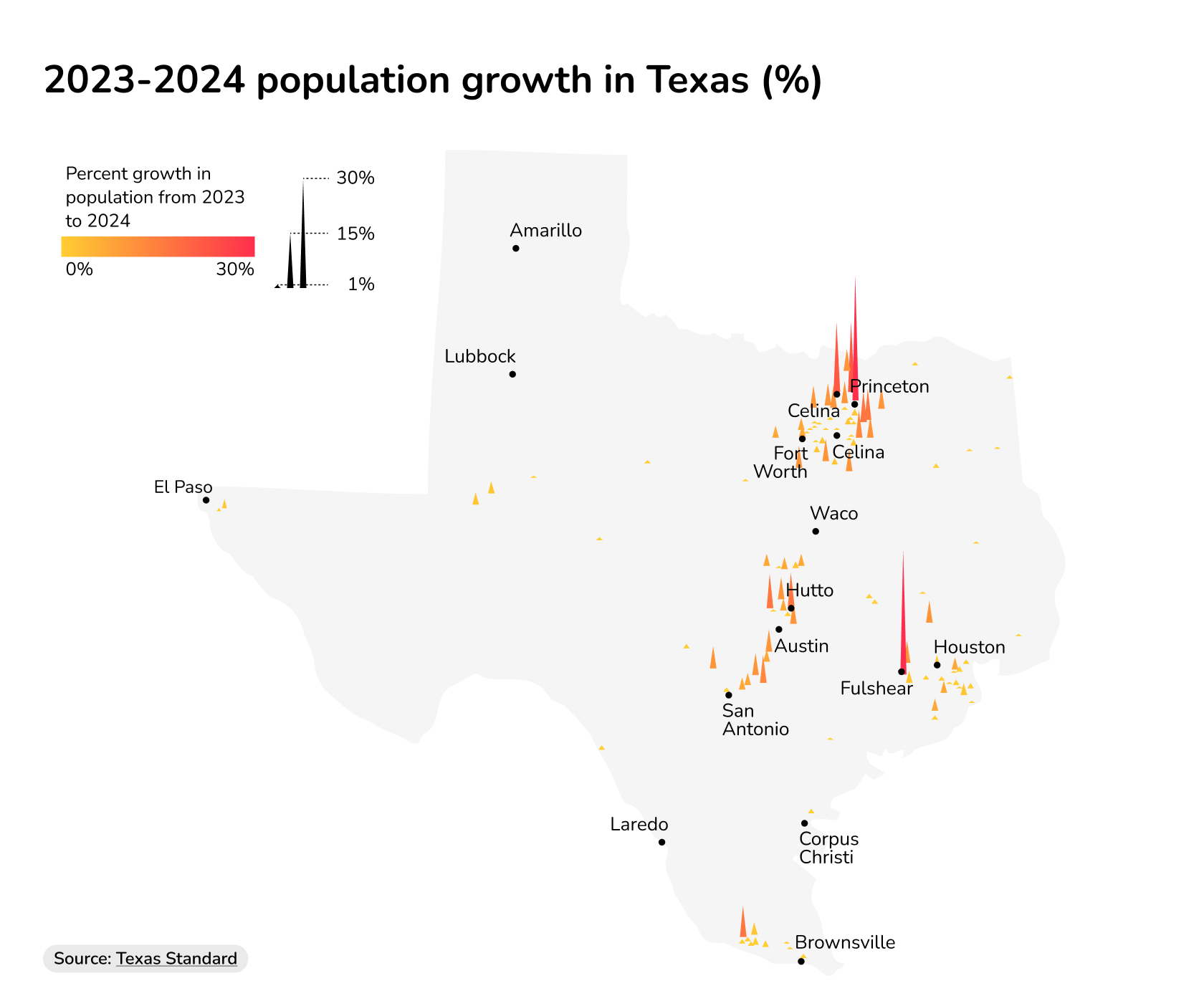
What makes the DFW region so attractive is its rapid suburban population growth. North Texas is the fastest-growing area in Texas, according to the Texas Standard, with cities like Princeton, TX growing 30.7% between 2023 and 2024 – the most nationwide.
These demographics are met with a projected 2.8% GDP increase and diversified job growth, translating into strong consumer demand for neighborhood centers in growing communities.
Source: Texas Standard
Phoenix retail research report
Phoenix follows closely, benefiting from market fundamentals that include a population growth of 1.8%, a low unemployment rate, and a 3.0% growth in consumer spending, according to CRE firm Cushman & Wakefield.
Investment activity in Phoenix surged in 2024, with approximately $2.0 billion in retail assets changing hands over the past year, CRE firm Matthews estimates, surpassing the previous year’s $1.7 billion. The CBRE agrees that infrastructure improvements and strategic investments are turning Phoenix into a retail hotspot, with significant development activity in expanding suburban areas that reflect confidence in the city's long-term growth potential.
It’s these growing urban areas that are interesting for development across retail property types but especially grocery-anchored shopping centers. With an occupancy rate of only 90.8%, the Mesa submarket has high potential for repurposing old retail properties.
Charlotte retail research report
Charlotte rounds out the top three as a financial and technology center attracting young professionals and high earners. This demographic shift is creating strong demand for lifestyle centers and "retailtainment" experiences, combining shopping and entertainment opportunities as an anchor for customers.
Charlotte's retail market holds a vacancy rate of 2.8%, according to CRE firm Colliers, making newly available spaces highly sought after. The city's suburban counties – Lancaster, Union, Cabarrus, and York – have become focal points for retail growth, with both Stanly and Lincoln counties entering 2025 with sub-1% vacancy rates, CRE firm Marcus & Millichap found.
Capitalizing on a competitive retail property market in 2025
This retail real estate market report shows a sector that continues to profit from regional population growth and consumer spending. The report shows another common thread across retail property types and regional markets – fundamental tightness. That means stable vacancy rates and strong absorption on one hand, and strong demand and competition for existing stock on the other.
Investors who want to capitalize on the retail opportunities out there – mixed-use suburban development, secondary market expansion, and retail format downsizing – require both capital and speed to move quickly when properties become available.
[From bidding on industrial property to closing the deal, leverage Duckfund’s equity financing for expertise and liquidity. Get up to $100 million in just five days to help you secure the deal from start to finish.]
Real Estate
Financing

- Approval within 24 hours
- Fund multiple properties at once
- No full deposit upfront — soft deposit only
- Apply in under 2 minutes
Secure your next commercial property acquisition — zero upfront capital required.
Start with Duckfund’s EMD financing program.- No capital commitment
- Close faster
- Scale with confidence