What’s Really Happening in the US Office Market Right Now? A 2025 Guide

Get up to speed with the latest developments in the U.S. office market that will affect investors and developers.
Keeping up with the U.S. office real estate market has rarely been more time-consuming.
If you’re an investor or developer, you must contend with a market that’s moving fast, and not always in one direction.
This U.S. Office Market Report cuts through the noise. We’ve pulled together the latest data, expert insights, and market-moving trends to help you make sense of what’s happening – and what’s coming next.
From the sharp slowdown in new office construction to the surprising resilience of Class A buildings, we unpack the shifts shaping the office real estate outlook in 2025.
This report will give you the clarity you need, whether you’re tracking office occupancy rates, scanning for hidden opportunities, or weighing where to place your next investment.
Read on to find out the latest office insights.
Table of contents:
- U.S Office Market Report: 7 trends to look out for in 2025
- The office market outlook: A snapshot of a fast-moving market
- U.S Office Market Report: Is office real estate a good investment in 2025?
Want to make an impact in the office space market? You’ll need the right funding. Contact Duckfund to find out how we can help you make your next project a success.
U.S Office Market Report: 7 trends to look out for in 2025
In an uncertain commercial real estate industry, the U.S. office market is undergoing something of a reset.
These seven office real estate market trends of 2025 so far reveal where the real movement is happening – and what investors, developers, and tenants need to watch as they attempt to make an impact in a challenging market.
1. Net absorption is still positive, but slowing
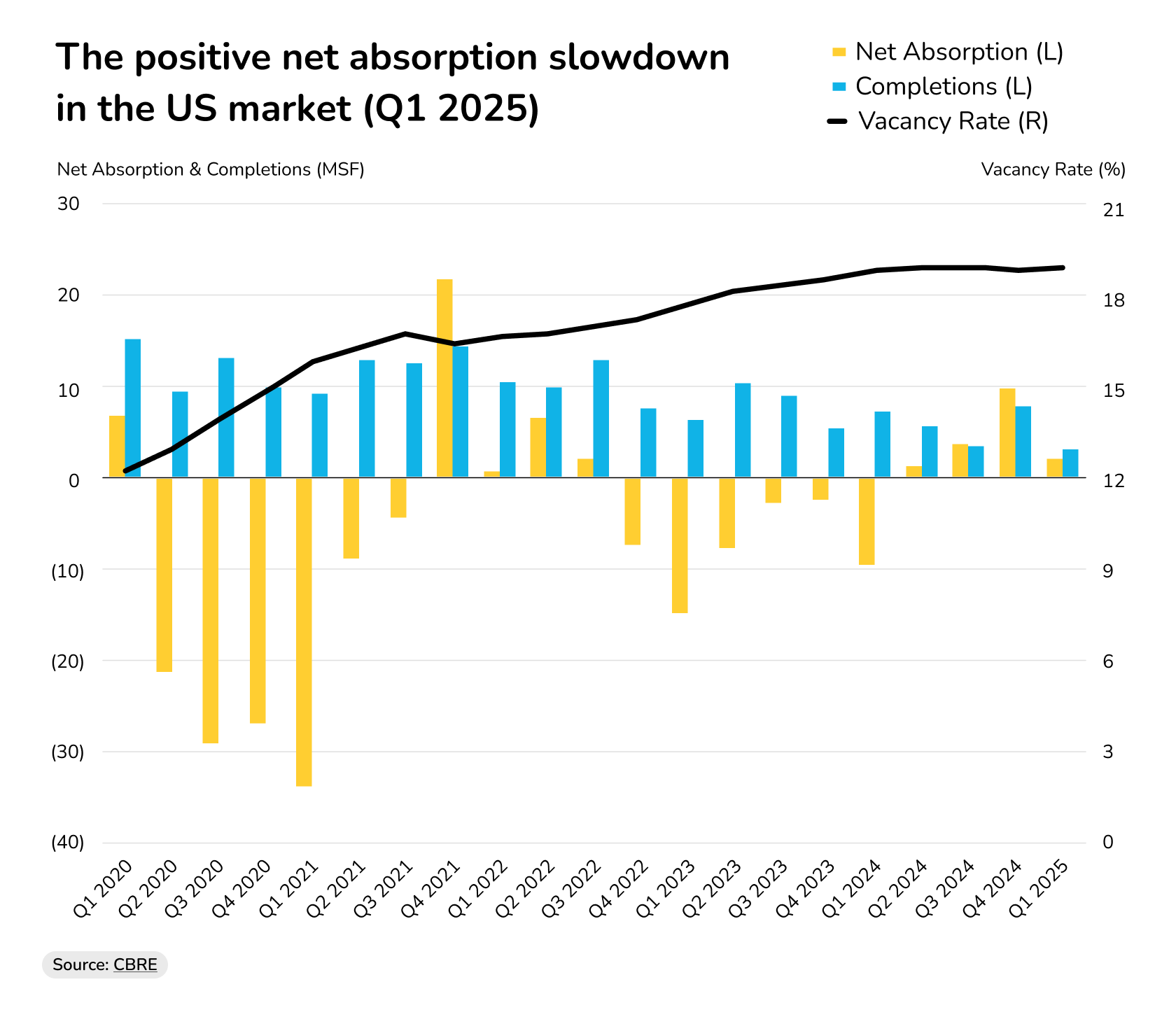
The U.S. office market has posted positive net absorption quarter-over-quarter since early 2024 – a clear sign of recovery. But growth has slowed. Q1 saw just 2.3 million square feet absorbed, down from 10 million in Q4, according to CBRE.
What’s behind the dip? Renewals are probably the main factor. Many large tenants are choosing to stay put. While this shows confidence in existing office spaces, it also means less new demand and slower absorption overall.
Still, there’s a silver lining. As the chart below shows, slower completions and steady absorption could help bring down vacancy rates, which spiked during the downturn from late 2022 to early 2024.
Source: CBRE
2. New office supply dries up as construction pipeline shrinks
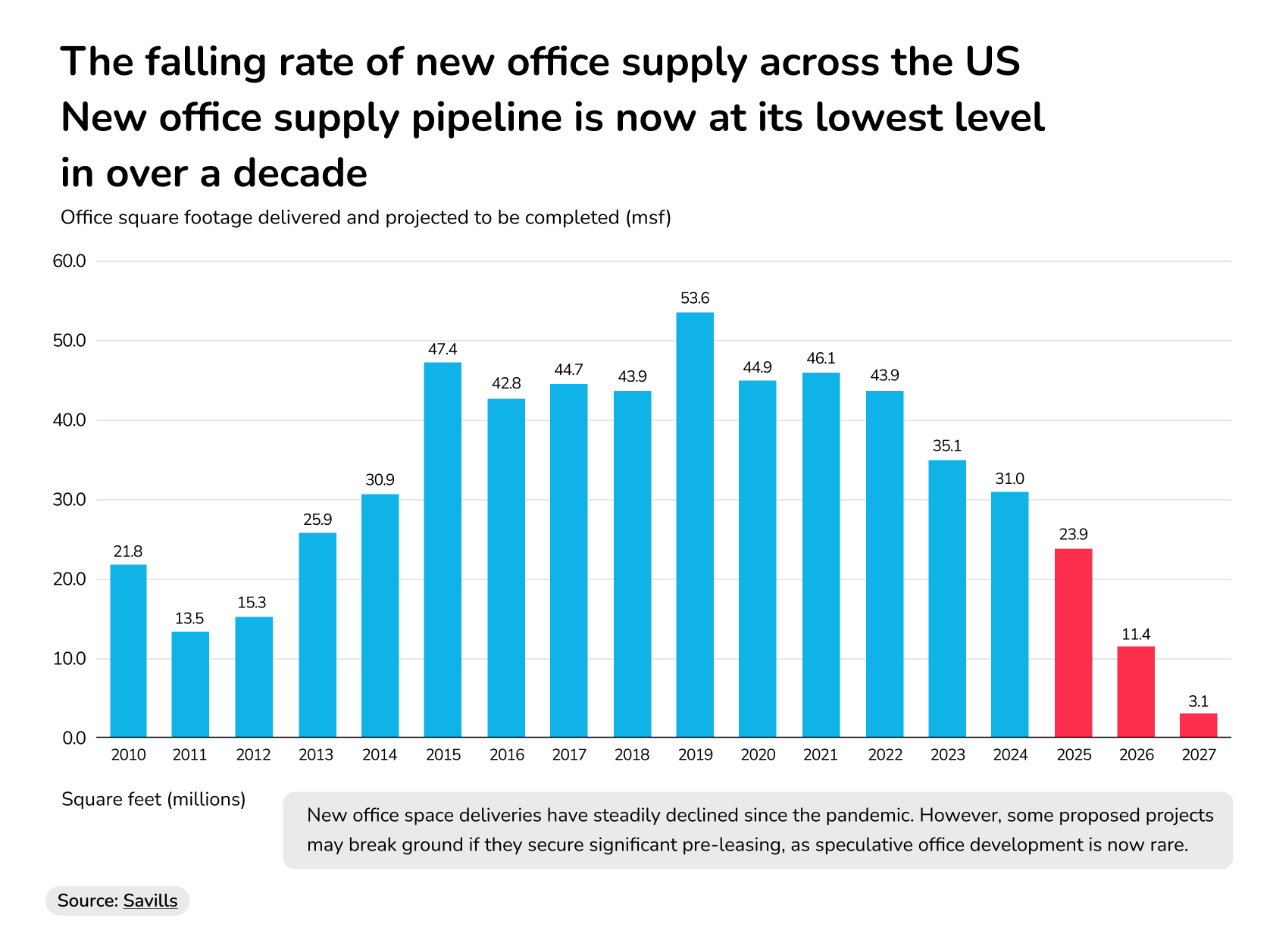
The future supply of office space in the US is facing a major squeeze as the new office pipeline reaches its lowest level in over a decade.
“Office square footage delivered and projected to be completed” peaked in 2019 at 53.6 million square feet and remained high through 2021.
Yet, since the pandemic, new office space deliveries are sharply dropping with 2025 at 25.9 msf, 2026 at 11.4 msf, and a mere 3.1 msf projected for 2027, according to Savills research.
Source: Savills
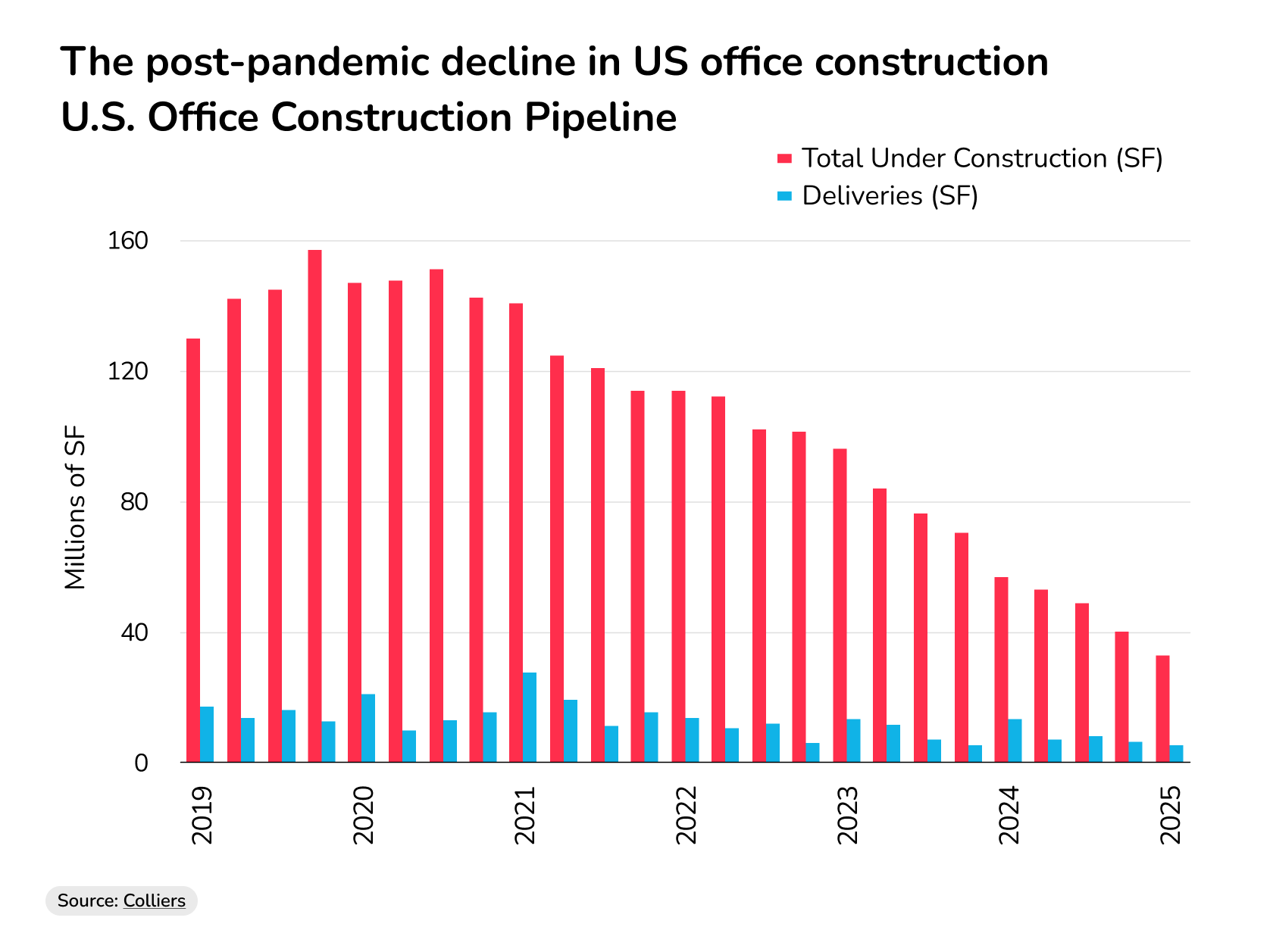
We can link this present and future slowdown in completions directly to the shrinking U.S. Office Construction Pipeline – this represents the total volume of office space actively under construction.
From nearly 160 million square feet (msf) in 2019, the total under construction has steadily decreased to just over 40 msf by 2025. The "Deliveries (SF)", which correspond to completions, are also shown to be declining within this pipeline data.
Source: Colliers
A falling number of projects actively under construction means that future completions will naturally be limited, leading to a general low supply across the market in the coming years.
3. Office models are shifting back to in-person
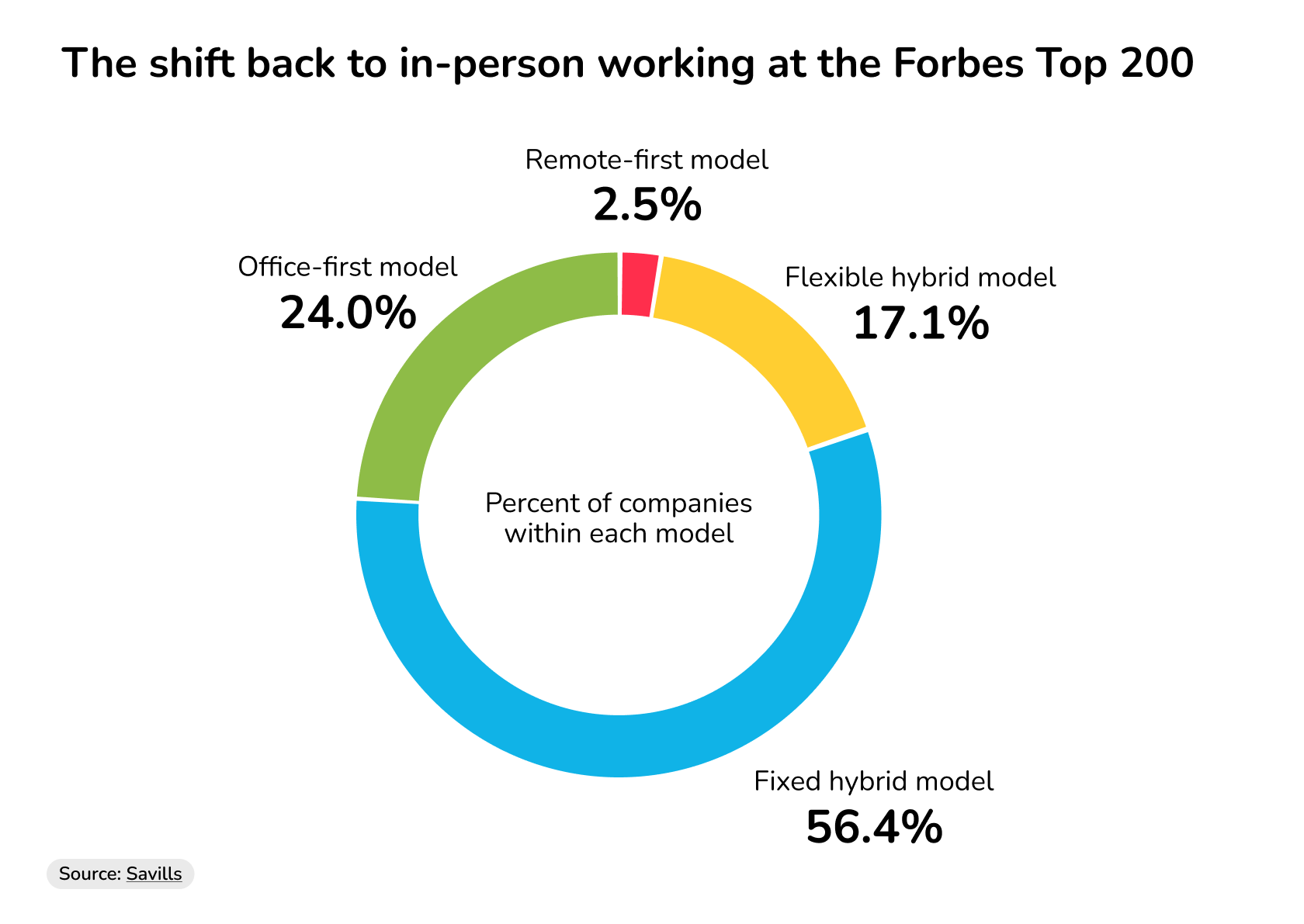
Workplace trends are settling, and the direction is clear: companies are moving back to the office.
Over 50% of Forbes' top 200 companies now require employees to follow a fixed hybrid schedule – a set number of in-office days. Another 24% have gone office-first, while just 2.5% remain remote-first. The rest (17.1%) offer a flexible hybrid setup.
Source: Savills
For office space investors, this matters. As return-to-office policies grow, demand for physical workspace is rising, especially for high-end, amenity-rich buildings.
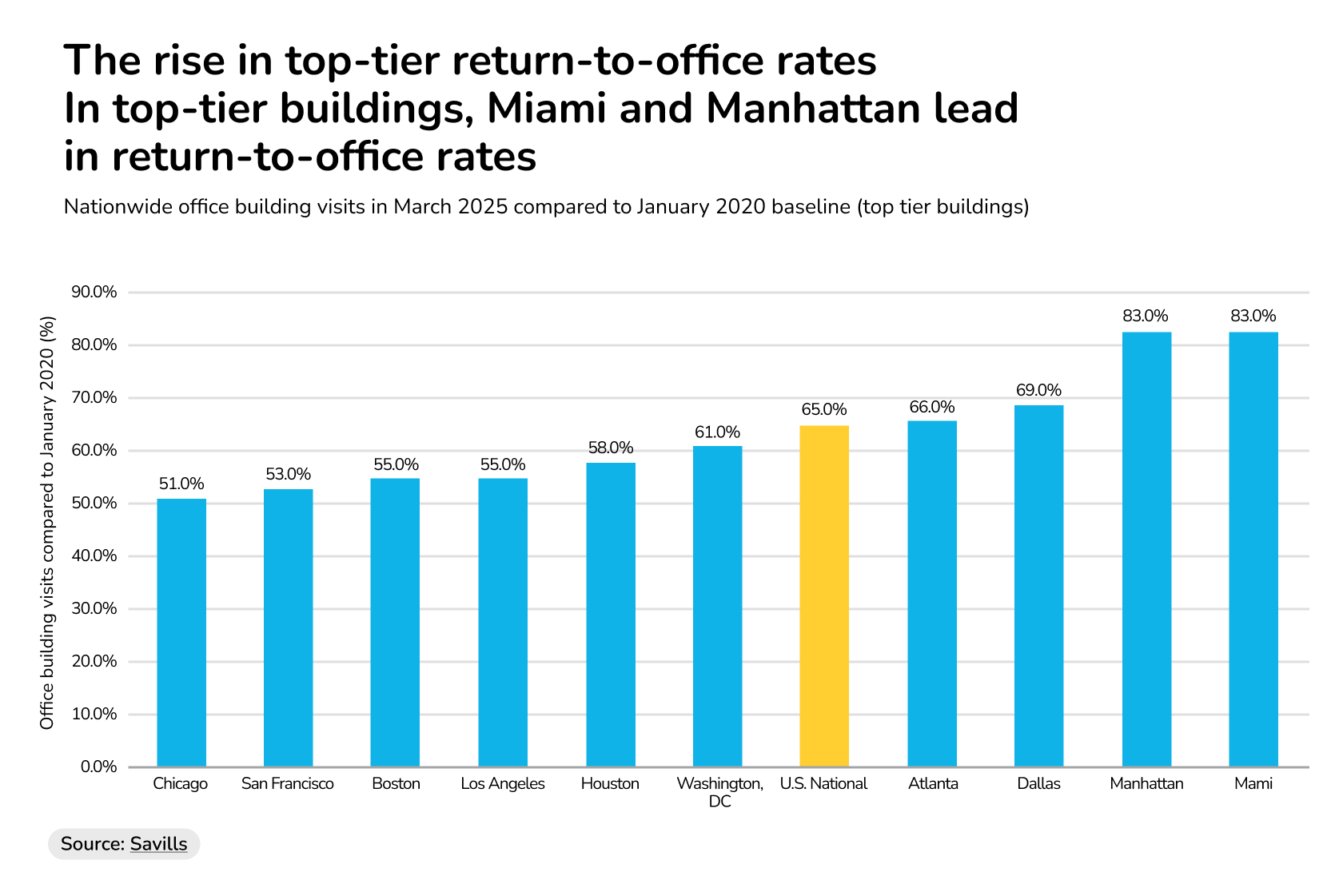
Data shows cities like Miami and Manhattan leading the charge in return-to-office rates, especially in top-tier office properties. Key markets Atlanta and Dallas are also above the national average, while major cities like Chicago, San Francisco, Boston, and Los Angeles show a spike of over 50%.
Source: Savills
The takeaway? Class A office assets in strong urban markets are seeing renewed interest. With more companies prioritizing face-to-face work, these spaces are well-positioned for increased leasing activity and greater long-term stability.
4. Leasing activity surges as office demand rebounds
The above return-to-office mandates are driving a rebound in U.S. office leasing.
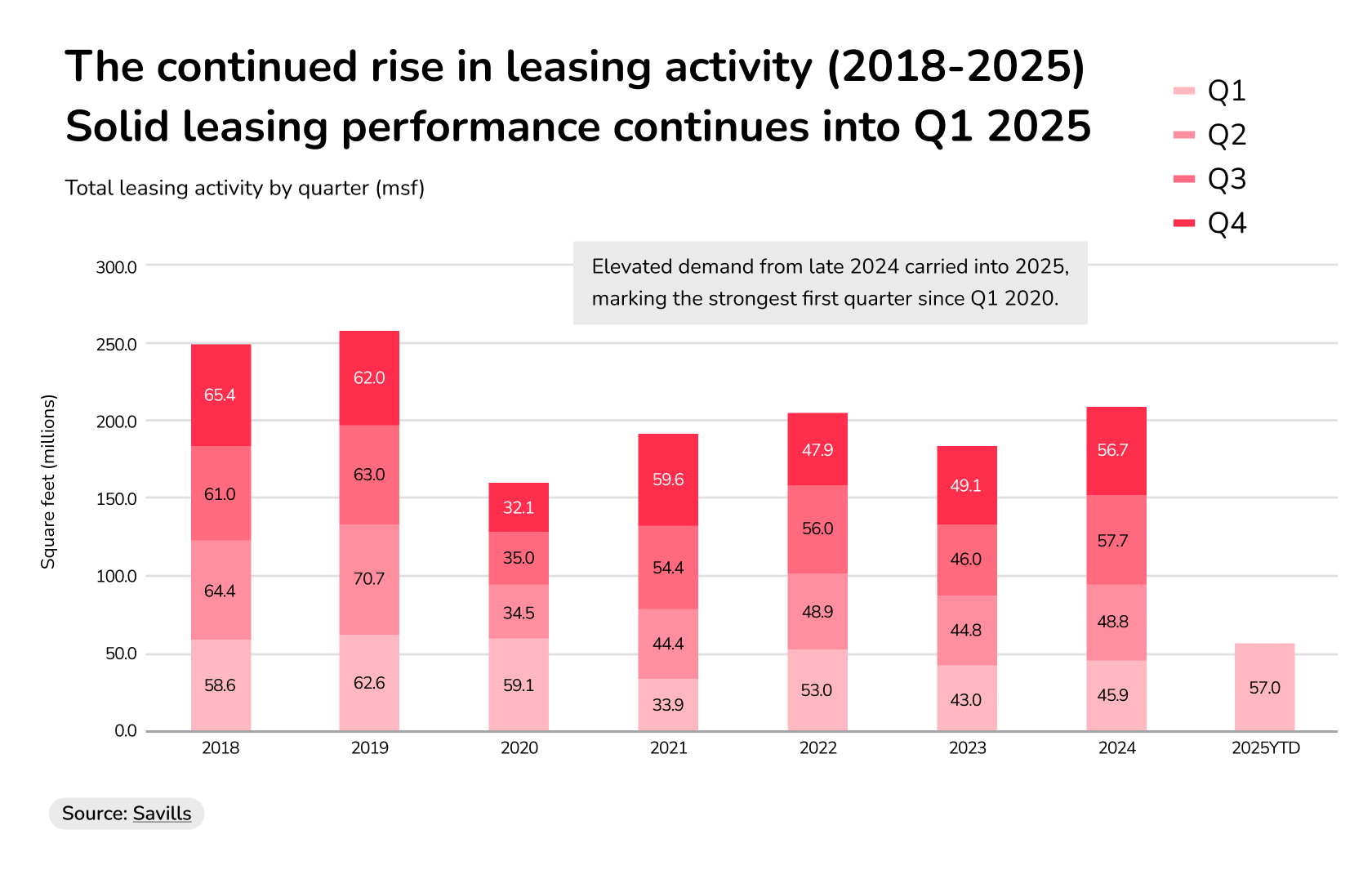
In Q1 2025, leasing hit 57 million square feet, the strongest first quarter since 2020, and up 18% year-over-year.
Source: Savills
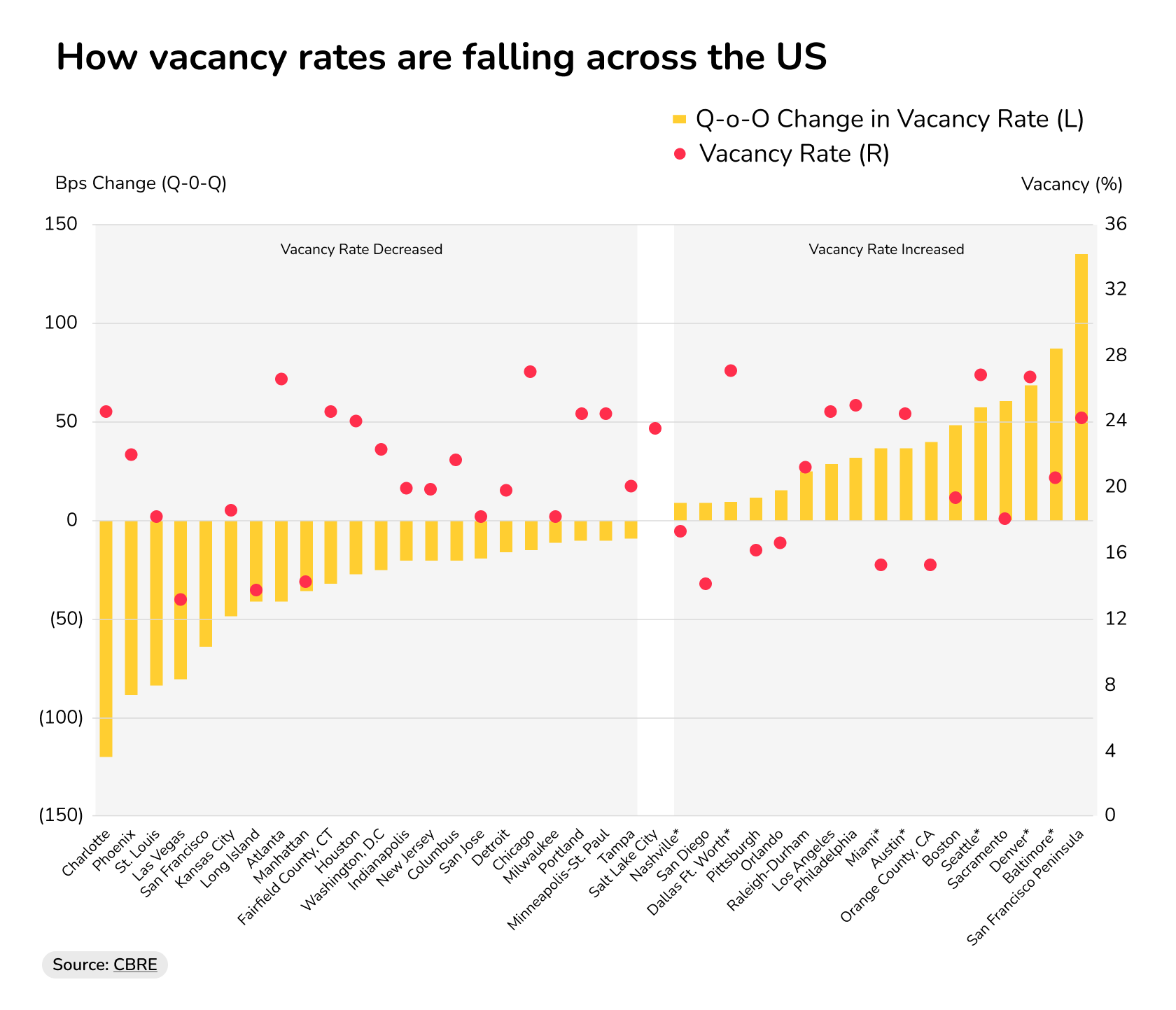
This momentum, which began in late 2024, is carrying into 2025. Vacancy rates are starting to fall, especially in high-quality buildings.
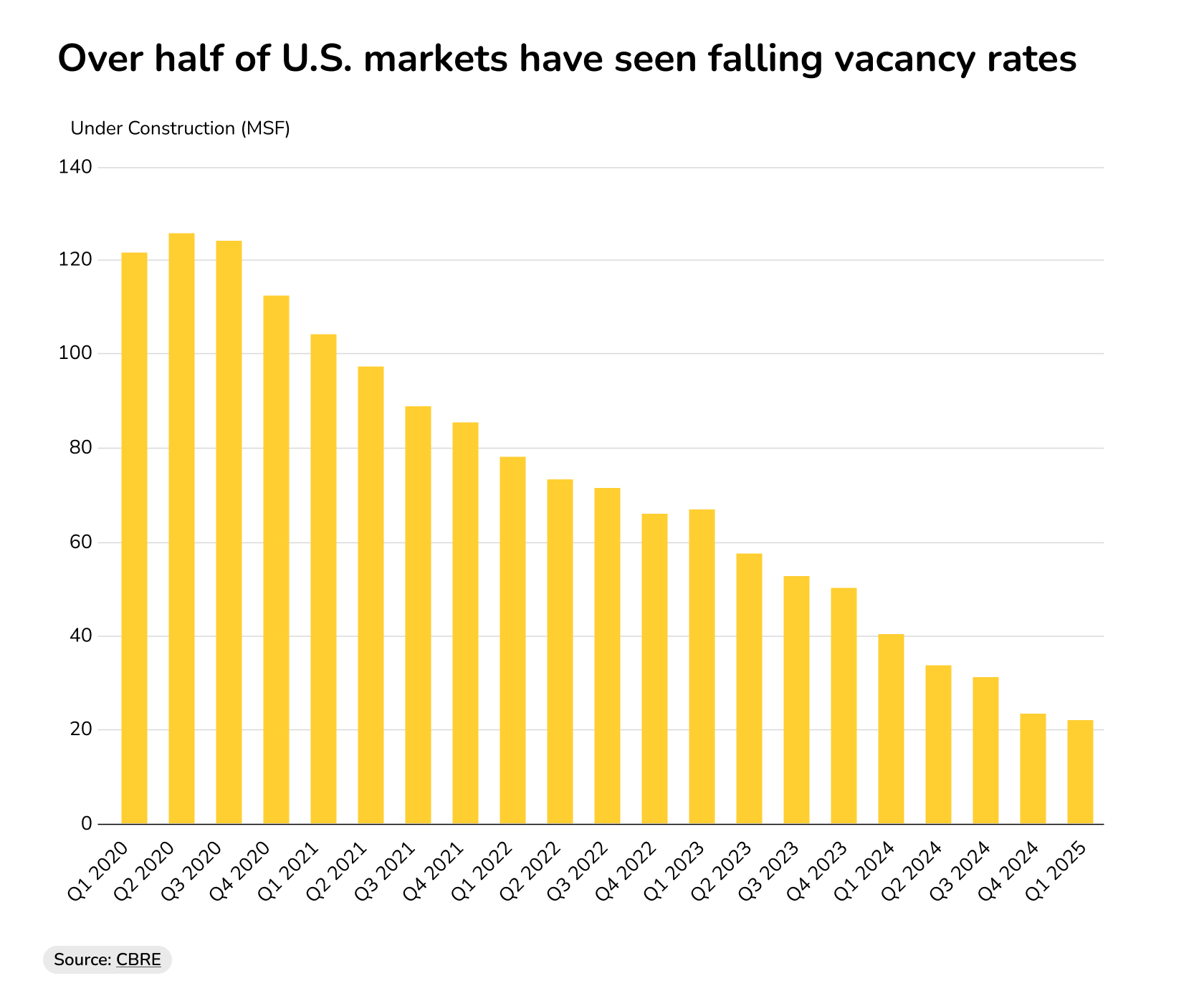
Nearly half of the tracked U.S. markets saw declines, with gateway cities like San Francisco (-70 bps), Atlanta (-40 bps), and Manhattan (-40 bps) showing strong improvements.
Source: CBRE
This points to another early sign of stabilization – and potential recovery – in key office markets as potential occupiers increase in number and possibly push up asking rents.
5. Conversions reshape the office market in 2025
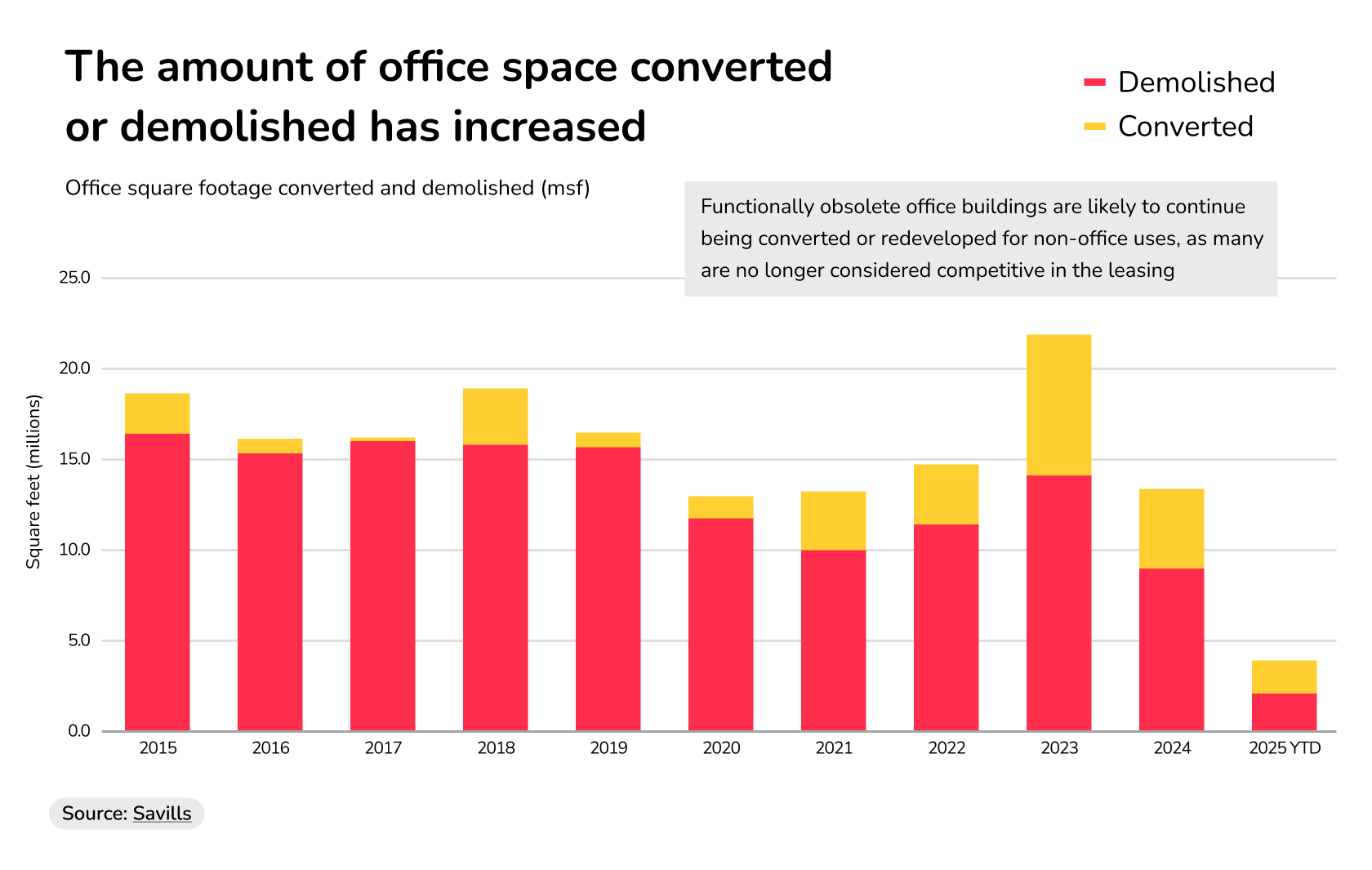
For the first time in decades, more U.S. office space will be removed than added in 2025 – a major shift driven by rising conversions and demolitions.
Developers plan to take 23.3 million square feet offline this year, according to CRE Daily: 12.8 million via conversions, and 10.5 million through demolitions. In comparison, just 12.7 million square feet of new supply is expected, underscoring the supply shift mentioned earlier.
This chimes in with Savills’ data that shows 2025 to have the strongest first quarter since pre-pandemic times for demolitions and conversions.
Source: Savills
What’s driving this? High vacancy rates (although they are now expected to fall) and a growing need for housing. Roughly 76% of conversions are for multifamily property investing, a segment where rents have surged 21.3% since 2020, while office rents barely moved (+1.4%).
With the office vacancy rate at 19% and multifamily at just 4.8%, the economics are clear.
Demolitions, meanwhile, clear out office buildings that can’t be repurposed, often due to outdated layouts or oversized floorplates. Cities like Manhattan, Washington D.C., and Cleveland are leading with local incentives to support the trend.
Despite challenges like high interest rates and construction costs, these conversions are helping clear obsolete inventory, revive urban cores, and stabilize values in the office sector.
6. Rising cap rates may unlock investor bargains
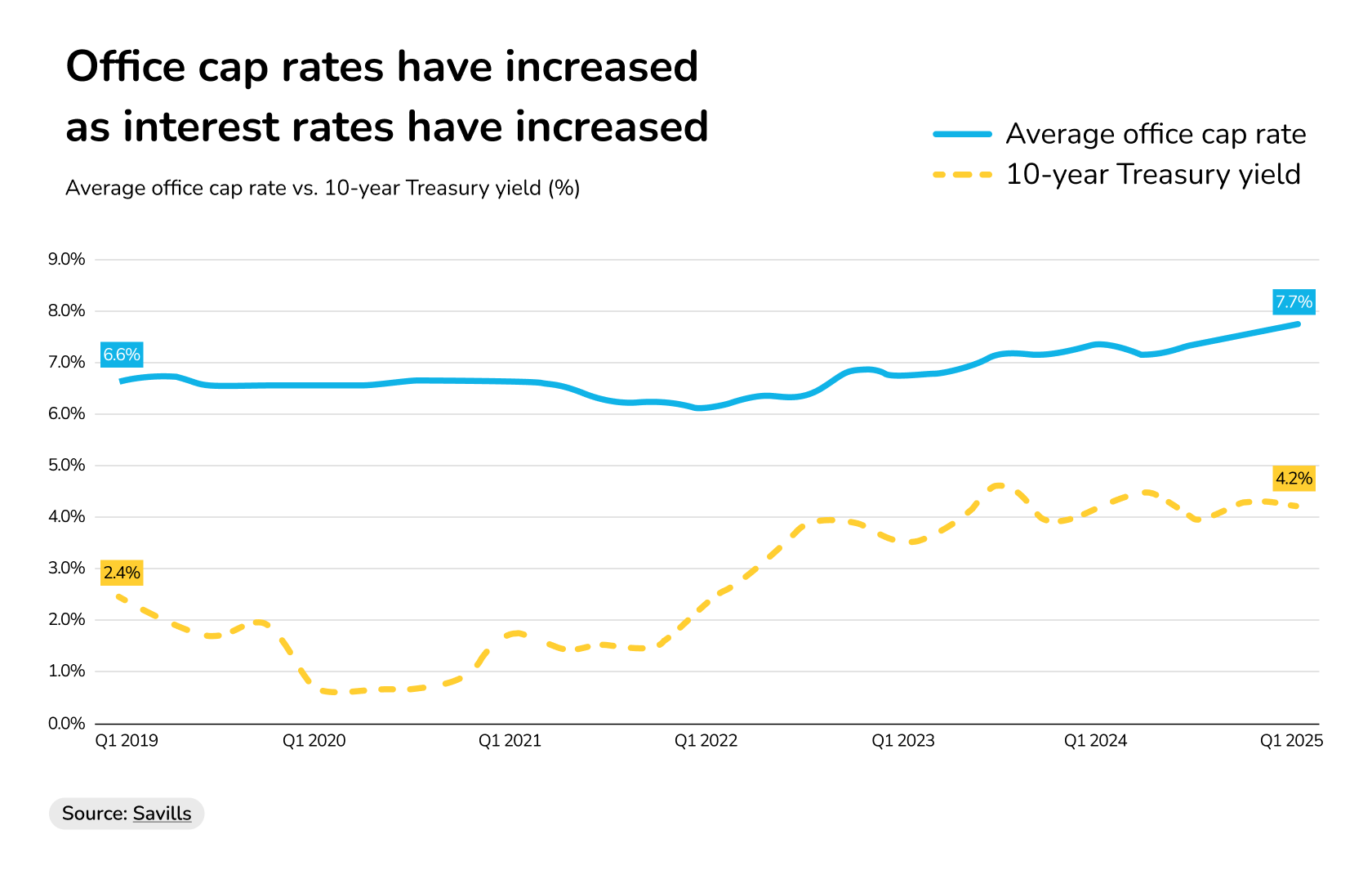
Office cap rates in the U.S. have risen by about 90 basis points since early 2019, up from 6.8% to 7.7% in Q1 2025. That climb tracks closely with the 10-year Treasury yield, which jumped 180 basis points over the same period (from 2.4% to 4.2%).
Source: Savills
The message is clear: higher rates mean investors want higher returns.
For the office sector, that means lower pricing, especially for older or non-core assets, as buyers adjust to meet new yield expectations. It’s a tough market for sellers, but a window of opportunity for investors with dry powder and a value-add mindset.
The growing spread between cap rates and Treasuries shows office assets need to offer more bang for the risk.
In 2025, the play is clear: target quality assets at a discount, with room to grow NOI as the dust settles.
7. Geopolitical uncertainty casts a shadow on office market recovery
Despite signs of the fragile rebound mentioned above, the U.S. office market is now facing new headwinds. Geopolitical tension and unclear federal policy are shaking investor confidence and slowing momentum.
As mentioned, net absorption has slowed due to renewals, but market jitters over trade policy and potential tariffs are also weighing on equities, delaying rate cuts, and dampening economic forecasts. That uncertainty is cooling business decisions, especially around office leasing and sales.
The impact may already be visible: office investment sales hit $13.7 billion in Q1, down 31% from Q4 2024, although still higher than at the same point in 2023.

Source: Savills
Adding pressure, the Department of Government Efficiency (DOGE) is planning to cut over 679 office leases and offload 400 federal properties. While spread nationwide, this move will hit Washington, D.C., particularly hard due to its high concentration of federal offices.
The combination of macroeconomic instability and direct government downsizing is a clear risk factor for the sector, and one investors will be watching closely.
The office market outlook: A current snapshot of a fast-moving market
Not all CRE markets are created equal in 2025. While national headlines still talk about high vacancies and weak demand, certain cities are telling a very different story.
From Dallas to Miami, some metros are seeing strong absorption, rising rents, and investor momentum.
Here’s a quick look at where office demand is heating up – and why these markets are standing out right now.
Which are the hottest commercial real estate office markets right now?
1. Dallas
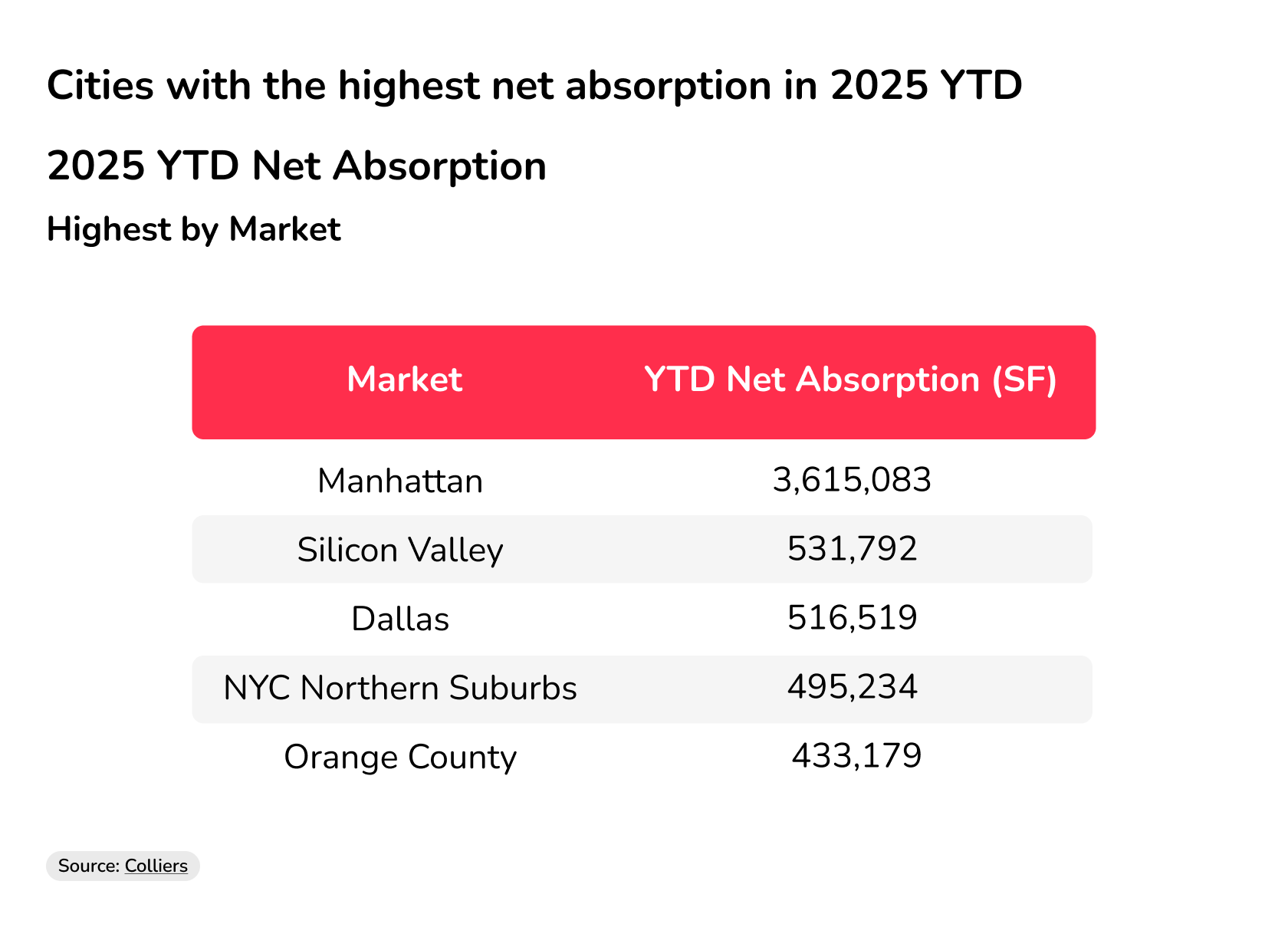
Dallas leads the pack in 2025. A booming population (like in fellow Texan city Austin), steady employment growth since 2020, and business-friendly policies are driving serious office demand. CRE investment here is among the highest in the U.S., with the second-highest absorption rate. The city has stable fundamentals and a strong leasing pipeline, keeping vacancy in check.
Source: Colliers
→ Takeaway: It’s the most attractive office market for investors right now.
2. Manhattan (NYC)
New York is back, at least at the top end of net absorption. While the national vacancy rate hovers near 20%, Manhattan’s is falling fast, especially in high-end buildings. Trophy properties are in short supply, pushing rents up and giving landlords the edge in negotiations.
Source: CBRE (national office statistics)
→ Takeaway: Availability dropped to 17.3%, the lowest since 2020.
3. Miami, FL
Miami continues to rise as a top-tier financial and corporate hub. The city is tightening up on Class A office availability, driven by relocations and mixed-use development. With average rents climbing and investor capital flowing in, Miami’s premium assets are outperforming.
→ Key stat: Vacancy in prime properties is expected to return to pre-pandemic levels (8.2%) by 2027.
4. Tampa, FL
Tampa is quietly becoming a CRE office favorite. A growing population, diverse economy (tech, healthcare, manufacturing), and ongoing infrastructure upgrades are fueling demand.
Office leasing is strong, and investors are targeting Class A properties in rapidly developing areas.
→ Takeaway: Lower costs + high-growth potential = strong returns.
4. Charlotte, NC
Charlotte is gaining steam thanks to its thriving finance sector and ongoing corporate expansion. As leasing activity rebounds nationwide, Charlotte’s population growth and affordable office supply make it a compelling bet for long-term value.
→ Recent trend: Surging interest from fintech and regional banks.
Notable mentions
- Houston, TX: A diversified economy, steady growth, and rezoning make Houston a strong, affordable investment market.
- Silicon Valley, CA: Tech resurgence and high absorption drive demand for innovation-focused, Class A office space.
- Orange County, CA: Strong absorption, mixed-use appeal, and life sciences growth make it a stable office market.
U.S. Office Market Report: Is office real estate a good investment in 2025?
Many investors are asking themselves this question right now. If you’re one of them, the answer depends on where and what you buy.
While national vacancy rates remain high, pockets of opportunity are emerging. Class A assets in urban cores like Manhattan, Dallas, and Miami are leading the rebound, thanks to return-to-office trends and limited new supply. Meanwhile, conversions and demolitions are helping reduce obsolete inventory.
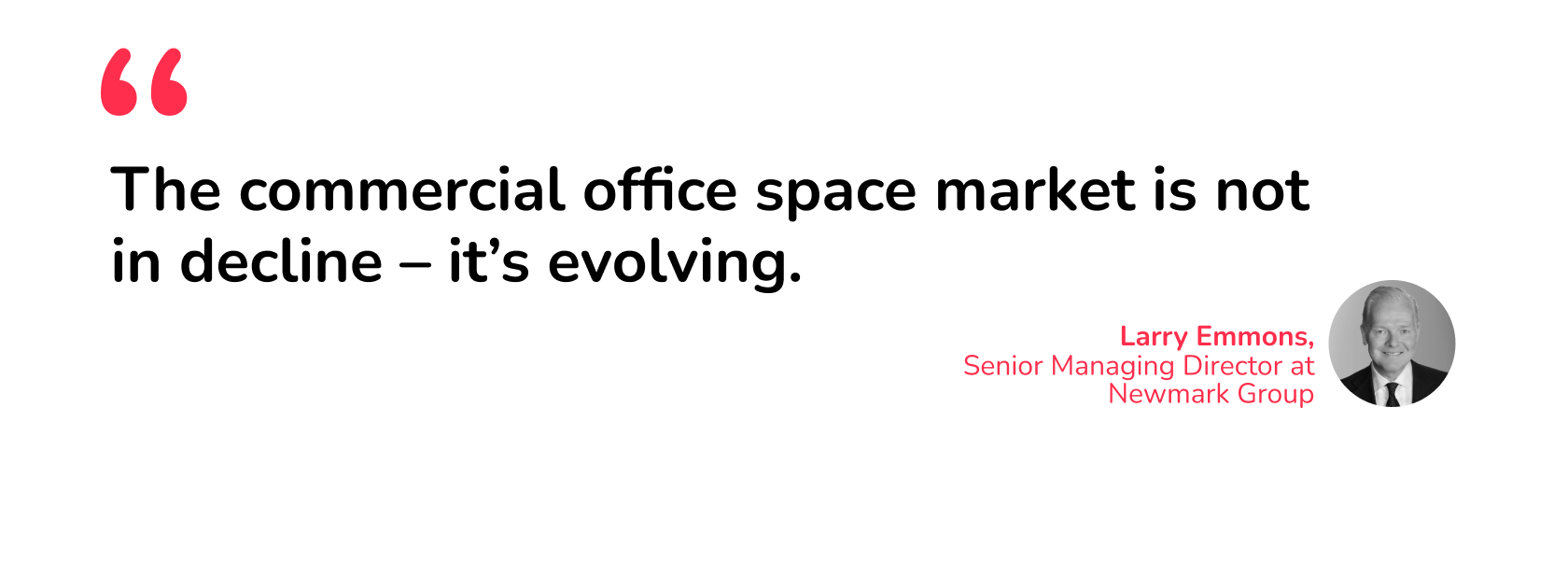
“The commercial office space market is not in decline – it’s evolving,” says Larry Emmons, Senior Managing Director at CRE advisors Newmark Group. “Tenants are redefining their needs, investors are targeting high-performing assets, and new submarkets are reshaping the CRE landscape.”
But risks remain – from geopolitical instability to shrinking federal footprints. High interest rates, cautious lending environments, and potential economic slowdowns are also clouding the outlook. Markets like Washington, D.C., face additional stress from government lease exits and planned property disposals.
For investors, the key focus is this: prioritize quality, location, and future-proof assets.
With the right strategy, including solid development finance, office real estate in 2025 can still deliver long-term value.
Looking to invest in prime office real estate? Sign up for Duckfund and find out how we can make sure you have the funding to make it happen right now.
Real Estate
Financing

- Approval within 24 hours
- Fund multiple properties at once
- No full deposit upfront — soft deposit only
- Apply in under 2 minutes
Secure your next commercial property acquisition — zero upfront capital required.
Start with Duckfund’s EMD financing program.- No capital commitment
- Close faster
- Scale with confidence