Commercial Property Valuation: 6 Methods Every CRE Investor Should Know

The seller's asking price doesn't always reflect a commercial property's value. Here's how CRE investors determine value.
A commercial property can look like the most obvious investment on paper, until you realize you have overpaid for it.
In the commercial real estate (CRE) world, an expensive-looking property may be undervalued, while a cheap-looking one may be overvalued.
This is why commercial property valuation is an essential part of the buying process. The seller’s asking price is one thing; your assessment of the property's true value is the one you should trust.
By improving your valuation skills and knowing when to use a commercial property appraisal, you can get more value for each dollar and build a more profitable CRE portfolio.
Read on as we explain what makes CRE valuation unique and introduce you to some of the popular valuation methods.
We’ll cover:
- Why CRE valuation differs from residential valuation
- 6 popular commercial real estate valuation methods
- Do you need a licensed commercial appraisal?
- Valuing properties when pursuing multiple deals
- Gaining a competitive advantage: How to close with speed
[Do you need a financing company that will provide earnest money deposits for all your CRE deals? Contact us now to learn more about our EMD financing product.]
Fund your next real estate deal
- Access fast financing
- Grow your real estate portfolio

Why CRE valuation differs from residential valuation
One mistake to avoid as a CRE investor is treating CRE valuation the same as residential valuation.
Before we go deeper into how CRE valuation works, it may help to understand the main differences between it and residential valuation.
1. Primary valuation factor
As a CRE investor, your priority is income and cash flow. A property makes sense if it can generate consistent income streams into the foreseeable future.
Residential buyers, on the other hand, prioritize the home’s subjective appeal – emotional connection, neighborhood prestige, aesthetics, and size.
“CRE differs from residential because you’re pricing utility, lease strength, zoning and future optionality,” said Kel Goesch, director at Brisbane Real Estate, a real estate brokerage firm. “Residential is far more influenced by presentation, emotion and comparable owner-occupier demand.”
This difference reflects that commercial buyers are primarily business-oriented, while residential buyers usually purchase properties for personal fulfillment.
2. Popular valuation method
The income approach remains the most popular CRE valuation method because it aligns with income and cash flow, a CRE investor's priority.
The sales comparison approach is more common with residential buyers. Knowing what people pay for similar properties gives them a quick view of the property’s value.
“A house is worth what the house next door sold for,” according to Vijay Mehra, the CEO of LenderBox, a CRE underwriting platform. “A commercial building is worth the income it produces and how confident you are that the income keeps showing up. You're valuing a small business with a roof on it, so the leases, tenants, and expenses matter more than the square footage.”
3. Valuation inputs
CRE valuation is mainly about the financials – lease terms, rent rolls, vacancy rates, market cap rates, and operating expenses. Residential valuation tends to highlight physical attributes like square footage, lot size, property condition, and physical amenities.
4.Valuation sensitivity
CRE valuation is sensitive to lease rollover risk, tenant creditworthiness, interest rates, and economic cycles. Residential valuation is sensitive to mortgage rates, consumer sentiment, and the local supply-demand dynamics.
5. Appraisal complexity
Residential appraisers use standardized forms, and they can complete an appraisal in days. Commercial appraisers, by contrast, create extensive reports, hold specialized certifications, and take weeks to complete a detailed appraisal.
Next, let’s explore 6 popular commercial property valuation methods.
6 popular commercial real estate valuation methods
Though the income approach is the most popular, other methods also have their appeal, depending on the nature of the deal.
We review both the income approach and the other popular methods below:
1. Commercial real estate valuation: The income approach
The income approach values a property based on its expected future income or its ability to generate future cash flows.
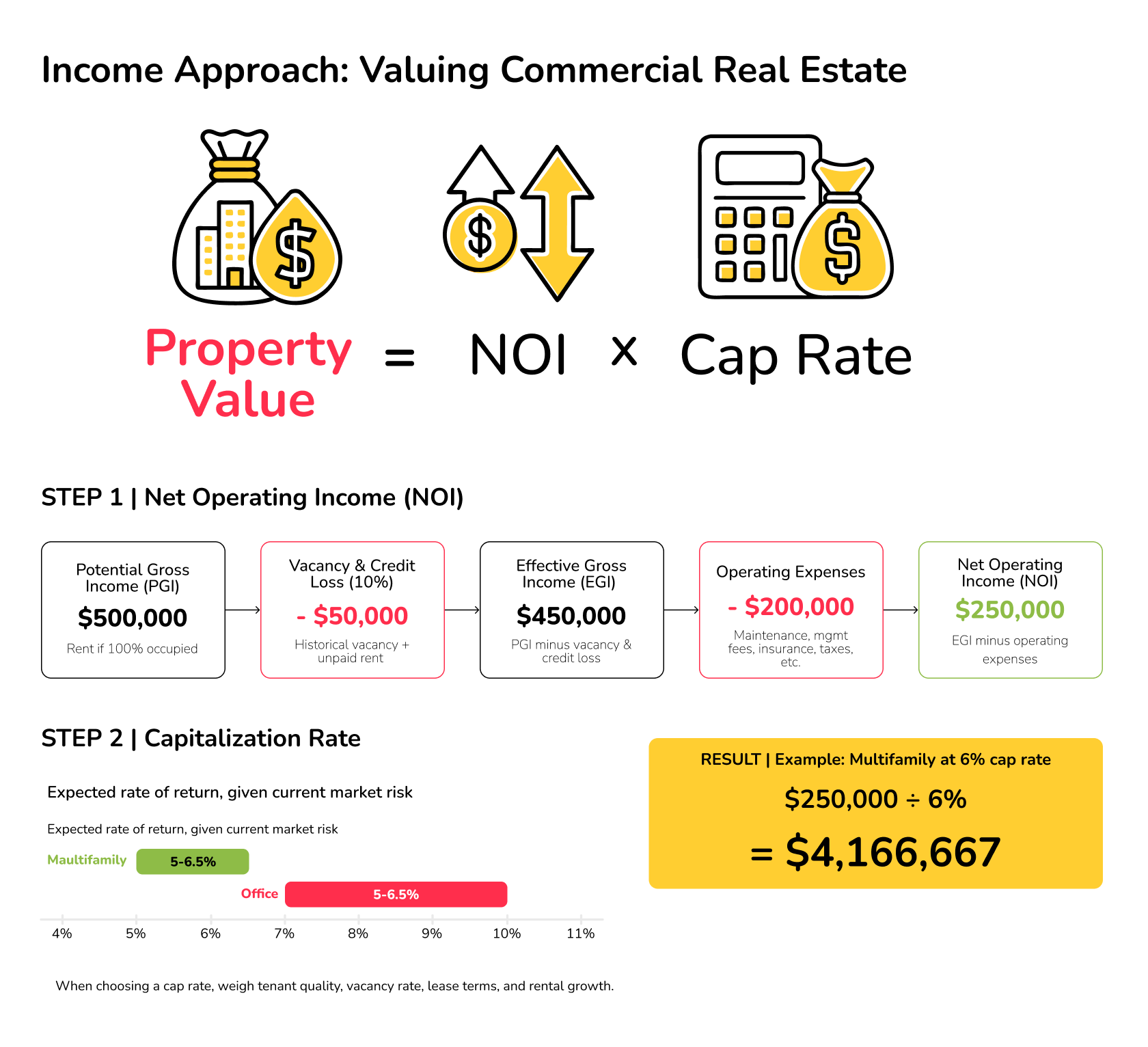
In this approach, a property’s value is its net operating income divided by its capitalization rate. Some words on these two components:
- Net operating income (NOI): A property’s NOI is its effective gross income (EGI) minus all operating expenses.
Effective gross income is the property’s potential gross income (PGI), meaning the rent you'd collect at 100% occupancy, minus vacancy and credit loss, plus any other income such as parking fees.
Suppose your property’s PGI is $500,000 per year. Adjust this by 10% to reflect historical vacancy rates and unpaid rent. Your EGI will then be $450,000 ($500,000 - 10% of $500,000).
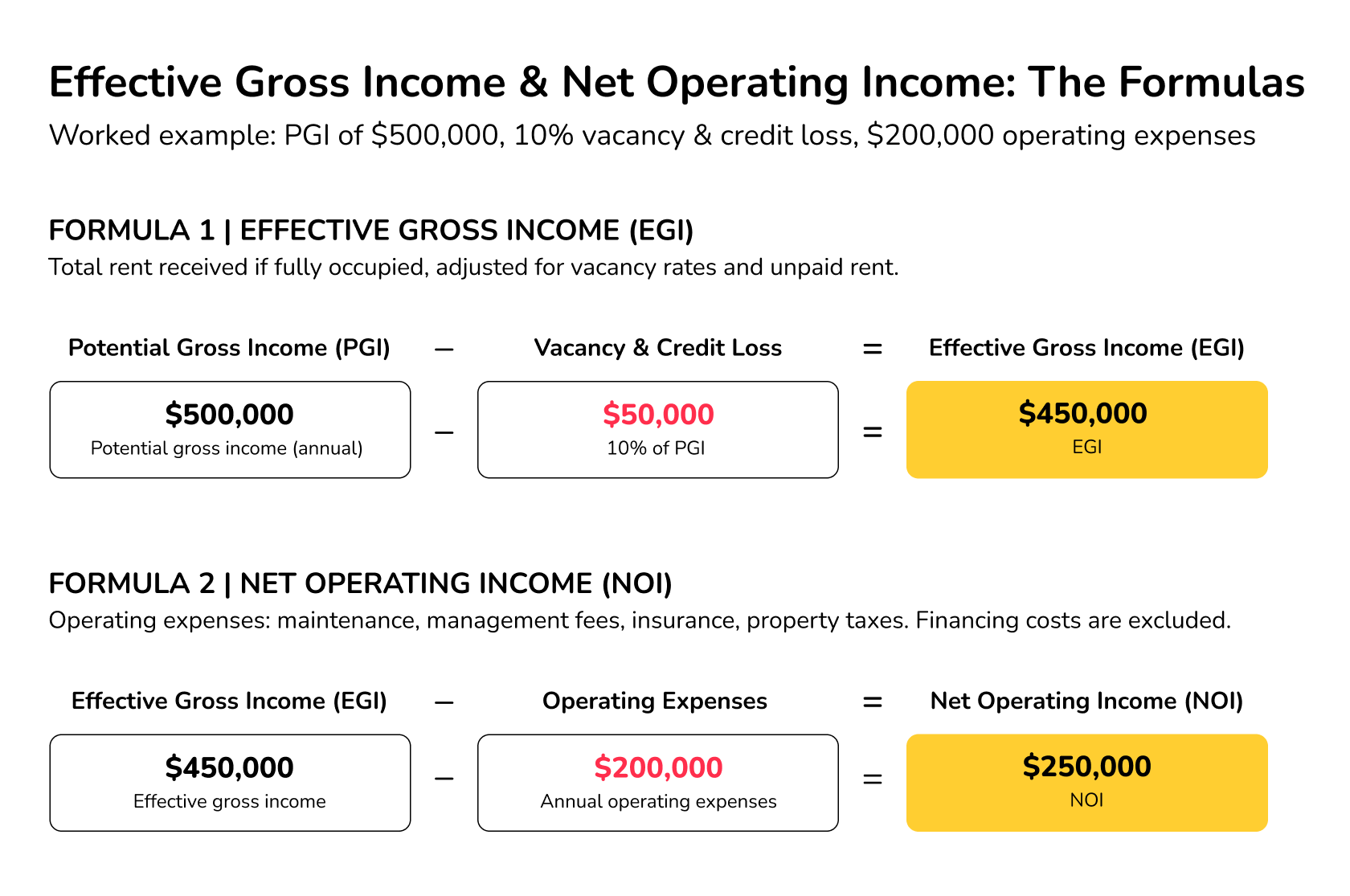
Operating expenses include maintenance, property management fees, insurance, property taxes, and more. (Note: Financing costs are not part of operating costs). Say all of these add up to $200,000 in a year.
The property’s NOI is $250,000 ($450,000 - $200,000).
- Capitalization rate: The cap rate is the expected rate of return on an asset, given the market’s current risk level.
Cap rates often vary across all CRE types, reflecting investors’ judgment on risk. For example, multifamily properties tend to have stable occupancy while office buildings have higher vacancy rates. As a result, mulitfamily cap rates are currently lower (4%-7%) than office (6%-15%), according to the U.S. Cap Rate Survey H1 2026 by CBRE, a commercial real estate services firm.
When choosing a cap rate, evaluate the property’s tenant quality, vacancy rate, lease terms, and rental growth, among other factors.
To continue with our example, suppose it is multifamily CRE and a 6% cap rate reflects its risk-return dynamic.
Based on these two figures, the property’s value = $4,166,667 ($250,000/6%).
Pros of the income approach
- Intuitive approach: It emphasizes what commercial investors prioritize: income and cash flow.
- Wide appeal: It’s applicable to all income-producing properties across all CRE sectors.
- Simplicity: The approach relies on two key pieces of information: NOI and cap rate.
Cons of the income approach
- Limited usage: This approach is less effective for non-income-producing commercial properties.
- Can depend too much on comparable data: For new properties, NOI depends on comparable data from similar properties. Also, most CRE investors select cap rates based on recent sales.
- Assumes constant EGI and operating expenses: The income approach assumes EGI and operating expenses remain stable into the foreseeable future.
2. Commercial real estate valuation: The discounted cash flow approach
The DCF approach modifies the income approach by eliminating one of the latter’s assumptions: stable NOI.
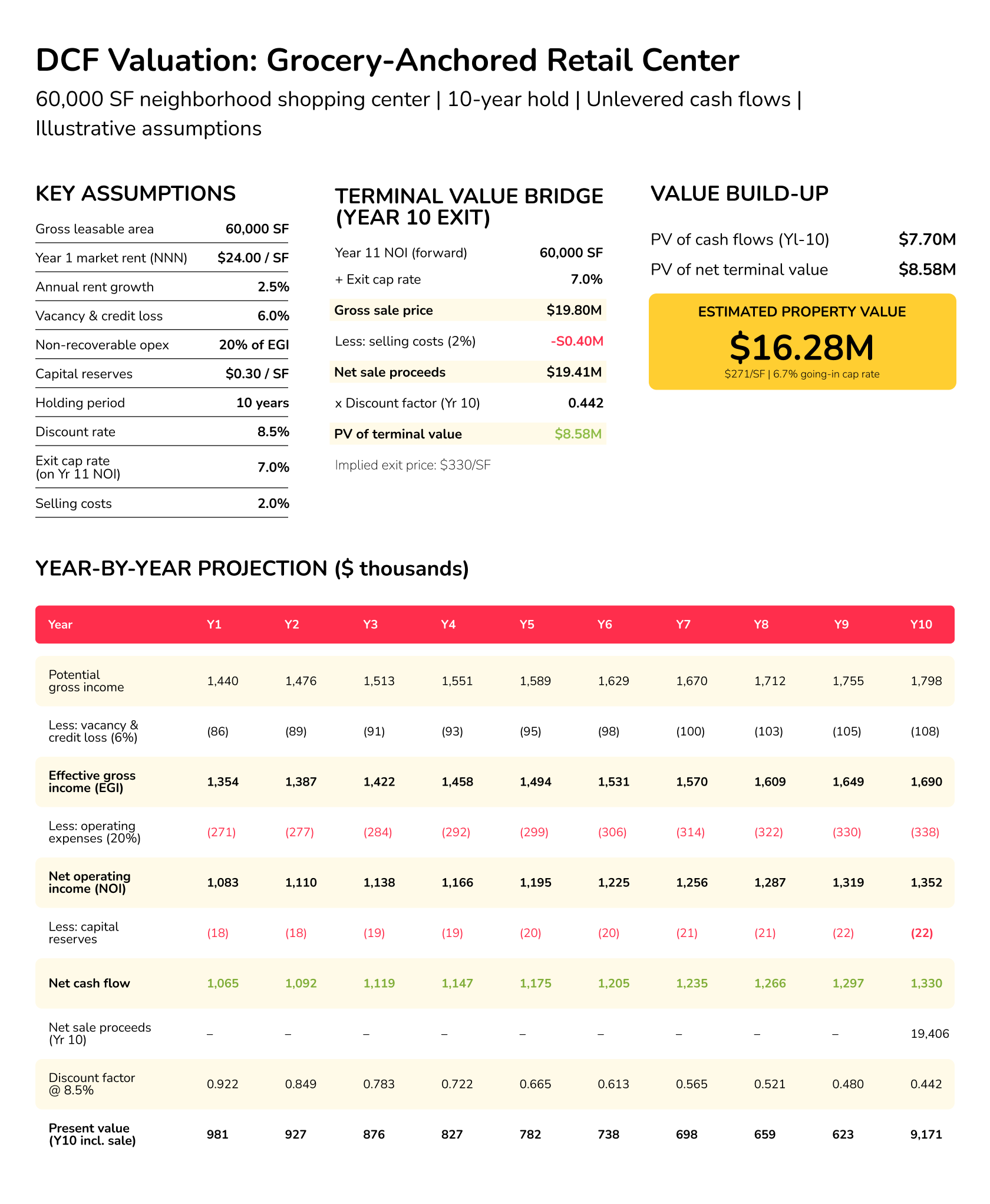
It accounts for unstable NOI (which makes sense for properties with lease turnover and variable income) and the time value of money by projecting multi-year cash flows and discounting them at your required return (the discount rate).
You can execute this approach through the following steps:
- Forecast future cash flows: You will estimate the NOI for each year, adjusting for rent growth, lease turnover, and inflation.
- Select the discount rate (r): The discount rate is the annualized return you expect to earn over the property's ownership period. It's typically higher than the cap rate because it reflects your total return, including expected rent growth, not just the first year's yield. In our example below, the discount rate is 8.5% against a 7% exit cap rate.
- Calculate the present value of each year’s cash flow: Multiply each year’s net cash flow (NOI minus capital reserves) by the discounting factor* (which depends on the discount rate). The present value (PV) shows what future cash is worth in today’s money.
*Discounting factor is 1 ÷ (1 + r)^n, where r is the discount rate and n is the year. At 8.5%, Year 1's factor is 0.922.
- Calculate the terminal value: You can’t project cash flows forever. The terminal value estimates the asset's projected sale price after the DCF calculation period (usually 5 or 10 years, depending on how long you intend to hold the property).
The terminal value is the NOI for the year after you stop the DCF calculation divided by the expected cap rate at the property’s disposal.
- Find the present value of the terminal value: Subtract selling costs, then multiply by the final year's discount factor (0.442 for Year 10 in our example).
- Add the present value of NOIs and terminal value: The property’s value is the sum of all the PVs plus the PV of the terminal value. In our example, $7.70M + $8.58M = $16.28M.
Let’s illustrate this with a grocery-anchored retail center.
Pros of the DCF approach
- Ideal for unstable assets: Lease-up properties and redevelopment sites can benefit from a dynamic NOI.
- Dynamic valuation: You can run a sensitivity analysis to see how valuation changes when you adjust any assumption.
Cons of the DCF approach
- Sensitive to assumptions: Small changes in the discount rate or NOI growth rate can affect the valuation.
- Complexity: A DCF valuation can be complex and time-consuming, especially when compared to the income approach.
3. Commercial property valuation: The sales comparison approach
Though the sales comparison (sales comps) approach is popular in residential real estate, it has its advocates in commercial valuation.
The sales comparison approach estimates a property’s fair market value by comparing it to similar recently sold properties. This approach assumes that a rational buyer will not pay more for a property than what it costs to acquire a comparable one.
It works in five simple steps:
- Identifying comparables: Before deciding whether two properties are comparable, consider size, condition, location, amenities, environmental risk, zoning laws, and price per square foot (or price per unit or price per key).
You can select multiple comparable properties to get a better view of the market’s average.
- Verify sales data: You should confirm the transaction details of the selected properties. Also, verify that none of the selected comps were distress sales.
- Analyze differences: In most cases, the properties won’t be fully comparable. They will differ in location, physical properties, economic characteristics, and legal conditions (zoning, easements, restrictions, liens).
- Quantify adjustments: Adjusting for these factors can revise the comps' value up or down to estimate the subject property’s value.
- Reconcile adjusted prices: You can take a simple average of the comps or give more weight to the most comparable properties.
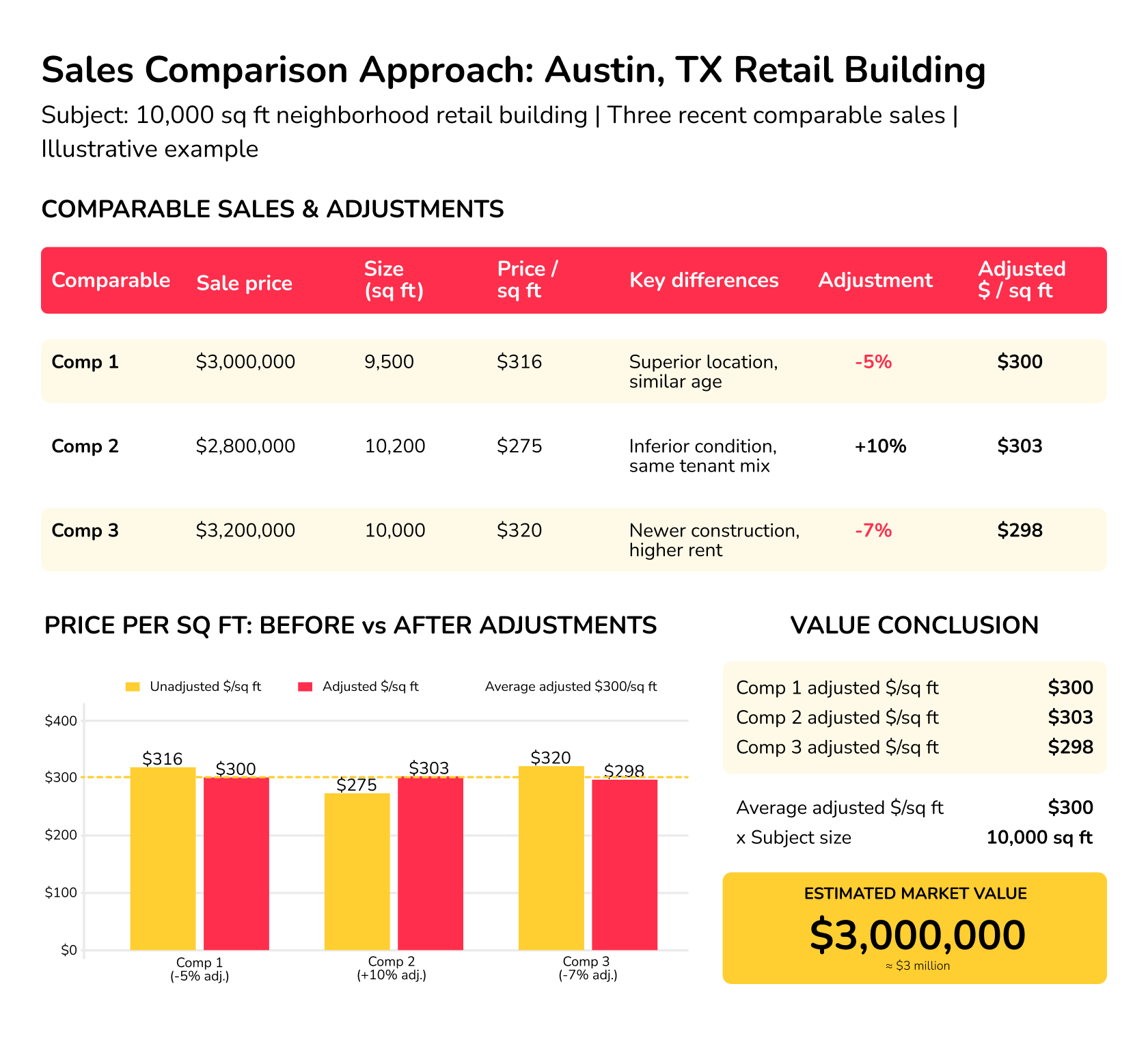
Let’s illustrate with a 10,000 sq ft retail space in Texas. Suppose three comparable properties sold recently. Below is how a sales comp approach would work:
Pros of the sales comp approach
- Simplicity: The sales comp approach is easy to understand and execute.
- Supports other methods: You can use it to confirm other valuation methods. Recent sales data can show if the valuation method you are using is realistic (are people buying at that price?).
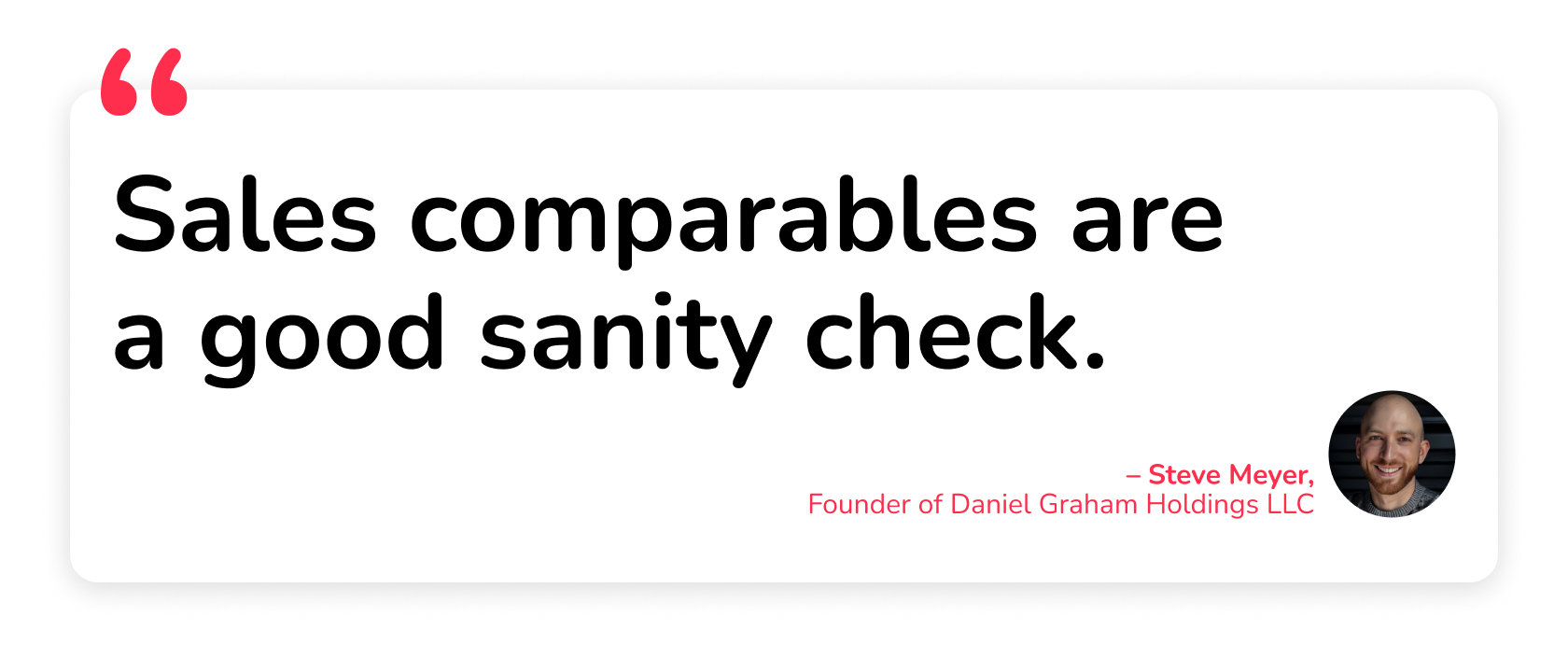
“Sales comparables are a good sanity check, especially for two- to four-unit buildings that often trade more like houses, and a way to confirm the cap rate the local market is really paying,” according to Steve Meyer, founder of Daniel Graham Holdings LLC, a multifamily investment company.
Cons of the sales comp approach
- Subjectivity: The adjustment process requires experience and subjective judgment.
- Market volatility: In volatile markets, selected comps may quickly become irrelevant.
4. Commercial property valuation: The gross rent multiplier approach
The gross rent multiplier (GRM) approach estimates a property’s value based on its gross rental income. Unlike the income approach, it excludes operating expenses.
This approach assumes properties generating similar gross rents should sell for similar rent multiples.
It works similarly to a sales comp approach, except you also look at the GRM of recent sales rather than just the sales price.
Consider the steps for implementing this approach:
- Select comparable sales: Identify similar properties recently sold.
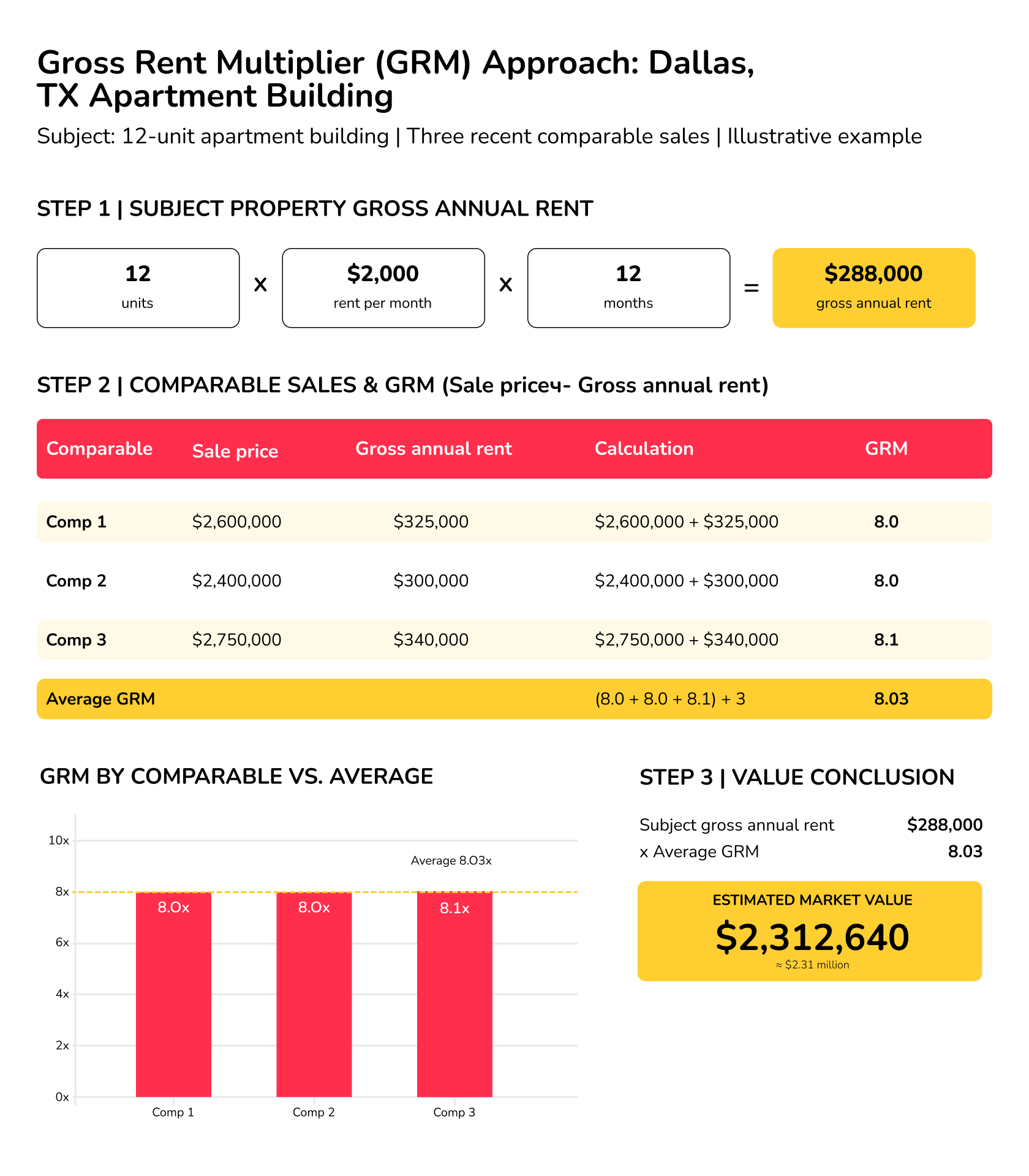
- Calculate gross rent multiplier (GRM) for each comp: The GRM is the sales price divided by the annual rent. If a property sold for $2 million has gross rental income of $250,000, its GRM is 8.
- Determine the average GRM: Take a simple average of all selected comps.
- Apply the average GRM to the subject property: Find the subject property's annual gross rental income and multiply it by the average GRM to estimate its value.
- Reconcile and adjust: You can revise this estimated value upward or downward to adjust for differences in location, property age, and property conditions.
Below is an example of how this works for a 12-unit apartment building in Texas:
Pros of the gross rent multiplier approach
- Simplicity: It is as simple as the income approach.
- Intuitive: Using a property's income as a valuation basis makes sense for investors. The GRM also provides a rough payback-period gauge: a GRM of 8 means it would take eight years of gross rent to equal the purchase price, before expenses.
Cons of the gross rent multiplier approach
- Ignores operating expenses: Using only gross annual income ignores operating expenses. NOI is more intuitive.
- Relies on the sales comparison approach: As we have seen, the sales comparison approach has its limitations.
5. Commercial real estate valuation: The cost approach
The cost approach is of little relevance to you as a CRE investor. It suits developers on the selling side of the CRE deal, as well as appraisers and lenders for new builds.
However, understanding it can still matter if you ever decide to develop properties from scratch.
With this method, a property's value is its replacement cost plus the value of the land, minus depreciation.
Let’s spend some time understanding the key terms:
- Replacement cost: You can calculate this using the replacement or reproduction method.
Under the replacement method, replacement cost is the cost to construct a new property like the one being valued, using new materials, design, and construction methods. The aim is for the new property to have the same utility as the one you are valuing.
On the other hand, the reproduction method considers how much it would cost to construct the same property today using the same materials, construction methods, and design.
- Value of the land: How much is commercial land worth? While many methods exist, the sales comparison approach is most appropriate for developers. In essence, consider how much comparable land is selling for right now.
- Depreciation: Depreciation measures an asset's decline in value over time. This decline can be due to physical wear and tear (physical depreciation), changes in customers’ tastes and preferences (functional depreciation), and changes in economic conditions (economic depreciation).
Deducting depreciation helps us to bring the cost of a brand-new building down to its true value.
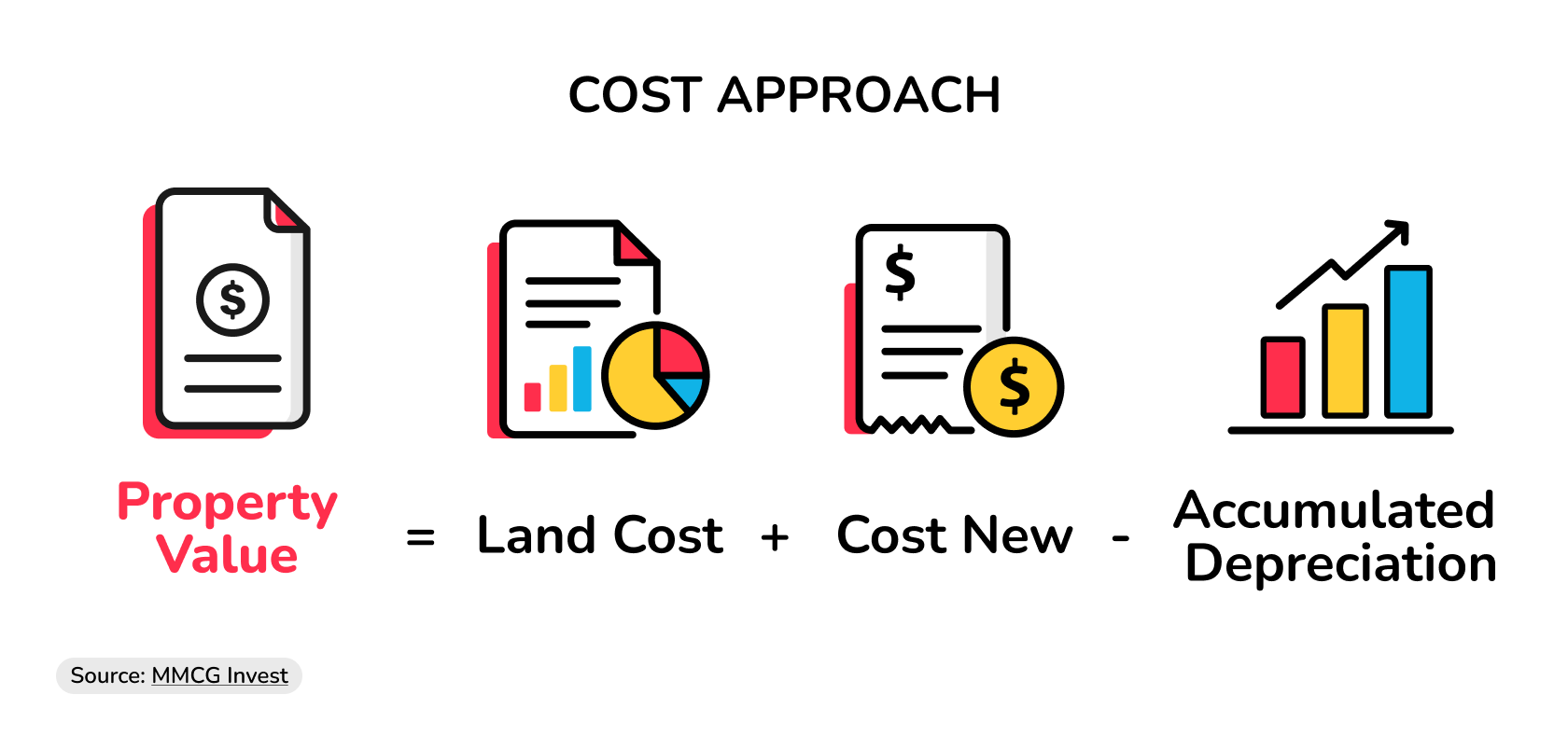
Source: Wall Street Prep
Let’s use an example to better understand this method.
Assume the building's replacement cost is $10 million (using the reproduction method), with the land valued at $2m using the sales comparison approach. Also, say an appraiser estimates total depreciation at $3m.
Given this information, the property in view should be valued at $9m ($10m + $2m - $3m).
Pros of the cost approach
- Very useful when sales comps data are not available: When a property market is inactive or new, it is hard to find the selling prices of comparable properties. The cost approach is a useful alternative to estimating the value of commercial real estate in this case.
Cons of the cost approach
- Subjectivity: Because depreciation can take many forms, it is difficult to determine an objective depreciation amount.
- Complexity: Determining a property's replacement cost can be complex, and developers may have to outsource the process to professional appraisers.
- Valuing land: It might be difficult to find comparable land for valuation. This may be because the area is fully developed or zoning laws have restricted available land for new developments.
6. Commercial real estate valuation: The yield-on-cost approach
Developers and value-add investors use the yield-on-cost (YoC) approach to evaluate if a property’s expected income justifies the building or repositioning cost.
The YoC is the stabilized NOI / total project cost. Stabilized NOI is the annual NOI once the property is fully leased. The total project cost includes land, construction, financing, fees, and contingencies.
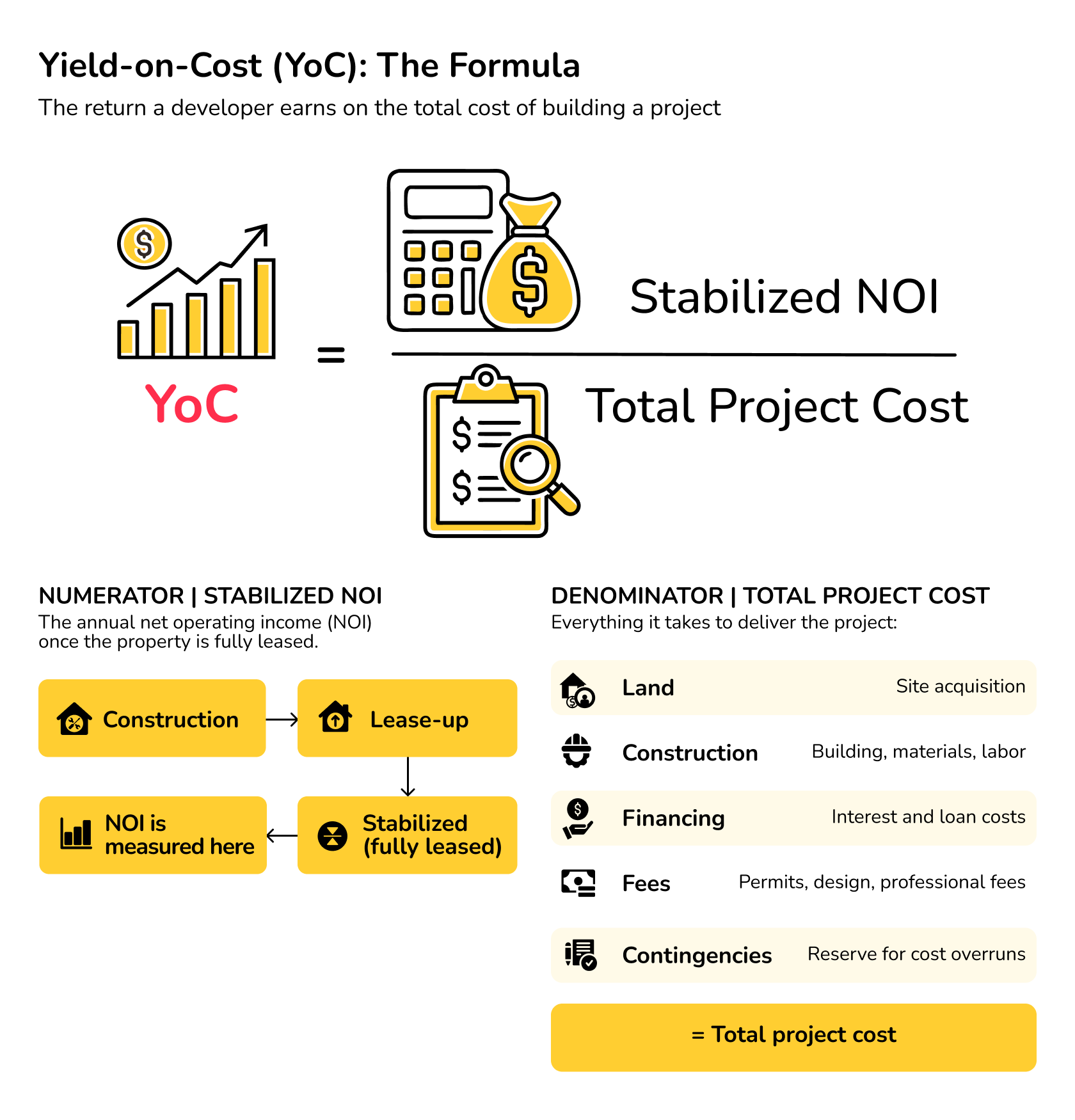
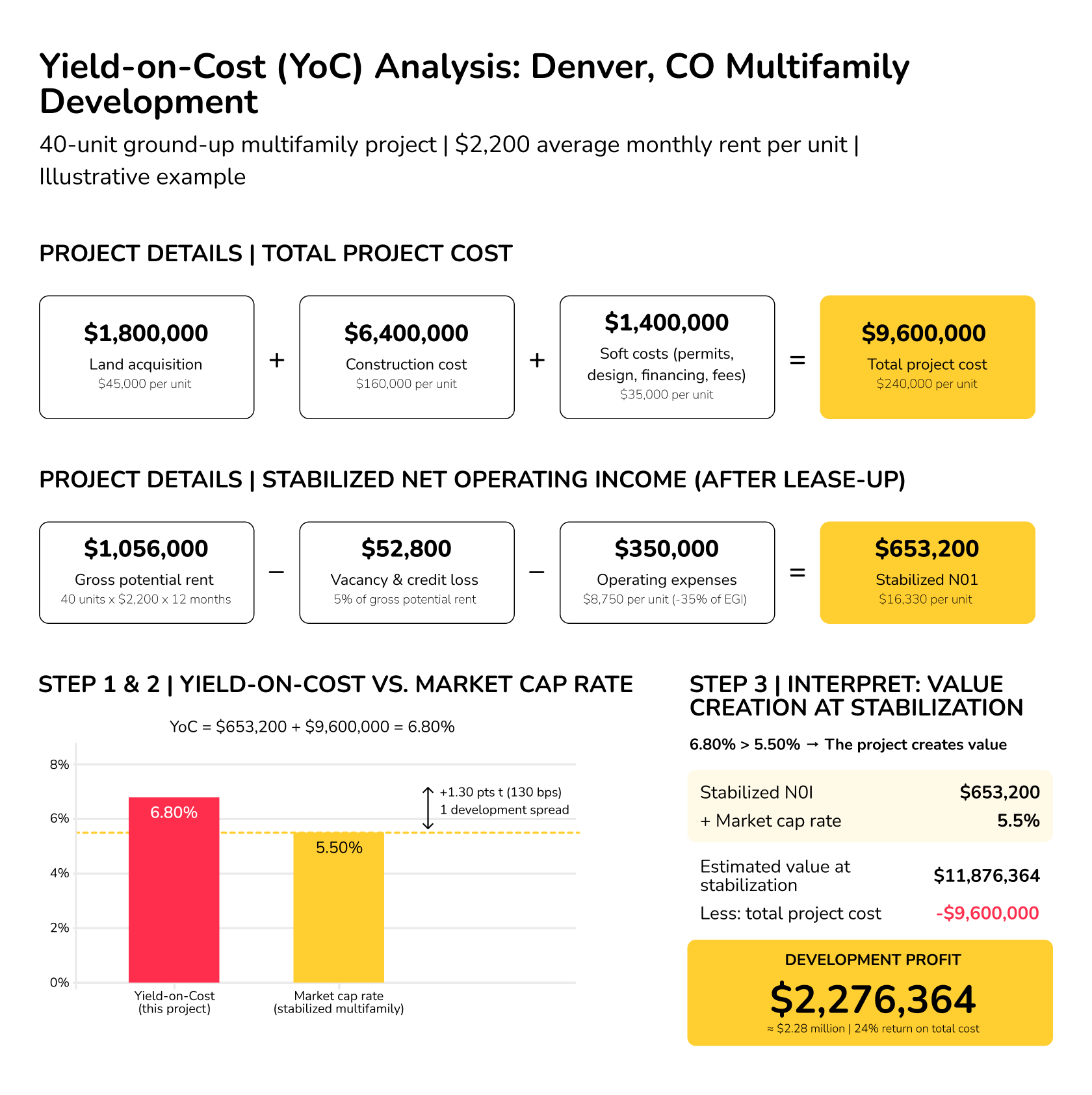
Once you calculate the yield on cost, you compare it with the market cap rate for similar stabilized assets. The project is valuable if the YoC exceeds the market cap rate.
Imagine a developer plans to build a 40-unit multifamily property in Colorado. Below is how a YoC valuation could work:
Pros of the YoC approach
- Good for feasibility studies: Developers can use it to determine whether a project is worth pursuing.
- Focuses on actual investment performance: This approach highlights actual investment performance rather than market speculation.
Cons of the YoC approach
- Ignores the time value of money: Like the income approach, it assumes stable NOI over the holding period.
- Requires accurate projections: The method’s usefulness depends on the accuracy of the NOI projections.
Do you need a licensed commercial appraisal?
No matter how detailed your commercial property valuation is, you may still need a licensed commercial property appraisal. Certain deals, lenders, and regulatory contexts may require it:
- Deals: You may need a certified appraisal when buying or selling high-value commercial properties or considering mergers and acquisitions.
- Lenders: You may need to order an appraisal when financing or refinancing a commercial asset with a traditional lender. SBA loans may also require it. Lenders request it to ensure the property’s value aligns with the loan amount.
- Regulatory contexts: You will need a certified appraisal for federally related CRE transactions above $500,000, according to the Code of Federal Regulations. You will also need regular appraisals if you operate as an institutional investor.
Unlike informal valuations, a commercial appraisal must be performed by a Certified General Appraiser under the Uniform Standards of Professional Appraisal Practice (USPAP).
How does the commercial property appraisal process work?
A certified appraisal follows a structured process. It provides a credible third-party opinion of commercial property values.
Though the process may vary by property type and complexity, it follows these key stages:
- Scope definition: You engage a Certified General Appraiser who then defines the scope of work (purpose, financing type, and approach – income, cost, sales comparison, etc.). The appraiser prepares a formal engagement letter outlining details like fees, deadlines, and data requirements.
- Preliminary research: The appraiser reviews market data, zoning, permits, and other public records relevant to the property.
- Property inspection: The appraiser inspects the property to confirm size, physical condition, location, layout, and other physical characteristics. This process also includes evaluating the property’s income potential by reviewing tenant leases and rent rolls.
- Market analysis: The appraiser gathers data about current market trends and conditions – comparable sales, lease data, cap rates, vacancy rates, absorption, among others.
- Valuation approach: The appraiser will usually choose one or more of the income, sales comp, and cost approaches. They will reconcile the results of the selected methods to arrive at a final value.
- Valuation report: The appraiser completes a USPAP-compliant report covering property description, market analysis, valuation methods, assumptions, and final opinion of the property’s value. This report is usually narrative for complex properties and form-based for smaller ones.
- Review and delivery: Depending on the reason for the certified appraisal, all interested parties will review the report.
What happens if the appraisal results differ from your valuation of the same property?
It’s not as simple as determining who is right and who is wrong. Instead, a detailed review process can give you the information you need to make a smart decision.
What would this process look like?
- Reviewing the appraisal assumptions: Valuation differences often stem from different assumptions about cap rates, vacancy rates, operating expenses, depreciation, and market comps, among others.
“I read the appraiser's assumptions more closely than the final number, especially rent growth and cap rate, and I pay attention when they disagree with mine,” said Mehra.
By comparing the appraiser’s report to your underwriting model, you can identify these differences and evaluate which ones better reflect the property and current market conditions.
“I treat external appraisals as one input, then test the assumptions against local inquiry, recent campaigns, rental evidence, and what our team is seeing across multiple departments,” said Goesch.
- Discussing discrepancies with lenders: If the appraisal comes lower than your valuation, you can discuss the discrepancies with the lender. The goal is to present supporting evidence for your valuation against the appraiser’s. If your case is convincing, the lender can re-order a new appraisal, known as a reconsideration of value (ROV), or revise the existing one.
- Adjusting investment strategy: If the lender sticks with the appraiser's lower valuation, you may need to adjust your CRE investment strategy. This can include renegotiating the purchase price, reevaluating LTV ratios and equity requirements, or delaying closing until market conditions improve.
On the other hand, if the appraisal suggests a higher value, you can secure better financing terms while maintaining conservative underwriting.
Valuing properties when pursuing multiple deals
When you pursue several CRE deals simultaneously, the valuation process can get complicated if you don't manage it well. If some of these deals are mutually exclusive, choosing the right one is crucial to your overall portfolio.
Let’s look at how you can manage this process without getting overwhelmed.
- Know when detailed analysis is necessary: Not every deal requires a detailed analysis like a DCF. That is why it’s better to use quick metrics like cap rates and GRM to filter opportunities that match your risk-return profile.
This lets you quickly identify opportunities that meet your yield thresholds and focus your valuation time and effort on them.
- Don't use one set of assumptions across asset types: A 6% cap rate may work for a multifamily property but might be too low for an office space. The same assumptions may make sense within sectors, but not across sectors.
- Rank deals by how far below your valuation the asking price lies: If comparability is an issue, you can evaluate properties across sectors by their “margin of safety”.
For example, property A, undervalued by 20%, is more desirable than property B, undervalued by 10%, all other factors held constant.
- Prioritize properties based on portfolio needs: You might have to overlook a property with a higher margin of safety if one with a lower margin better fits your portfolio.
Your portfolio goals can shift between increasing yield/returns and lowering risk. You might also prioritize certain locations, asset types, and tenant mix at any given point.
- Gaining a competitive advantage: How to close with speed
Knowing how to value commercial real estate is only useful if you can act on that knowledge when the right opportunity appears.
When you find that undervalued property, you need to move fast, especially in a competitive commercial real estate market.
In today’s CRE market, this often means paying an earnest money deposit (EMD) to kickstart the due diligence period while the seller takes the property off the market. This also gives you the time to conduct a detailed underwriting process.
Without paying this deposit, your interest in the undervalued property remains superficial. Another investor can swoop in and get through the door while you keep knocking from the outside.
If capital is tied up or you have multiple commitments, earnest money deposit lending can help you move fast, without low liquidity holding you back. This lets you access the funds you need to pay for EMD now and repay when you close.
At Duckfund, we provide EMD financing to CRE investors operating in different CRE sectors. You can complete an application in two minutes and get the funds to an escrow within 48 hours. Our fees are structured as LP soft costs, passed through at closing, with competitive rates that decrease for larger deposits.
We also provide EMD funding for multiple simultaneous deals, so you can keep building your CRE portfolio without waiting to conclude one deal.
[Are you ready to secure more CRE properties? Don’t let earnest money deposit requirements stop you. Apply to Duckfund today to get earnest money financing so you can explore more investment opportunities and close more deals.]
Takeaways
- Unlike residential valuation, commercial property valuation focuses heavily on income, cash flow, leases, operating expenses, vacancy, and cap rates rather than primarily on physical characteristics.
- No single valuation method fits every property. Income, DCF, sales comparison, gross rent multiplier, cost, and yield-on-cost approaches each have different applications, strengths, and limitations.
- You may also need to request a certified appraisal, depending on the deal, lender, and regulatory context.
- Once you identify an undervalued property, fast access to earnest money can help secure the deal and begin due diligence.
Frequently Asked Questions
1. How is commercial real estate valued?
Commercial real estate can be valued using several methods, including the income, discounted cash flow, sales comparison, gross rent multiplier, cost, and yield-on-cost approaches. The income approach is particularly common because it values a property based on its net operating income (NOI) and capitalization rate.
2. How much is my commercial property worth?
Your commercial property's value depends on factors such as its income, operating expenses, vacancy, lease terms, location, comparable sales, and applicable cap rate. For an income-producing property, one common starting point is to divide its NOI by the appropriate capitalization rate.
3. How to calculate cap rate for commercial real estate?
Calculate the cap rate by dividing a property's net operating income (NOI) by its current or estimated property value, then multiplying by 100 to express the result as a percentage. For example, a property generating $250,000 in NOI and valued at $4.17 million has a cap rate of approximately 6%.
4. How do you value multiple commercial properties at once?
When valuing multiple properties, investors can apply a consistent valuation framework across each asset using standardized assumptions for NOI, cap rates, vacancy, operating expenses, and comparable sales. This makes it easier to compare opportunities, rank deals, and identify which properties warrant further underwriting.
5. What's the difference between a commercial appraisal and a valuation?
A commercial valuation is an investor's or analyst's estimate of a property's value, often used to screen or underwrite a potential deal. A commercial appraisal is a formal, independent opinion of value prepared by a qualified appraiser and may be required for certain financing, legal, regulatory, or institutional purposes.
Real Estate
Financing

- Approval within 24 hours
- Fund multiple properties at once
- No full deposit upfront — soft deposit only
- Apply in under 2 minutes
Secure your next commercial property acquisition — zero upfront capital required.
Start with Duckfund’s EMD financing program.- No capital commitment
- Close faster
- Scale with confidence