Multifamily Commercial Real Estate: The Complete Investor's Guide

Multifamily commercial real estate is outpacing other CRE asset classes for investment growth in 2026, with a forecasted 20% rise in volume, according to CBRE.
If you’re an investor or developer, you may already have multifamily near the top of your list, but you might also find it a difficult market to read because you’re not sure:
- If rising CMBS distress signals across the market mean opportunity or risk
- Which financing routes are open to you right now
- What separates investors who win deals from those who miss out on them.
No wonder. The largest wave of new apartment supply since the 1980s is only just clearing, and the recovery is arriving unevenly across metro areas. Two identical buildings in different submarkets could be telling you completely different things about the market.
In this guide, we cover what a multifamily investor or developer needs to know in an uneven multifamily market in 2026, including:
- What is multifamily commercial real estate?
- Is multifamily commercial real estate a good investment in 2026?
- How to measure profitability: cap rates and NOI
- How do you finance a multifamily commercial property in 2026?
- How to close multifamily deals faster than the competition
Want to make your next multifamily deal work? Contact us to find out how we can help you secure your next investment ahead of rivals.
Fund your next real estate deal
- Access fast financing
- Grow your real estate portfolio

What is multifamily commercial real estate?
Many investors new to the market often confuse the definition of commercial multifamily properties with residential real estate, assuming that any building with multiple tenants counts as commercial.
Commercial multifamily real estate is any residential property with five or more units that is treated as an investment rather than a home. These investment properties are normally maintained by professional property management companies on behalf of the owner.
Several types of properties can fall into this category, including:
- Commercial apartment buildings
- Apartment complexes
- Student housing
- Condominium or townhome developments
- Mixed-use properties that combine residential units with retail or office space.
Residential multifamily real estate is normally fewer than five units (i.e., a duplex, triplex, fourplex), often owner-occupied, and financed by a residential mortgage.
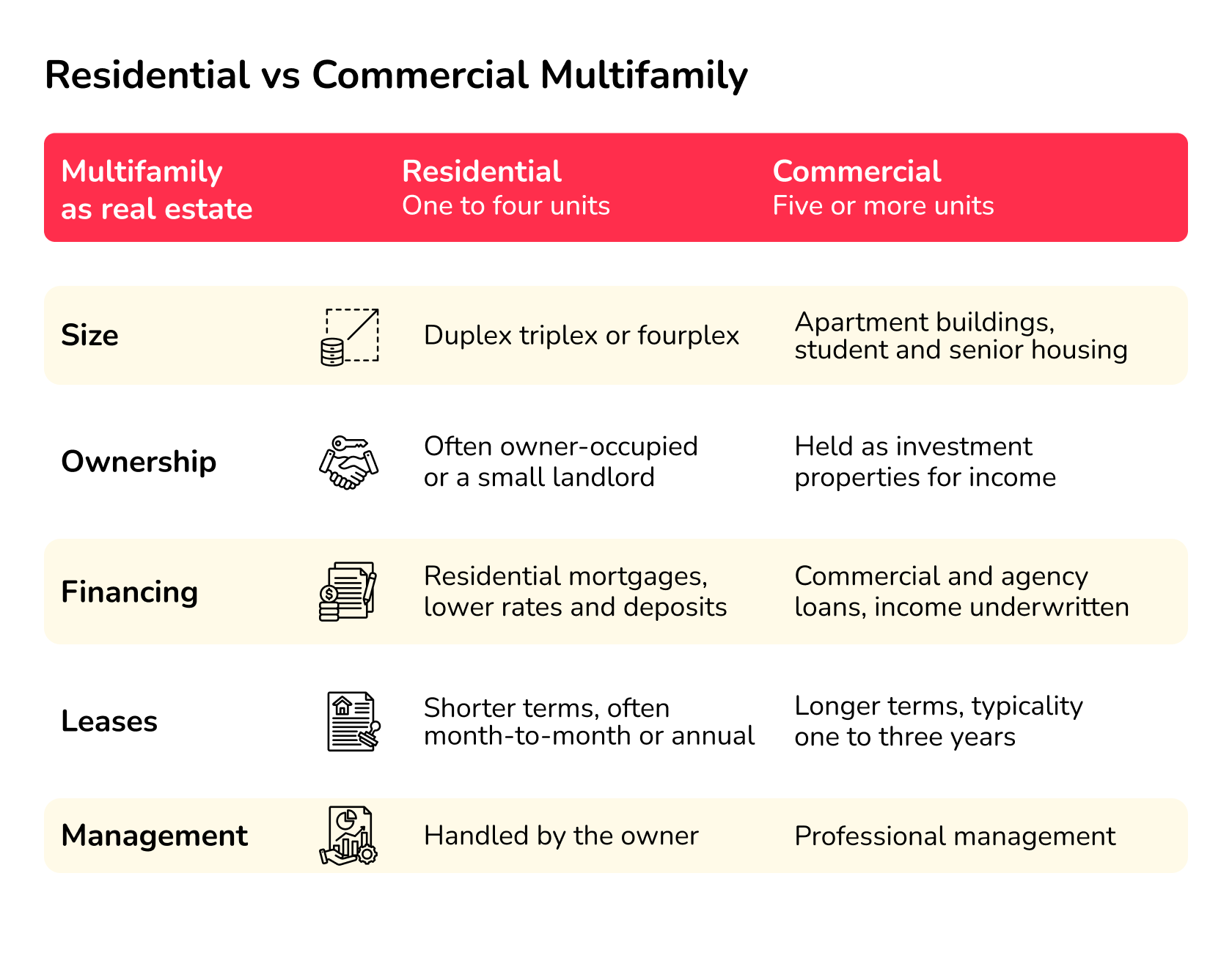
Yet, the type of building doesn’t matter as much as how the owner finances, leases, and manages the property.
A single-family home rented out is still residential real estate, however you hold it. A 40-unit apartment community is a commercial asset valued on the cash flow it produces, which is why lenders underwrite the rent roll before they underwrite you.
This helps to explain why investors move into commercial multifamily. While a residential property tracks what other similar homes sell for, commercial values go by their net operating income, so investors can increase the building’s worth by improving how it operates.
Is multifamily commercial real estate a good investment in 2026?
Multifamily is the strongest-performing major asset class in CRE this year, but there are certain factors to look out for when sizing up an investment.
1. Supply is finally thinning
The oversupply that flattened rent growth for three years is working its way through.
Annual supply dropped by 25% in 2025 to around 523,000 units, according to MMCG Invest data, which forecasts a further 36% contraction in 2026 to around 333,000: the lowest annual delivery total since 2014.
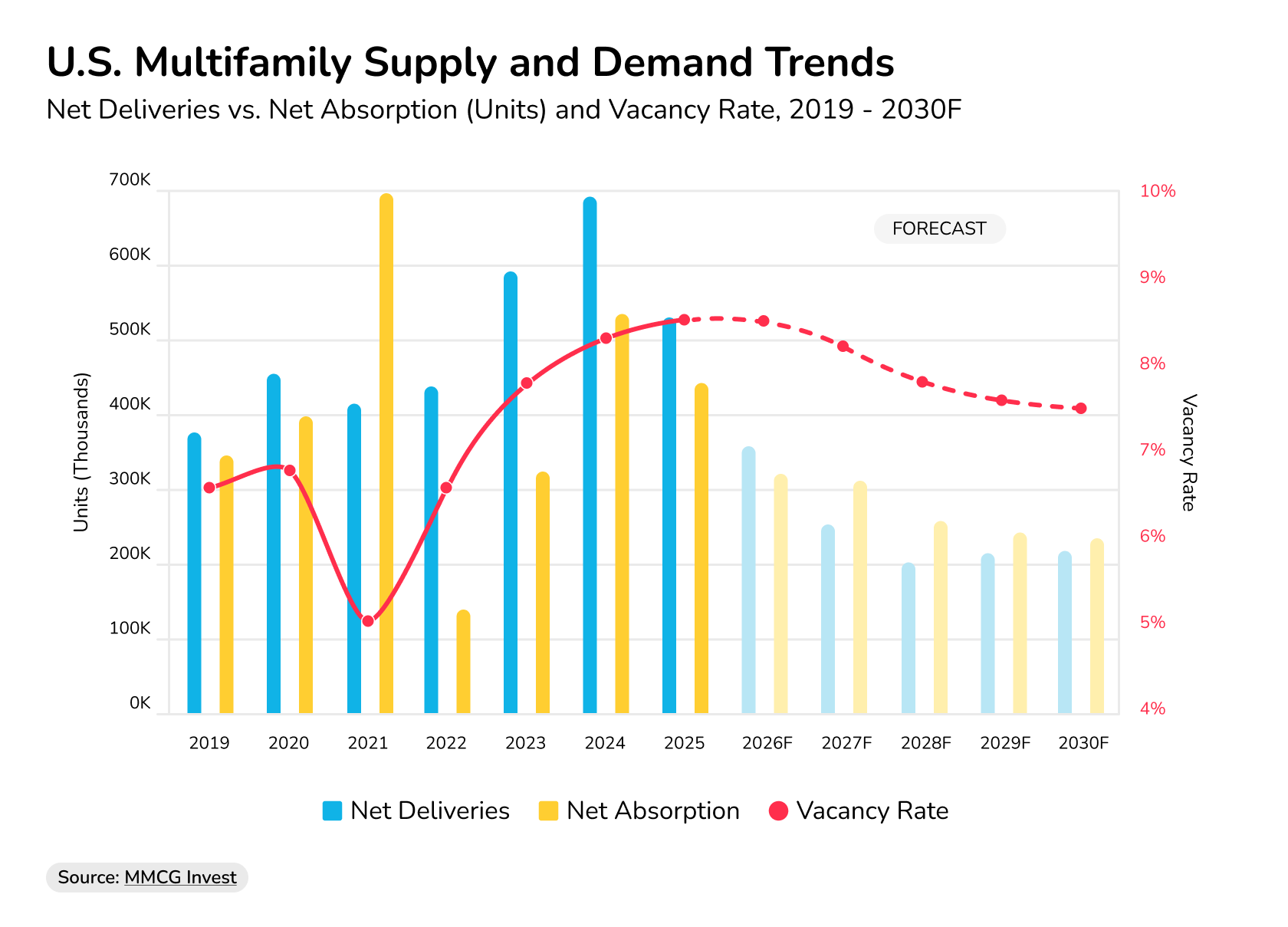
Source: MMCG Invest
The pipeline behind those numbers has more than halved. The number of units under construction dropped from approximately 1.18 million in Q1 2023 to roughly 579,000 by Q4 2025, according to the same report, with construction starts now at their lowest level in over a decade.
The pullback isn't uniform, however; Austin deliveries are projected to fall 47% in 2026 and Denver by more than half, while Miami and Charlotte still lead the country with over 8% of inventory under construction.
To add to this, construction costs are up around 39% since 2020, nearly double general inflation over the same period.
What this means for investors
The stats point to a simple takeaway: CRE bought now in markets with emptying pipelines are likely to face less competition by 2027. With the US needing millions of new apartments over the next decade, this could very well lead to a drastic undersupply in high-growth metros over the coming years.
2. Rent growth is slow nationally, but submarkets are key
On the face of it, national multifamily rent averages have looked concerning. Advertised rents rose just 0.2% year-over-year through November 2025 (MMCG), and CRE Daily report a forecast of a mere 1.2% growth this year.
Yet this is hiding two very different markets. While rents in oversupplied metros have fallen dramatically since 2023, such as Austin (14.2%) and Phoenix (9%), according to CRE Daily, undersupplied markets have gone the other way. New York is up 13% and Chicago 10.2%, for example.
CBRE reports similar from the demand side. They see strong performance in the New York tristate area, San Francisco’s Bay Area, and Orange County, CA, as the driving force behind a national rent recovery of 2.8% compound annual growth rate over the next five years.
What this means for investors
Anyone underwriting multifamily assets right now should bear two things in mind. First, rent growth is about submarkets rather than the national average. A 1.2% national forecast probably means very little when it comes to the building you’re assessing.
Second, today's numbers appear to be the trough rather than a long-term multi-family market trend. CBRE and Yardi Matrix both point to robust rent growth figures over the next few years, so if you’re underwriting now in a market where pipeline is emptying, you’re likely doing it at the bottom of the cycle.
3. Capital is back, and so is distress
You can’t win deals without capital, and there’s good news with multifamily credit.
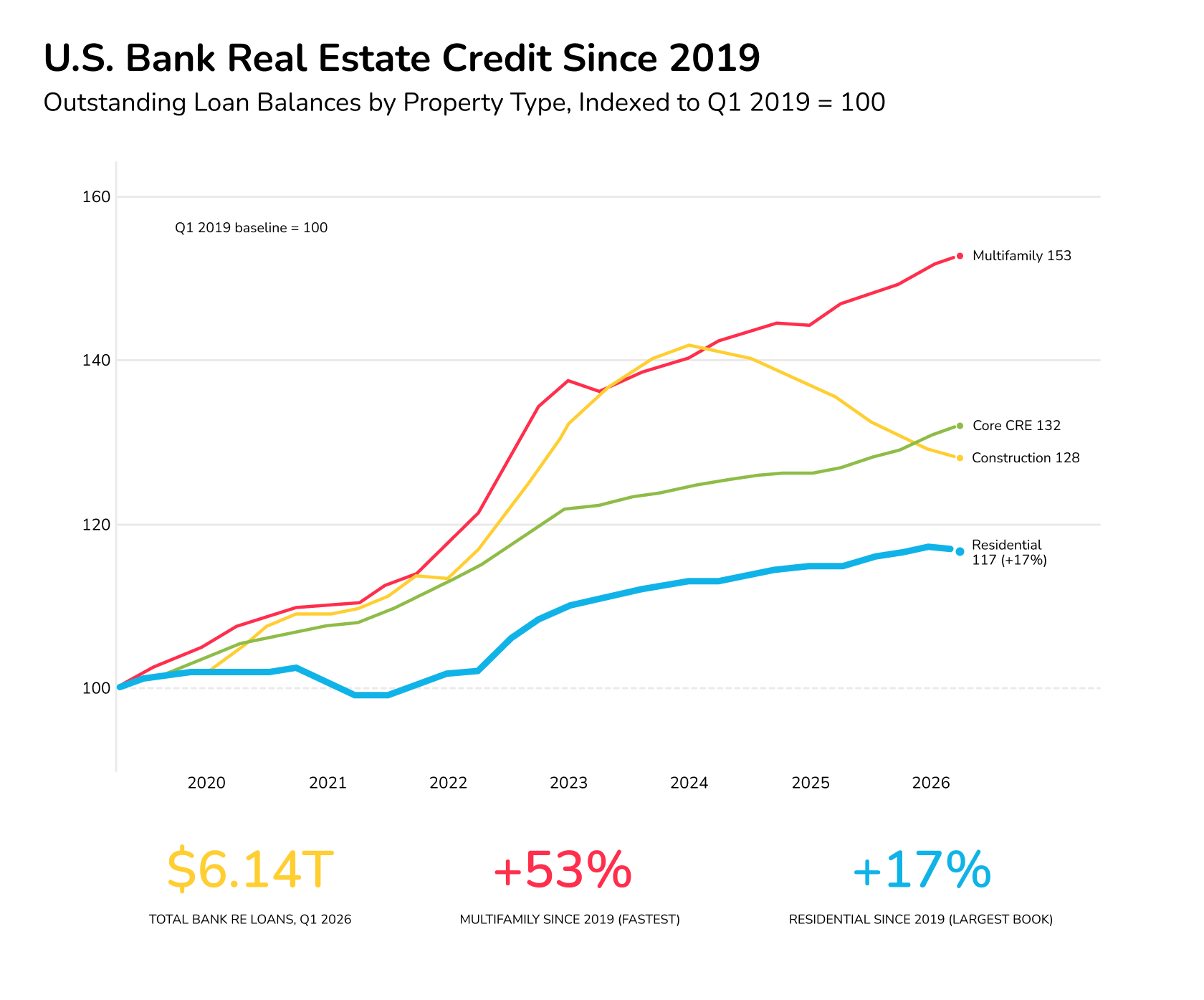
Banks grew their multifamily loan books to roughly $665 billion in Q1 of this year, up 4.1% on the year, according to Cred IQ, a CRE data firm. This is part of a 53% rise since 2019.
Apartment CMBS delinquencies, meanwhile, rose 28 basis points to 7.23% in June, up from 5.91% a year ago, with several large loans falling behind, according to Trepp, Inc. research.
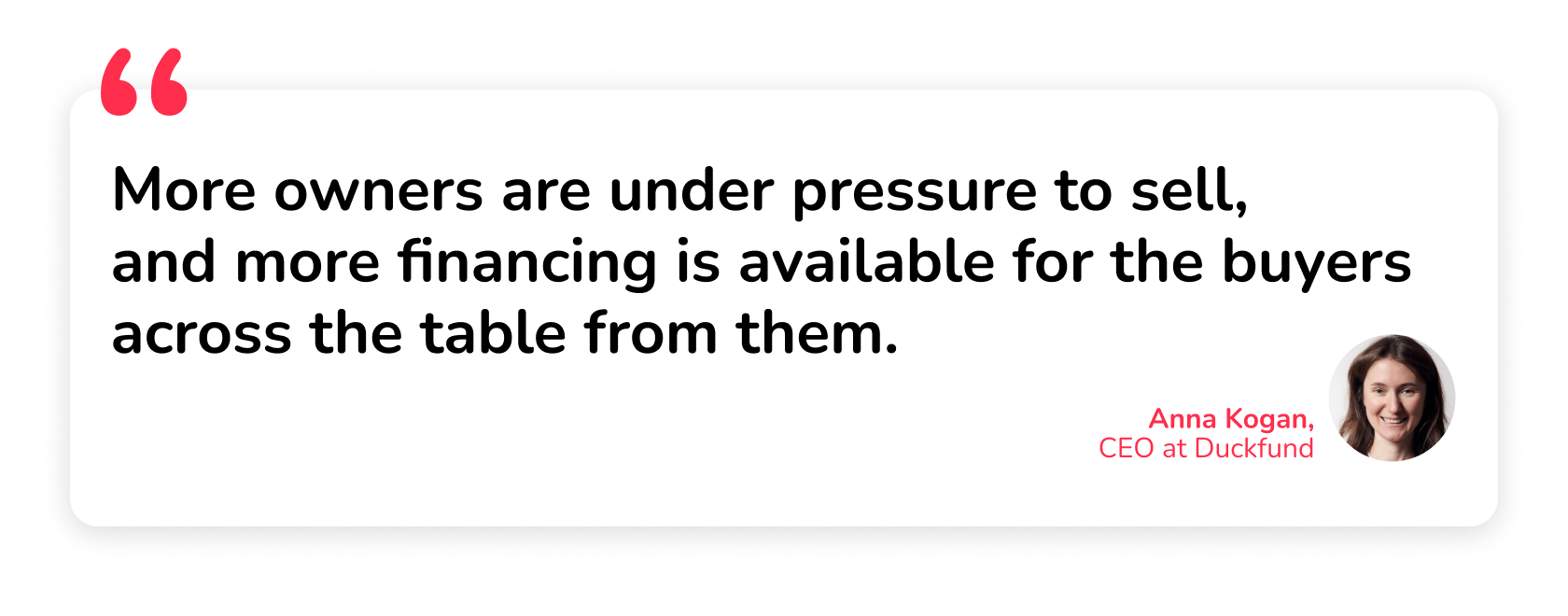
The two trends are connected, according to Anna Kogan, CEO of Duckfund. "Put those two things together and you get the setup that matters,” she observes. “More owners are under pressure to sell, and more financing is available for the buyers across the table from them. That combination usually rewards the buyers who are ready to move, and it tends to pass over the ones still waiting for the data to settle down."
What this means for investors and developers
More distressed owners and more available debt suggest a buyer’s market, but only for investors ready to act on it. Under-pressure sellers are more concerned with whether a deal will execute, rather than just the highest number on the paper.
]This is what can make or break a deal. If you have a financing lined up (including a strong earnest money deposit) and a shorter timeline, then you’re more likely to beat a buyer with a slightly higher price but who needs several weeks to arrange capital.
How to measure profitability: cap rates and NOI
As mentioned previously, real estate agents typically value commercial multifamily properties on the income they produce instead of what similar buildings have sold for.
They do this using the cap rate, which is net operating income (NOI) divided by property value X 100, but what is a good cap rate for commercial real estate?
Let’s take the example of a 50-unit apartment complex in Houston:
- Rental income: $500,000
- Operating expenses: $150,000
- NOI: $350,000
- Value: $5,600,000
- Cap rate: 6.25% ((350,000/5,600,000) X 100)
Multifamily cap rates have averaged 5.7% since mid-2025, according to MMCG, so 6.25% is a solid return. However, a high cap rate doesn’t necessarily mean a bargain – there are usually other factors at play, including a weaker submarket, higher vacancy, or deferred maintenance you'll inherit.
CBRE expects cap rates to hold steady in 2026 and compress after that, so should you buy at today's rates, you may pick up appreciation on top of cash flow.
How do you finance a multifamily commercial property in 2026?
Multifamily commercial financing has two stages. The acquisition loan, or mortgage, is seen as the finance that seals the deal, but deals often get lost before then because of a lack of earnest money that gets the property under contract.
Here’s a look at the options open at both stages for investors.
1. Multifamily commercial real estate loan options
- Agency debt (Fannie Mae and Freddie Mac). Seen as the default for stabilized assets, loan caps rose to $88 billion each for 2026, up more than 20% on the previous year.
- Banks and balance-sheet lenders. These are back in force after a quiet post-pandemic period, with many offering competitive terms.
- Bridge and debt funds. Here is where many value-add opportunities get financed. Multifamily bridge loans may be higher cost, but they offer faster execution and more flexibility on the business plan.
Yet multifamily underwriting is different from many other CRE asset types thanks to the lenders’ building income demands, including DSCR, rent roll quality, and occupancy history, before they underwrite you.
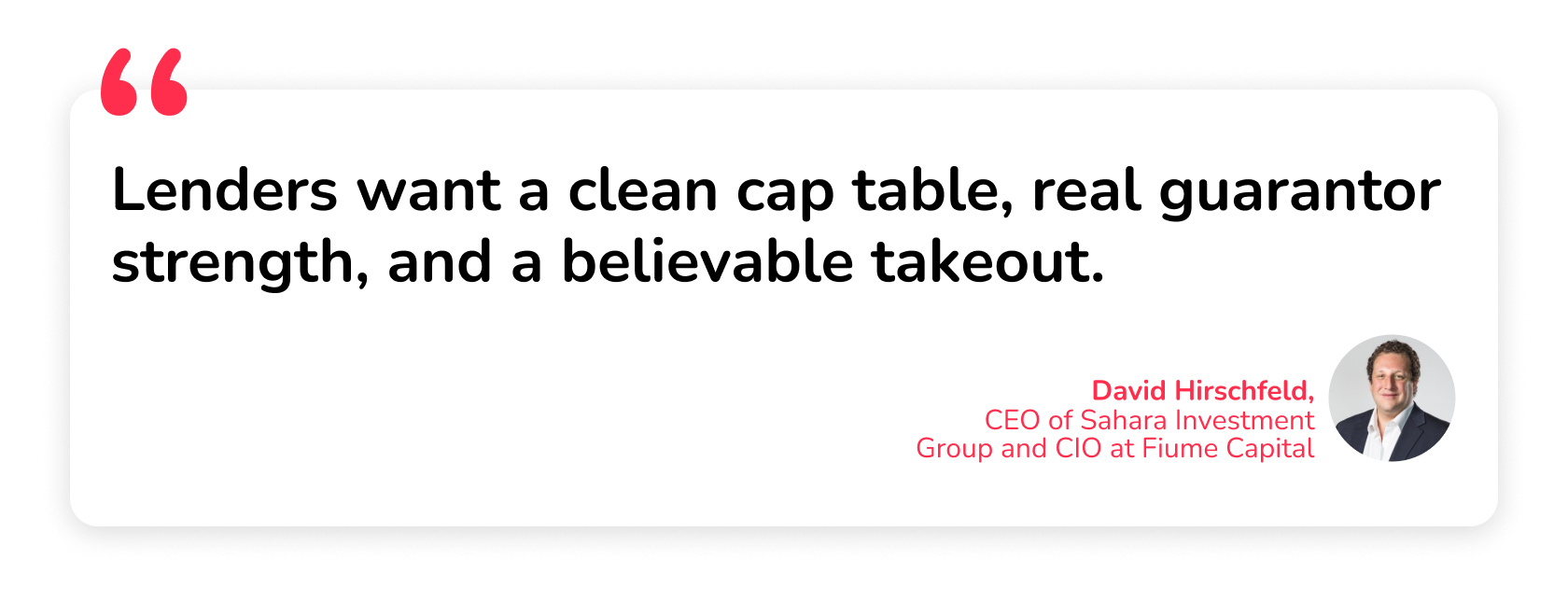
"Lenders want a clean cap table, real guarantor strength, and a believable takeout,” says David Hirschfeld, CEO of Sahara Investment Group and CIO at Fiume Capital, who has seen the approval filter move over the last 18 months. “They’re also looking for a refi or sale path that still works if cap rates move another 50 to 100 basis points."
His advice? Hand the lender everything up front instead of answering questions one at a time, including sources and uses, current debt schedule, lien search, insurance, tax status, and a capex table tied to actual bids.
Yet despite all this good work, none of the above funds the deposit, often a sizeable figure that’s due in days and can make or break a deal.
2. Earnest money deposits
For investors, earnest money in commercial real estate is the amount a seller demands to take a property off the market while you complete due diligence. This can be a lot of money.
Multifamily EMDs typically register at between 1% and 5% of the purchase price, but this can rise to as much as 10% in competitive markets if the seller knows there’s a high demand. This might mean a million dollars or more frozen in escrow while your acquisition loan drags through underwriting. It can’t fund soft costs or support a second deal, and it’s often due within days of agreeing terms.
Investors running multiple multifamily transactions at once feel this the most. Every live PSA ties up another six figures, and they often can’t guarantee execution to a willing seller, which can be a dealbreaker.
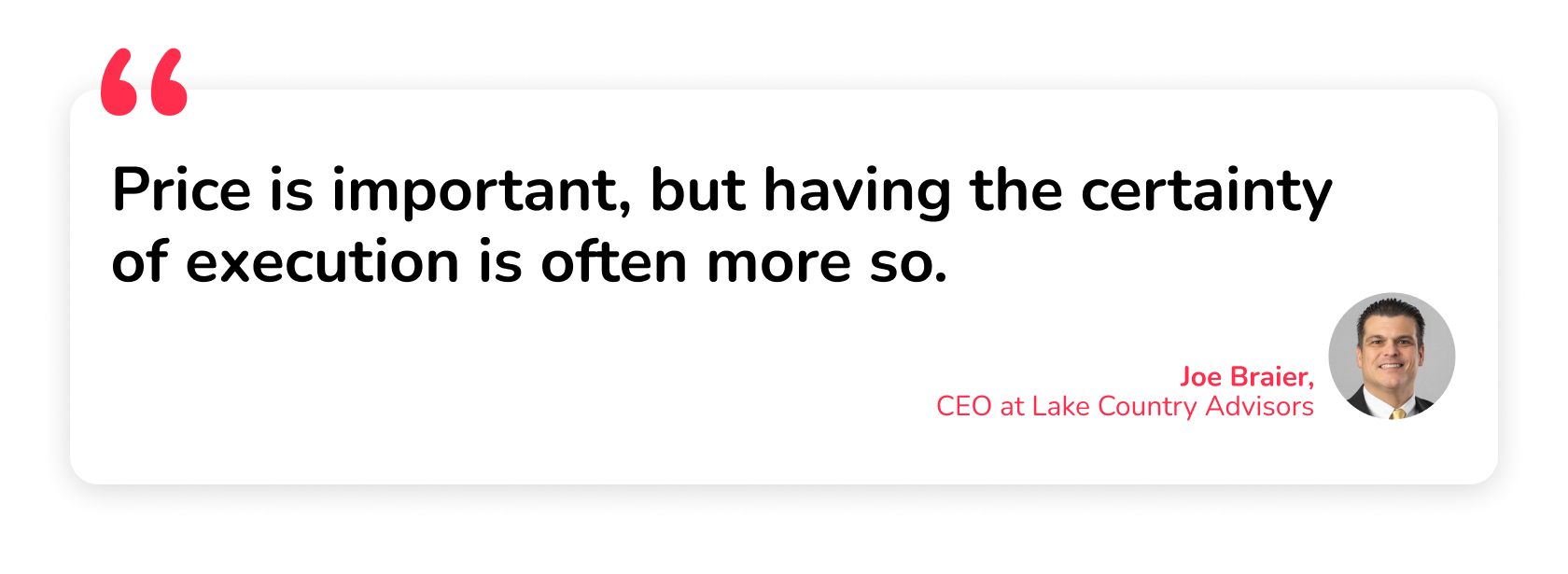
“Price is important, but having the certainty of execution is often more so,” says Joe Braier, CEO of Lake Country Advisors, specialists in commercial mergers and acquisitions. “Those that can deliver on the promises made to the seller will succeed over those that can't."
So, how do you deliver that certainty without freezing your own capital to do it?
How to close multifamily deals faster than the competition
Commercial real estate buyers are testing the multifamily investing market more than at any point since 2021, and with more competition for the best properties, the most successful investors are those ready to move on a property before the rest of the market has finished analyzing it.
Financing an EMD in real estate, rather than funding it yourself, is an excellent way to get leverage at the moment you need it most, and Duckfund is leading the way with EMD funding designed around how CRE deals actually move.
By financing your earnest money deposit through Duckfund, you secure the property under PSA without freezing a dollar of your own capital as well as:
- Approval in 24 hours, funds in escrow within 48 hours
- No collateral required
- The chance to work on multiple deals at once, with no cap on applications
- A fully refundable deposit, held in sole-order escrow for your benefit.
Fees are structured as LP soft costs and pass through at closing, with rates that decrease for larger deposits.
You can offer a larger deposit than you'd be comfortable committing yourself, which strengthens the offer on a competitive multifamily investment, and your cash stays available for the soft costs that stack up during predevelopment and value-add work: often the difference between holding one asset and building a portfolio.
Every deal you pass on because your capital is tied up in the last one is a deal someone else is closing. Multifamily rewards momentum: make sure yours isn't sitting in escrow.
Get your next EMD funded in 48 hours, no collateral required. Contact us to sign up for Duckfund and work on other deals while we help you close your multifamily investment.
Real Estate
Financing

- Approval within 24 hours
- Fund multiple properties at once
- No full deposit upfront — soft deposit only
- Apply in under 2 minutes
Secure your next commercial property acquisition — zero upfront capital required.
Start with Duckfund’s EMD financing program.- No capital commitment
- Close faster
- Scale with confidence