EMD Loans for Commercial Real Estate: How to Close More Deals Faster

Earnest money helps CRE sponsors jump on opportunities fast – but the catch is that cash meant to be put to work is then locked in escrow for months. EMD loans for commercial real estate solve exactly that liquidity problem, and Duckfund has become the go-to platform for sponsors who run into it repeatedly.
Duckfund has supported over $1.5 billion in acquisitions with a 65% client retention rate, funding deposits from $25,000 to $20 million across multifamily, industrial, and mixed-use deals.
If you're chasing acquisitions in today's market, you've probably already had situations where:
- CRE opportunities require a big deposit before your capital raise is even close to done
- Multiple deals land but you can only fund one deposit at a time
- Competing buyers move faster because they have more cash available
That's the gap an EMD loan is built to close. This guide is written for CRE investors and developers who need a faster way to secure the deal once the letter of intent turns into a signed contract.
We cover the what and how of EMD loans for commercial real estate, including:
- What Is an EMD Loan?
- How Do EMD Loans Work?
- EMD Loan vs. Bridge Loan vs. Hard Money Loan
- When an EMD Loan Is (or Isn't) the Right Fit
Looking for a fast and efficient earnest money loan in CRE? Contact Duckfund to find out how you can move quickly on investment opportunities.
Fund your next real estate deal
- Access fast financing
- Grow your real estate portfolio

What Is An EMD Loan?
An EMD loan for commercial real estate is short-term financing that covers a buyer's EMD in real estate. The loan is repaid or refunded at closing and exists purely to keep a buyer's own capital free while a deal moves through due diligence.
EMD financing in commercial real estate is an important creative financing tool because locking earnest money in multiple deals drains a sponsor’s capital quicker than buying distressed property ever could.
Earnest money in CRE differs sharply from what you’d pay in residential deals, where a deposit of 1% to 3% of the purchase price is typical. Commercial deals run much higher, where “your EMD can run 5-15% because sellers are taking property off the market for months while you do due diligence”, according to Joshua Katz, founder of Universal Tax Professionals.

On a $10 million property, a 15% deposit means parking $1.5 million in escrow before you've even started due diligence. That's a lot of money doing nothing when you want it working on your next deal.
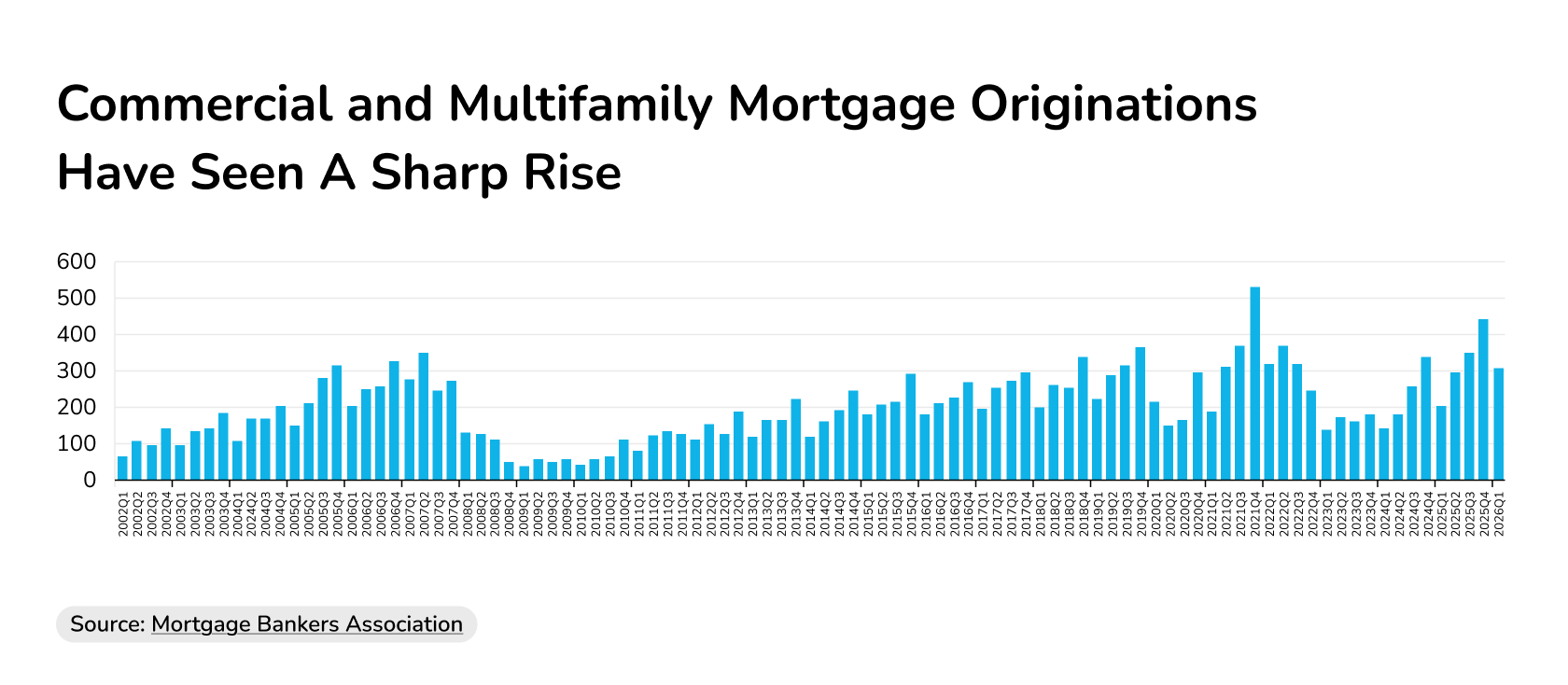
And the pool of sponsors raising capital and competing for those deals is only getting bigger. Commercial and multifamily mortgage originations jumped 52% year-over-year in Q1 2026, the sharpest growth rate in five years, according to Mortgage Bankers Association data.
More deals in motion means more commercial real estate investors racing for the same escrow deadlines, which is exactly why an earnest money loan in CRE has become such an unmissable financial tool.
Source: Mortgage Bankers Association
How Do EMD Loans Work?
An EMD loan works by having a specialist EMD lender for commercial real estate front the buyer's earnest money deposit directly to escrow.The lender is repaid at closing or when the deal falls through. Unlike other commercial real estate loans, the EMD financing process runs on the deal itself, not a credit check or collateral.
EMD lenders distinguish themselves on speed and timing. Speed because an EMD is only effective if it can be posted within days after the PSA is signed. Timing because a typical commercial due diligence period runs 30 to 90 days or beyond on complex deals. A financing structure priced for a 30-day bridge doesn't hold up over a 90-day one.
Duckfund built its EMD financing around that reality: pricing runs at a standard rate per month and can be extended at the same rate and with no additional setup fee, so a sponsor working through a longer inspection period isn't penalized for the deal simply taking the time it needs.
EMD loans for commercial real estate follow these five steps:
- Signed letter of intent
Once the letter of intent is signed and the buyer and seller have landed on headline terms, the buyer needs to post the earnest money deposit to keep the deal moving.
- Apply with the purchase agreement
The buyer submits the signed purchase contract, property details, and the loan amount needed. There's no personal credit pull here — a specialist EMD lender underwrites the deal itself, not the borrower's balance sheet.
- Approval and funding
Approval on a deal with strong underwriting can land within a few days. Duckfund reviews the real estate transaction, timeline, and escrow structure and issues most decisions within 24 hours. Funds are wired to the title company or closing attorney within 48 hours, making it one of the faster soft deposit providers available for CRE sponsors.
- Held in a third-party escrow account
The deposit sits with a neutral third party, often through an LLC structure set up specifically to pay earnest money online without exposing the sponsor's personal accounts. The buyer's own cash stays liquid while due diligence runs its 30-to-90-day course.
- Closing or refund
At closing, the buyer repays the loan from sale proceeds, or gets the deposit back if the deal exits during a contingency period. Either way, the sponsor's own capital was not frozen during due diligence.
Knowing how to borrow earnest money for commercial real estate is one thing. Knowing when an EMD loan is the right call is another. Let’s quickly compare EMD funding versus bridge loans or hard money loans, and when using which financing structure makes sense.
EMD Loan vs. Bridge Loan vs. Hard Money Loan
You now know how to secure earnest money deposits for commercial real estate quickly – but knowing when to pick an EMD loan over other loan structures is equally important.
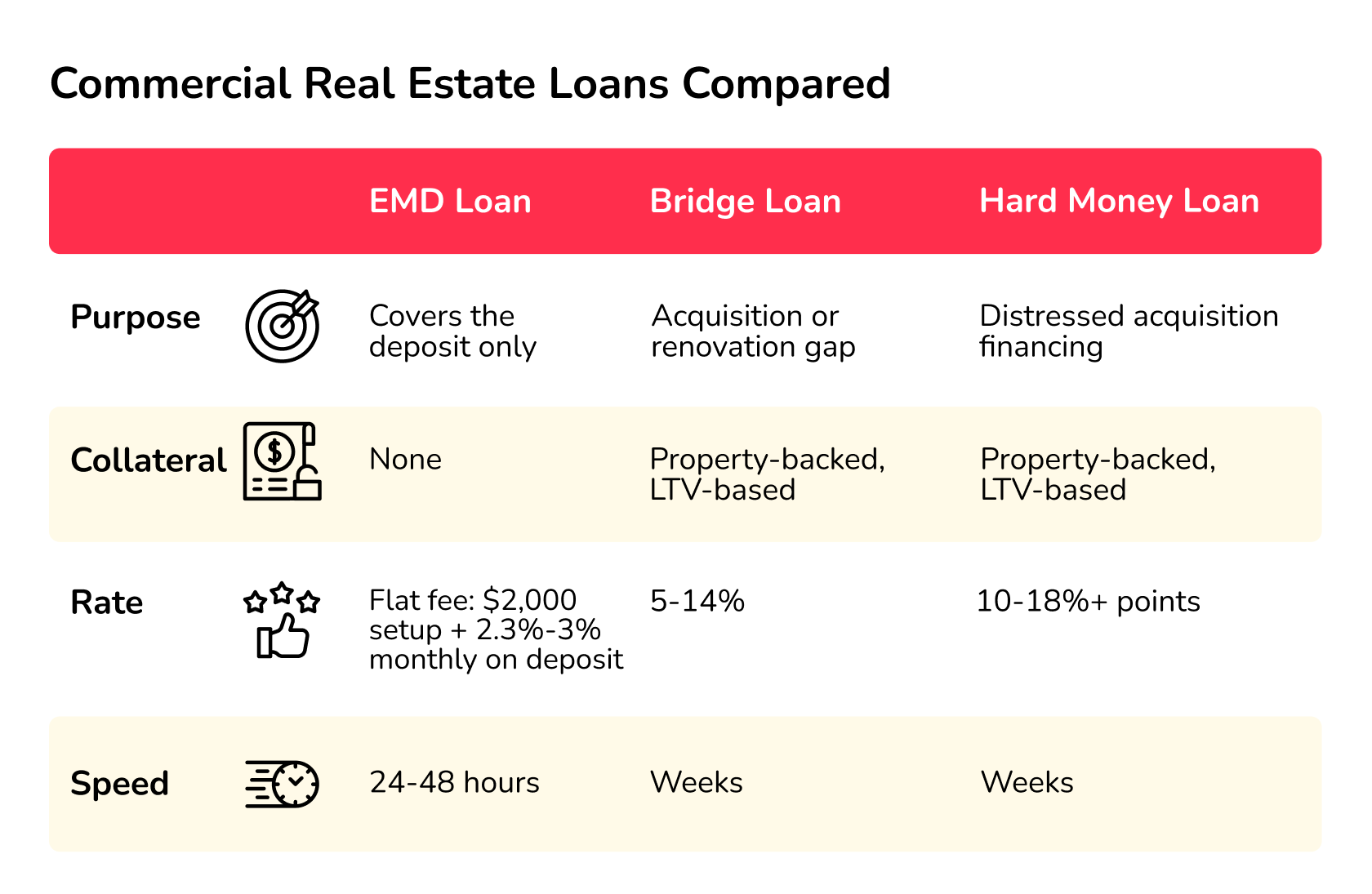
A soft deposit loan for commercial real estate covers only the earnest money, needs no collateral, and moves in 24 to 48 hours. Bridge loans and hard money loans work differently: both are asset-backed, both take weeks to close, and both are meant to fund (a portion of) the acquisition itself, not the deposit standing in front of it.
All three loans might come from private lenders, but there’s a real structural difference – and big cost gap. CRE bridge loans currently run 5% to 14%, and hard money lenders charge 10% to 18% interest rate plus points, legal fees, and appraisal costs that stack up fast when used as alternative financing solutions for CRE deposits.
A specialized EMD lender typically charges a flat fee, since it's pricing a shorter, narrower risk. Duckfund charges an average setup fee of $2,000 and a monthly premium of 2.3% to 3% of the deposit amount.
Gap funding can also fill financing shortfalls in a CRE deal, including the earnest money deposit itself – but it's a broader product covering closing costs, down payment gaps, or renovation overruns too. It’s not a purpose-built EMD tool, nor does it have the speed to match earnest money deposits.
When an EMD Loan Is (or Isn't) the Right Fit
An EMD loan earns its place in a sponsor's toolkit when speed and capital efficiency justify a small monthly fee. It's the wrong tool when the deal itself, not the financing, is the actual problem.
David Hirschfeld, Partner at Sahara Investment Group, frames the math simply: “Short-term EMD debt makes the most sense when your equity return profile on the acquisition itself is materially higher than the cost of that bridge capital. If your deal underwrites to a 20%+ IRR, the math is straightforward: borrow the deposit, preserve equity for construction draws or value-add capital where it actually moves the needle on returns.”
On competitive deals, Hirschfeld adds that “showing up with clean, committed capital while keeping dry powder intact is a real structural advantage over buyers who've tied up equity in deposits.”

But the case of using EMD loans for commercial real estate deals only holds up when the deal itself is sound. Tricia Watts, Founder of MaxNet Homes, pushes back on treating EMD debt as an automatic win: “Short-term EMD debt is not automatically better than deploying personal equity. If the deal has unresolved diligence risk, extra leverage can magnify a bad decision.”
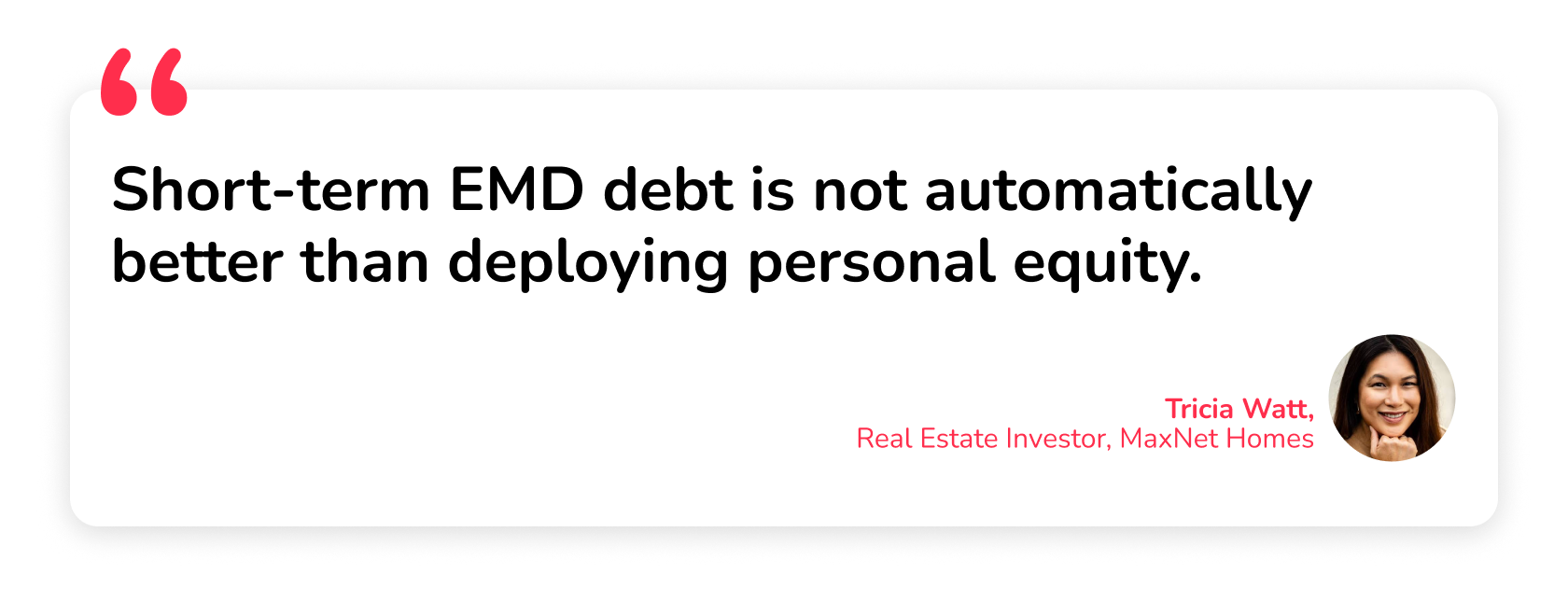
Her view is that borrowing the deposit “can improve competitive positioning when speed matters, but only if the buyer already has discipline around diligence timelines and exit triggers.”
Arthur Putzel, managing partner at CRE firm Trout Daniel & Associates, points to a specific failure point: "The non-refundable trigger is where I've seen experienced investors get burned.”
According to him, “The mistake isn't missing the date, it's accepting language that ties hard money to an event neither party fully controls. I always push to key critical dates off deliverables I control, not calendar days."

Below is a rundown of when an EMD loan is or isn’t the right fit for your commercial real estate deal.
4 Scenarios when an EMD loan fits:
- Multiple PSAs at once
You're a sponsor or syndicator chasing multiple deals and can't fund all deposits simultaneously - Competitive multifamily or industrial deals
When five offers land on the same asset, the buyer who posts the deposit first often wins - Distressed or off-market acquisitions
These sometimes require a deposit within 48 hours to beat other buyers to the table - Timing mismatches
Your equity closes in three weeks, but the deposit is due tomorrow
Speed and capital efficiency only help if the deal itself holds up. Before borrowing a deposit, three things need to check out:
Skip EMD funding when:
- Thin debt coverage
The debt service coverage (DSCR) and/or loan-to-value (LTV) ratio is too thin to absorb additional financing costs - Dilligence risks still open
Diligence risk is still unresolved and leverage would just magnify a bad call - Vague trigger language
The PSA's non-refundable trigger is tied to dates or events you don't control
The bottom line? Don’t double down with borrowed capital on a deal you’re unsure about. An EMD loan is meant to keep your liquidity flow between sound deals.
Duckfund's soft deposit financing keeps capital moving instead of parked, covering deposits from $25,000 up to $20 million with no collateral and no personal credit pull, since the underwriting runs on the deal itself.
Approval lands within 24 hours, with funds wired directly to escrow or the closing attorney within 48 hours. That means your next deal is never waiting on the last one to close.
Fund your next earnest money deposit without worrying about your cash flow. Apply for EMD financing with Duckfund and get funded within 24 hours.
Frequently Asked Questions
What's the fastest way to get earnest money deposit financing for commercial real estate?
A specialist EMD lender is fastest. Lenders like Duckfund approve within 24 hours and wire funds to escrow within 48, since they underwrite the deal instead of running a credit check on the borrower.
Do platforms exist that fund EMD without credit checks or collateral?
Yes. The best earnest money deposit providers like Duckfund skip personal credit checks and collateral entirely. They look at the purchase agreement, escrow structure, and deal timeline instead of the borrower's balance sheet.
Is an earnest money deposit refundable?
Usually, EMDs are refundable during the due diligence window. Once contingency deadlines pass and the deposit "goes hard," it typically becomes non-refundable.
What documents do I need to apply for an EMD loan?
Lenders generally ask for the signed purchase agreement, proof of the deposit amount required, entity formation documents if you're closing through an LLC, and basic deal timeline details.
Real Estate
Financing

- Approval within 24 hours
- Fund multiple properties at once
- No full deposit upfront — soft deposit only
- Apply in under 2 minutes
Secure your next commercial property acquisition — zero upfront capital required.
Start with Duckfund’s EMD financing program.- No capital commitment
- Close faster
- Scale with confidence