Multi-Family Development: 4 Challenges CRE Developers Often Face (and How to Capitalize on Them)
Intense competition among multi-family developers and shifting broader market forces mean that not every multi-family development leads to strong returns.
Facing the pressure of elevated interest rates and high construction costs, even seasoned CRE professionals can fall into common traps that undermine affordability and profitability in today’s commercial real estate sector.
Without smart decision-making, multi-family developers could:
- Miss rare opportunities to acquire or reposition properties due to inaccurate market analysis.
- Get bogged down in extended construction timelines from regulatory setbacks or inefficient project management.
- Face capital constraints that jeopardize project completion or force costly compromises.
Yet developers who know how to navigate today’s turbulent market conditions and adapt to new industry trends see strong returns – even as the commercial real estate landscape becomes more and more complex.
This article breaks down the four top challenges that CRE developers face in multi-family development and outlines proven, actionable strategies for avoiding those missteps.
Want to stay ahead of the competition? Read on to discover what separates top performers from the rest in multi-family development, and learn why the right strategies make all the difference.
[Secure CRE deals without tying up your capital. Duckfund provides fast and easy earnest money financing.]
Multi-family development in today’s market
Multi-family development is a cornerstone of commercial real estate growth. Demand for this robust CRE class is generally strong, because when aren’t people looking for rental housing, whether that be luxury or affordable housing?
So what is multi-family development again? Multi-family encompasses urban development projects that create multifamily residential buildings designed to house multiple separate units, such as apartment buildings, condominiums, duplexes, triplexes, and townhouses – all structured to accommodate more than one family under one roof or within one property complex.
Looking at the U.S. market, multi-family CRE sees completions peaking in 2025 and into 2026 before declining, investment consultancy Callan reports – a trend they see supported by a steep drop in U.S. apartment starts that began in late 2023. What does this mean for developers?
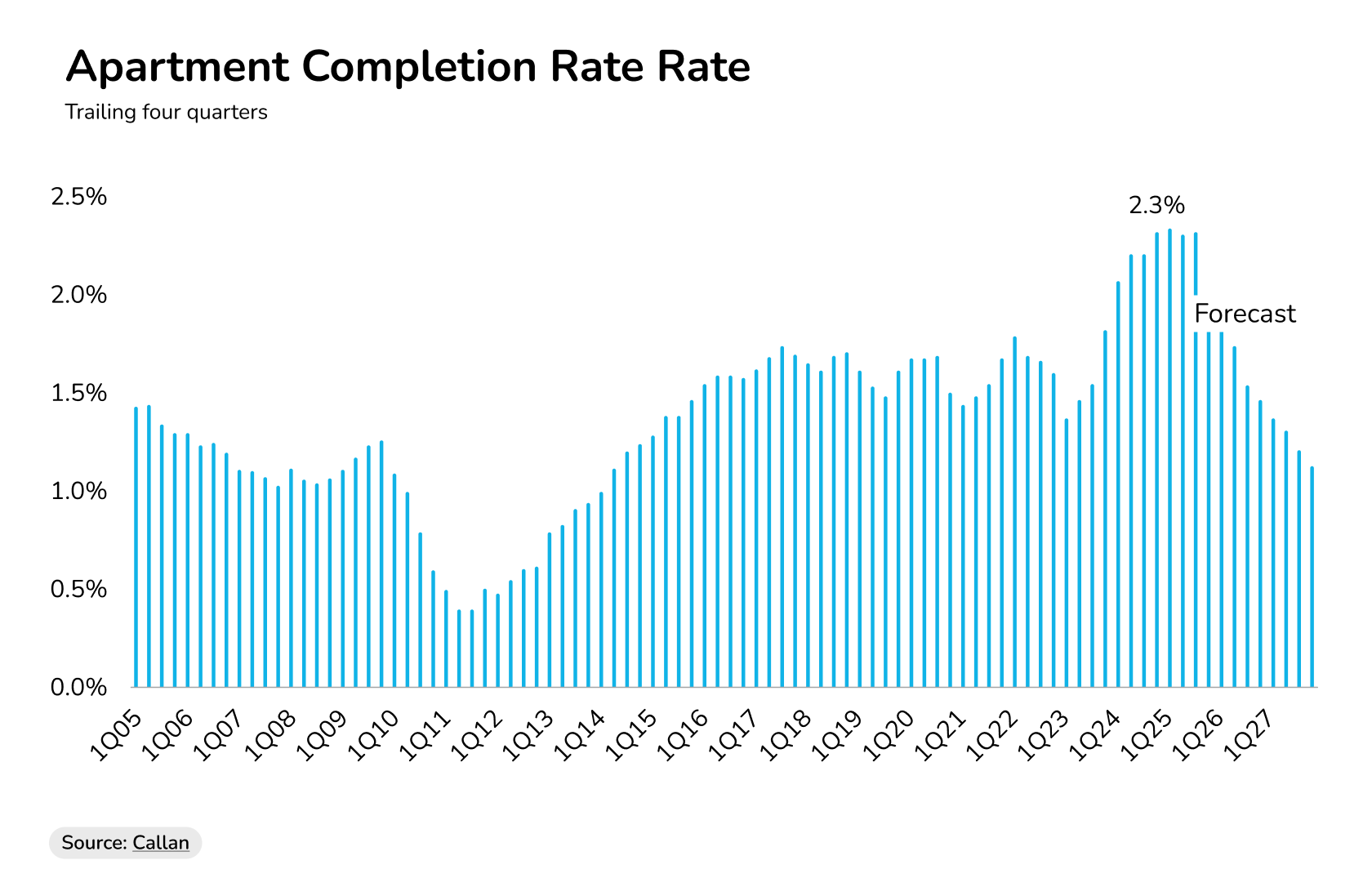
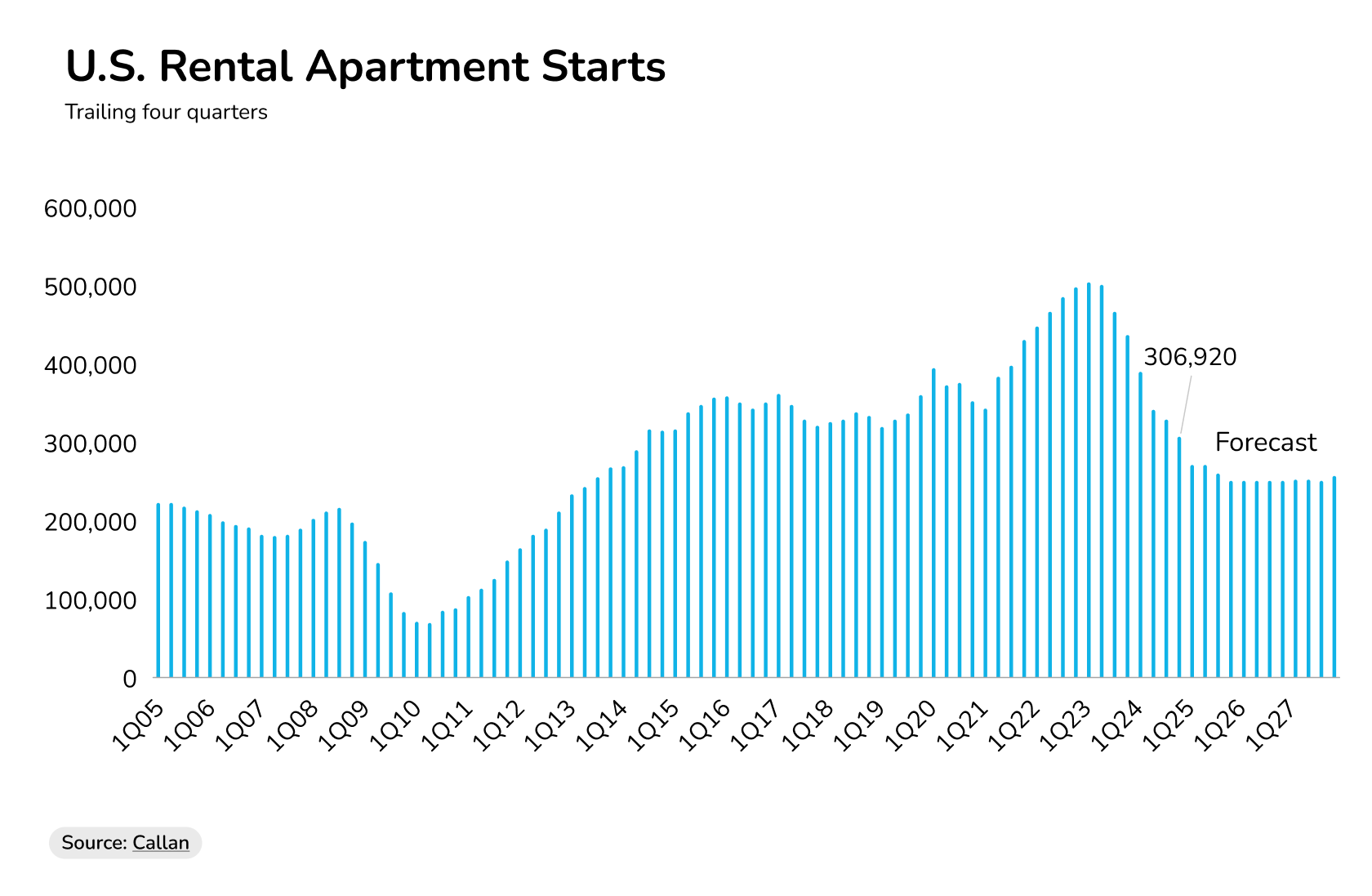
Source: Callan
Reflecting on this trend, Lee Everett described 2025 as “an inflection point for the multifamily market.” Everett, who is the EVP and Head of Research Strategy at multi-family development firm Cortland, emphasizes that “while the upcoming wave of completions offers growth opportunities, stakeholders need to remain vigilant about potential oversaturation and shifts in demand.”
Everett states, “Developers and investors who adapt strategically to these changes will be best positioned to capitalize on the market’s eventual recovery.”
.png)
That said, what are the biggest challenges developers face in this environment – and what are the best ways to avoid or, better yet, capitalize on the challenges ahead?
1. Market timing and local demand
With construction projects declining into 2027, understanding when and where to build is as critical as knowing what to build. Average vacancy rates in multifamily properties are expected to stabilize near 4.9% by the end of 2025, with modest annual rent growth projected at 2.6%, according to CBRE.
Yet local dynamics vary widely, with Sun Belt markets facing higher supply and competitive pressures, while some Northeast and Midwest cities show more balanced demand-supply fundamentals, J.P. Morgan reports.
Challenge #1: Skipping in-depth local demand analysis
A costly mistake rookie CRE developers tend to make is to rely on national or regional trend reports while ignoring local market signals. Think of neighborhood-level demographic shifts, rental absorption rates, and future infrastructure projects.
Developers that don’t take these crucial factors into account risk running into oversupply, poor occupancy, and missed rent growth. For example, entering a neighborhood with a shrinking retail presence can lower demand and, in turn, returns.
How to overcome this challenge
As a CRE developer, you should always conduct rigorous market timing and micro-location analysis. This includes integrating quantitative data – occupancy, rent growth trajectories, pipeline completions – with qualitative insights from local economic drivers, employment diversity, and community planning efforts.
What’s the median income? What kind of housing units are in demand? Low-income or luxury condos?
Don’t just focus on the numbers, but get in touch with local stakeholders to avoid overbuilt zones and identify small pockets of demand.
2. Zoning, permitting & regulations
Few hurdles cause as many headaches to unassuming developers as zoning and permitting. Lengthy approval processes, outdated zoning laws, and opaque bureaucracy all contribute to project delays and cost overruns.
Zoning boards apply strict rules to building height, density, setbacks, and parking requirements, often requiring special variances that entail public hearings and possible opposition.
A National Association of Home Builders (NAHB) report highlighted that multifamily developers face an average permitting delay of six to twelve months in many metros, with municipalities still catching up on modernizing code.
Challenge #2: Underestimating zoning and regulatory complexity
Not being fully aware of the complexity of these regulatory processes means risking long construction delays and costs that come with halted development projects.
Not securing these timely rezonings or variances can do more than stall your housing projects for months. In bureaucratic nightmare scenarios, developers have to abandon, alter, or drastically downsize planned developments.
How to overcome this challenge
Carefully review zoning maps, understand permitted uses, and prepare thorough, well-structured plans aligning with local requirements. In other words, make zoning rules work for you instead of against.
One way is to look for rezoning areas for Planned Unit Developments (PUDs). Are multi-family developments considered PUDs? They sure are, if you match the criteria and develop different types of multi-family units along with shared amenities and community spaces.
3. Borrowing and capital structure
Mirroring the broader market, the multi-family development sector is facing financial headwinds. Higher interest rates – though expected to slightly decrease later this year – and tighter requirements set by lenders put pressure on both borrowers seeking to refinance and new constructions.
On top of that, average cap rates for multifamily assets hovered around 4.75% to 5.2% in Q2 of 2025, according to news outlet CRE Daily, reflecting tight market conditions.
Challenge #3: Poor financial modeling and capital structure
It’s all too easy to do unrealistic cash flow projections and underestimate the stress that rising interest rates and costs can cause on your capital structure.
But between elevated interest rates and rising construction costs, misjudging your capital mix between debt and equity can kill cash flow or dilute control quickly.
How to overcome this challenge
As a multi-family developer, you should adopt conservative financial models that account for interest rate volatility, cost overruns, and delayed lease-ups.
Structuring a balanced capital stack – layering senior debt, mezzanine financing, and preferred vs common equity — is key to managing risk and optimizing returns.
Including buffers in proformas and collaborating with capital partners who offer flexible financing options such as soft deposits can provide the kind of financial resilience that is much needed in this market.
4. ESG, energy efficiency, and modern amenities
In 2025, ESG (Environmental, Social, and Governance) factors are not optional. It’s not even a matter of compliance. Instead, consider them a value driver in multifamily development.
Implementing ESG strategies in multi-family development and property management can lead to cheaper financing, tax credits, and lower operating expenses.
Challenge 4#: Ignoring ESG benefits
If your multi-family housing development ignores ESG and energy efficiency, you’re looking at higher operating costs, reduced asset valuations, and difficulty attracting increasingly demanding tenants.
Modern renters and homeowners want green features alongside lifestyle and wellness amenities. Properties without these upgrades can suffer from higher vacancy and turnover.
How to overcome this challenge
Successful multifamily real estate development and asset management start with embedding ESG principles into design and operations early on.
Invest in energy-efficient building systems, renewable energy, and smart technologies. Enhanced community and lifestyle amenities, like a gym and coworking lounges, drive tenant satisfaction and fetch premium rents.
This strategic approach turns compliance into a competitive advantage by lowering costs and boosting multi-family rental prices, aligning profitability with sustainability in an evolving market where premium multifamily projects are in high demand.
What is multi-family housing worth in today’s CRE market?
Thriving in today’s multi-family market isn’t easy. Overcoming the biggest challenges in multi-family development comes down to understanding what multi-family homes are generating demand and a steady return in the current market.
Whether you’re developing affordable housing or premium mixed-use urban development, developers need to first analyze the hyperlocal market.
Missing critical market signals, underestimating zoning or financing complexity, and ignoring ESG and amenities can easily lead to building unprofitable apartment complexes. Getting these factors right, on the other hand, creates high demand and puts a premium on rent.
Want to gain an extra edge over the competition? Smart CRE developers face today's market challenges with innovative financing solutions like Duckfund to stay agile and close land acquisitions in even the toughest markets.
[Duckfund's soft deposit financing solutions empower developers to act swiftly on land acquisition opportunities. Schedule a call with Duckfund now to discuss your project and financing needs.]
Real Estate
Financing

- Approval within 24 hours
- Fund multiple properties at once
- No full deposit upfront — soft deposit only
- Apply in under 2 minutes
Secure your next commercial property acquisition — zero upfront capital required.
Start with Duckfund’s EMD financing program.- No capital commitment
- Close faster
- Scale with confidence