Multifamily Bridge Loans in 2026: Top Benefits and Use Cases

Instead of waiting for interest rates to come down and traditional lenders to become less restrictive with long-term financing, smart investors are using alternative financing solutions to build a strong portfolio.
One of such solutions is multifamily bridge loans. The short-term financing they provide continues to help ambitious investors strike good deals while they plan long-term refinancing, property sales, or operational stability.
Strong rent growth, high occupancy rates, adoption of proptech, and expanded cap rates continue to make multifamily properties desirable, according to J.P. Morgan, a global financial firm.
“There's a huge demand here for multifamily and mixed-use properties, especially if you have a buy-and-hold, long-term strategy,” according to Robert Clippinger, CEO of Clippinger Investment Properties, a real estate investment firm in Los Angeles.
But the opportunities are not limited to Los Angeles or California. They are everywhere in the US.
In this article, we consider the benefits of multifamily bridge loans, how they operate, and how you can use them to build a profitable portfolio wherever you are in the US.
We’ll cover:
- How do multifamily bridge loans work in the US?
- What are the benefits of multifamily bridge loans?
- What are the multifamily bridge loan rates across the US?
- How can you use multifamily bridge loans in the US?
Do you want to take advantage of the opportunities in the multifamily CRE sector? Sign up or contact Duckfund to access the funding you need.
1. How do multifamily bridge loans work in the US?
There are at least four broad processes involved in a multifamily bridge loan: identifying a funding need, qualifying for multifamily bridge loans, applying for a multifamily bridge loan, and repaying a multifamily bridge loan.
We’ll cover each of them in more detail below:
Identifying a funding need
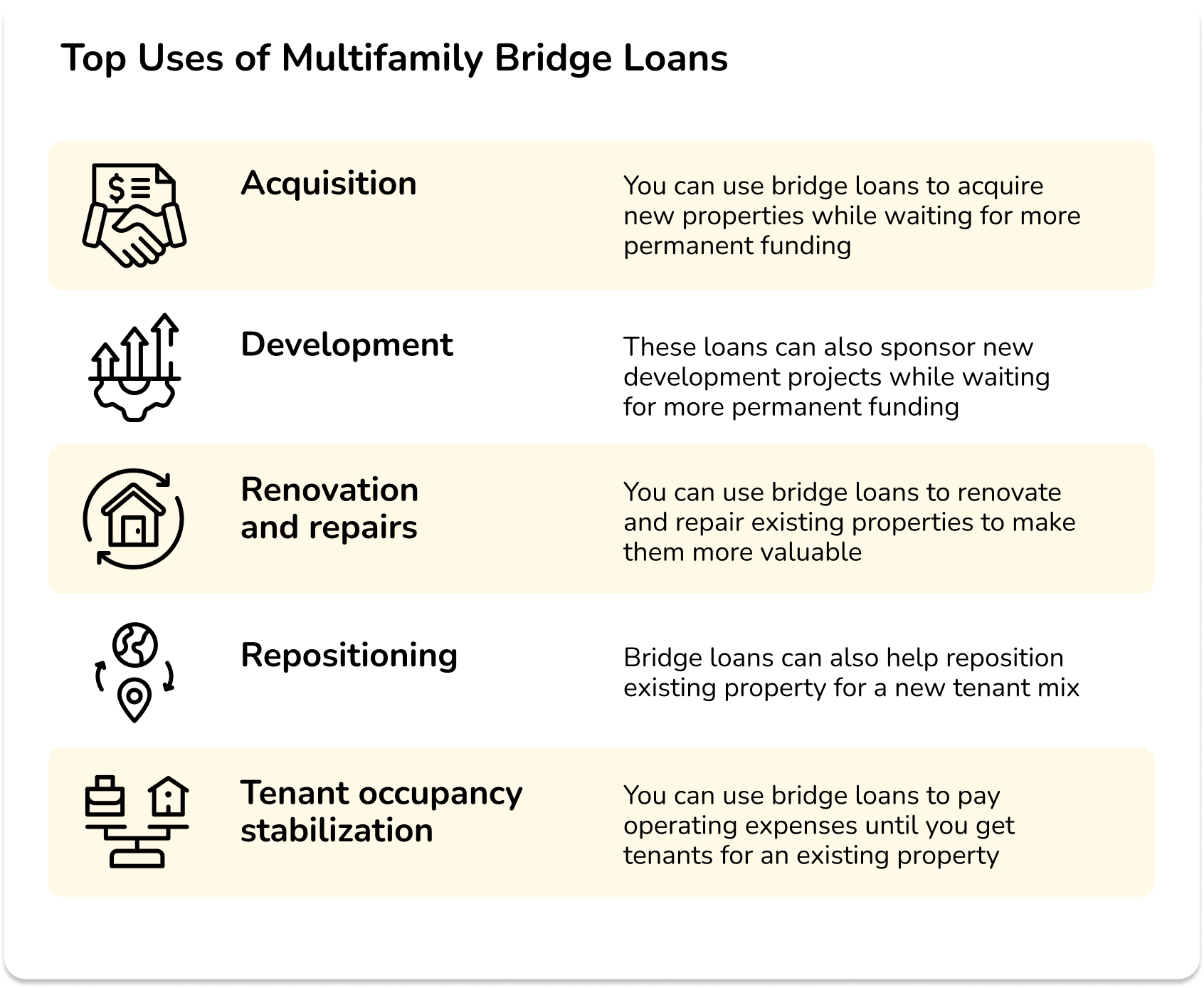
The use cases of commercial bridge loans for multifamily properties are numerous.
First, you can secure a multifamily bridge loan for a multifamily development or acquisition. Many commercial real estate lenders will give loans with up to 85% loan-to-cost (LTC) or loan-to-value (LTV).
Second, you can use commercial real estate bridge loans for repairs, renovations, and repositioning. In other words, you can use the funds to improve the value of a property you already own, thereby earning higher rents.
In this case, lenders usually base the loan amount on the property’s after-repair value (ARV) rather than its current value.
Third, you can use multifamily bridge loans for tenant occupancy stabilization. In other words, you can use the funding to meet operational needs while you look out for new tenants.
“Smart investors use multifamily bridge loans strategically to reposition assets, complete renovations or fill occupancy gaps without being locked into long-term debt too early,” according to Deepak Shukla, CEO of Pearl Lemon Properties.
Qualifying for multifamily bridge loans
Though bridge loans for multifamily properties are easier to get than mortgages from traditional banks, they are not a walk in the park.
For most underwriters, the most important criterion is your experience and track record with CRE in general and multifamily properties (apartment buildings, condominiums, and townhouses) in particular.
Also, credit rating is a consideration. Though it is not the most important criterion, it also helps to have a good credit score.
Furthermore, in the case of existing properties, lenders will request documents that show financial performance.
Regarding the loan amount, the important considerations are the commercial property’s value (which is the most important), current cash flow generation, and your net worth as the borrower.
Factors such as LTC, LTV, and debt service coverage ratio (DSCR) will also feature in the evaluation process.
Applying for a multifamily bridge loan
The turnaround time for a multifamily bridge loan is usually short, with many lenders releasing funds within 10 days.
Loan terms usually extend up to 12 or 24 months, with an average interest rate between 8% and 12%.
However, commercial real estate bridge loans can be very flexible, with terms like loan amount, interest rate, and repayment schedule negotiable. For example, you can negotiate a longer term for a higher interest rate or a shorter term for a lower interest rate.
Repaying a multifamily bridge loan
As the name implies, bridge loans are meant to be temporary financing that fill in the gap while you await more permanent funding.
Repayment is usually in the form of monthly interest payments (making it an interest-only loan) and a balloon payment at the end of the loan term. However, there are occasions where the lender can agree on full repayment (accumulated interest and principal) at the end of the loan term.
Borrowers usually rely on three financing sources for the balloon payment.
First, buy-and-hold investors will usually refinance the bridge loan with a mortgage from traditional or alternative lenders or by exploring SBA, FHA, HUD, Fannie Mae, or Freddie Mac loan programs.
Second, flippers will sell the property and repay the bridge loan from the proceeds.
Third, buy-and-hold investors can use equity injection, either from their pockets or other investors.
Interestingly, many lenders allow prepayments for bridge loans. That is, you can pay off the loan earlier than the maturity date. However, some lenders will charge prepayment penalties to compensate for the lost interest payments.
Given the scope of opportunities present, it makes sense for you to learn how to get a commercial loan for multifamily.
But why should you settle for bridge lending when there are other financing options?
2. What are the benefits of multifamily bridge loans?
Multifamily bridge loans provide flexibility, accessibility, quick funding, and value-add leverage.
“Multifamily bridge loans are flexible and fast, and allow investors to purchase properties faster or fill in the blanks in between until a long-term financing facility comes by,” according to Nick Heimlich, the owner of Nick Heimlich Law. “They best suit people who want to seek opportunities in a very competitive market, particularly when obtaining traditional loans may prove to be slow.”
We consider these benefits in turn:
- Flexibility: As we have seen, you can negotiate loan terms and design a customized solution that meets your needs.
Also, some bridge lenders will allow you to prepay the loan without penalty, while others will offer non-recourse bridge lending.
- Accessibility: Though a good credit score is a factor, it is not the ultimate consideration. If you tick all the right boxes (property value, investment experience, strong financials), you can get a bridge loan for multifamily properties even with an imperfect score.
- Quick funding: You can close a loan deal and get the required funds within 10 days. Some lenders will even provide them earlier.
“The biggest side benefit I see is speed,” according to Scott Bialek, Co-founder of Hurst Lending, a real estate financing company. “We closed a deal last month in Florida where the buyer needed to get a 12-unit property before a competitor swooped in. A traditional bank would have taken 60 days. We did it in two weeks with a bridge loan.”
Bridge loans can be a competitive advantage in markets where speed is crucial.
- Value-add leverage: You can get funds to conduct repairs, renovations, capital improvements, and repositioning. This allows you to increase the property’s value without diluting your equity. In other words, you can earn a higher return on investment (ROI) with bridge loans.
3. What are the multifamily bridge loan rates across the US?
You can expect an average multifamily bridge loan rate of 9-11% in the US, according to Private Capital Investors, a CRE lender. They also note that the interest rate on such loans is usually 2% above that of other loans.
“Typical bridge rates today range from 7% to 9%, depending on credit and property quality,” according to Shukla. “It’s higher than traditional mortgages, but worth it when time is the differentiator between winning or losing a deal.”
However, this national average figure will vary from state to state.
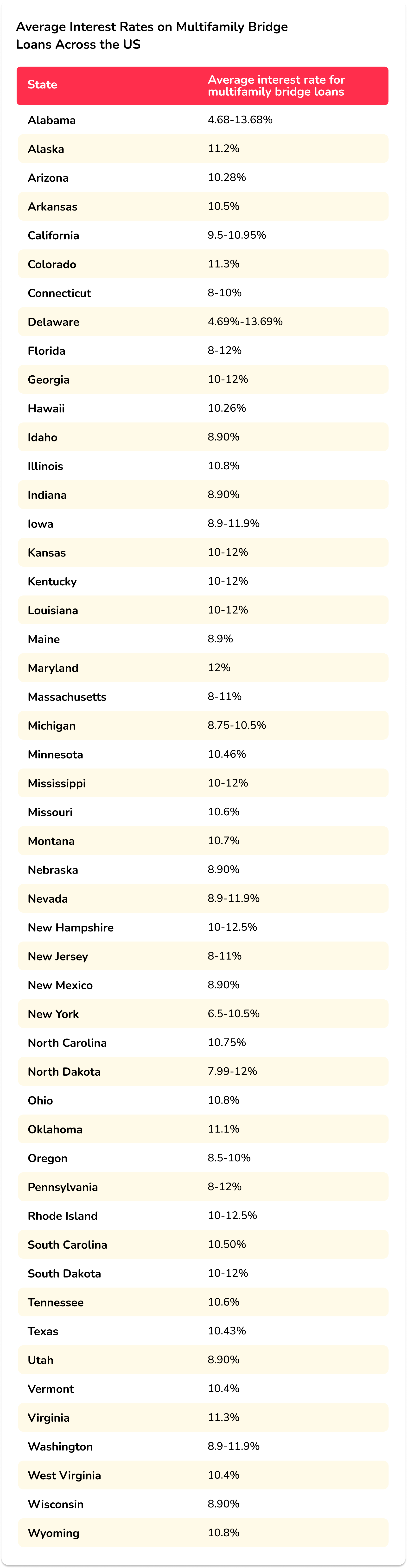
“Average rates are usually in the high single digits to low to mid tens, with higher rates in competitive markets such as California and lower rates in less competitive markets,” according to Heimlich. “Practical pricing is determined by leverage, length of the term, as well as the cost of capital to the lender.”
For example, bridge loans in Wisconsin have an average interest rate of 8.90%, while Connecticut bridge loans have an average interest rate of 8-10%. Also, bridge loans in Minnesota can go for an average interest rate of 10.46%, while bridge loans in Florida have interest rates between 8 and 12%.
In the chart below, we provide you with figures that are more reflective of each US state:
4. How can you use multifamily bridge loans in the US?
Smart investors have been using multifamily bridge loans to lock in good deals (new construction or property purchase) until they get more permanent financing.
Even flippers are using them to purchase new properties or improve old ones and sell for a profit.
With Duckfund, you can get loan products that serve both functions.
We offer senior debt financing of up to $500 million for 12-36 months, with up to 75% LTC and 70% LTV. You can use this money for development, pre-development, value-add, and redevelopment projects in multifamily, build-to-rent, industrial, and hospitality CRE sectors.
Our funding solutions are available in the Sunbelt and across major US states.
We also offer LP/co-GP and preferred equity financing solutions for 24-48 months, with 10-15% equity contribution demand. You can use these for the same projects and in the same CRE sectors as the senior debt financing.
Furthermore, we make it easy for you to quickly start the property inspection and negotiation process by providing timely soft deposit financing. You can complete an application in two minutes and get the funds to an escrow within 48 hours.
We provide soft deposit financing for multiple deals and allow you to propose higher amounts in competitive markets.
With Duckfund, you have a financing partner that will help you build a strong CRE portfolio, unencumbered by funding challenges.
Do you want to access quick and flexible financing solutions to take advantage of the opportunities in the multifamily sector? Sign up now with Duckfund for earnest money, debt, and equity financing in the Sunbelt and across major US states.
Takeaways
- Strong rent growth, high occupancy, and pricing flexibility make multifamily a good CRE sector for investors to explore opportunities.
- Multifamily bridge loans allow investors to act quickly without waiting for long-term funding or traditional lenders.
- Bridge financing enables acquisitions, new developments, renovations, repositioning, and lease-up strategies that increase ARV and ROI.
- Multifamily bridge loans provide important benefits such as flexibility, accessibility, quick funding, and value-add leverage.
Real Estate
Financing

- Approval within 24 hours
- Fund multiple properties at once
- No full deposit upfront — soft deposit only
- Apply in under 2 minutes
Secure your next commercial property acquisition — zero upfront capital required.
Start with Duckfund’s EMD financing program.- No capital commitment
- Close faster
- Scale with confidence