How Does Sale-Leaseback in Commercial Real Estate Work? Everything You Need to Know
Sale-leaseback in commercial real estate (CRE) is enjoying a revival right now as owners seek ways to unlock trapped equity within their portfolio, but the deal only works if both sides get the structure right.
If you’re involved in the CRE market and wish to explore a commercial sale-leaseback, you may not be sure:
- How a sale-leaseback deal is structured and what each side gets out of it
- What kind of risks come with such a transaction, such as giving up future appreciation as the seller, or the seller’s credit history if you’re the buyer
- How much capital you’d need as a buyer to cover you until the first rent check arrives.
Yet when done well, a leaseback puts equity back in the hands of the seller and gives the buyer a committed tenant, as well as minimal property management and the security of a triple-net lease.
Keep reading to find out how sale-leaseback transactions work, what a deal looks like in today’s market, and how to fund the acquisition without tying up your own capital.
We’ll cover:
- What is a sale-leaseback in commercial real estate?
- How does a commercial sale-leaseback work?
- Why sponsors use sale-leaseback for commercial property
- Sale-leaseback example: freeing $4.4M from a warehouse
- The buy side: what sale-leaseback investors need to close
- How Duckfund bridges the acquisition-stage gap
- FAQ
Buying a leaseback deal? Duckfund funds your earnest money deposit in 48 hours, with no collateral required. Contact us to talk through your deal, or sign up to get started.
Fund your next real estate deal
- Access fast financing
- Grow your real estate portfolio

What is a sale-leaseback in commercial real estate?
A sale-leaseback in commercial real estate is a transaction where the owner sells their commercial property to an investor and immediately leases it back on a long-term lease.
The seller becomes the tenant, the buyer becomes the landlord, and typically the day-to-day operations at the property stay the same.
You might hear people refer to it as a seller leaseback or a sale and leaseback, but they all mean the same thing. The purchase and the sale-leaseback agreement are signed at the same time, so the ownership changes while the occupancy stays the same.
Sale-leaseback in commercial real estate gained momentum in 2025 with an 18% rise in aggregate dollar volume, according to data from SLB Capital Advisors.
The study listed high demand from owners, strong merger and acquisition (M&A) activity, and competitive pricing as the key factors behind the rise.
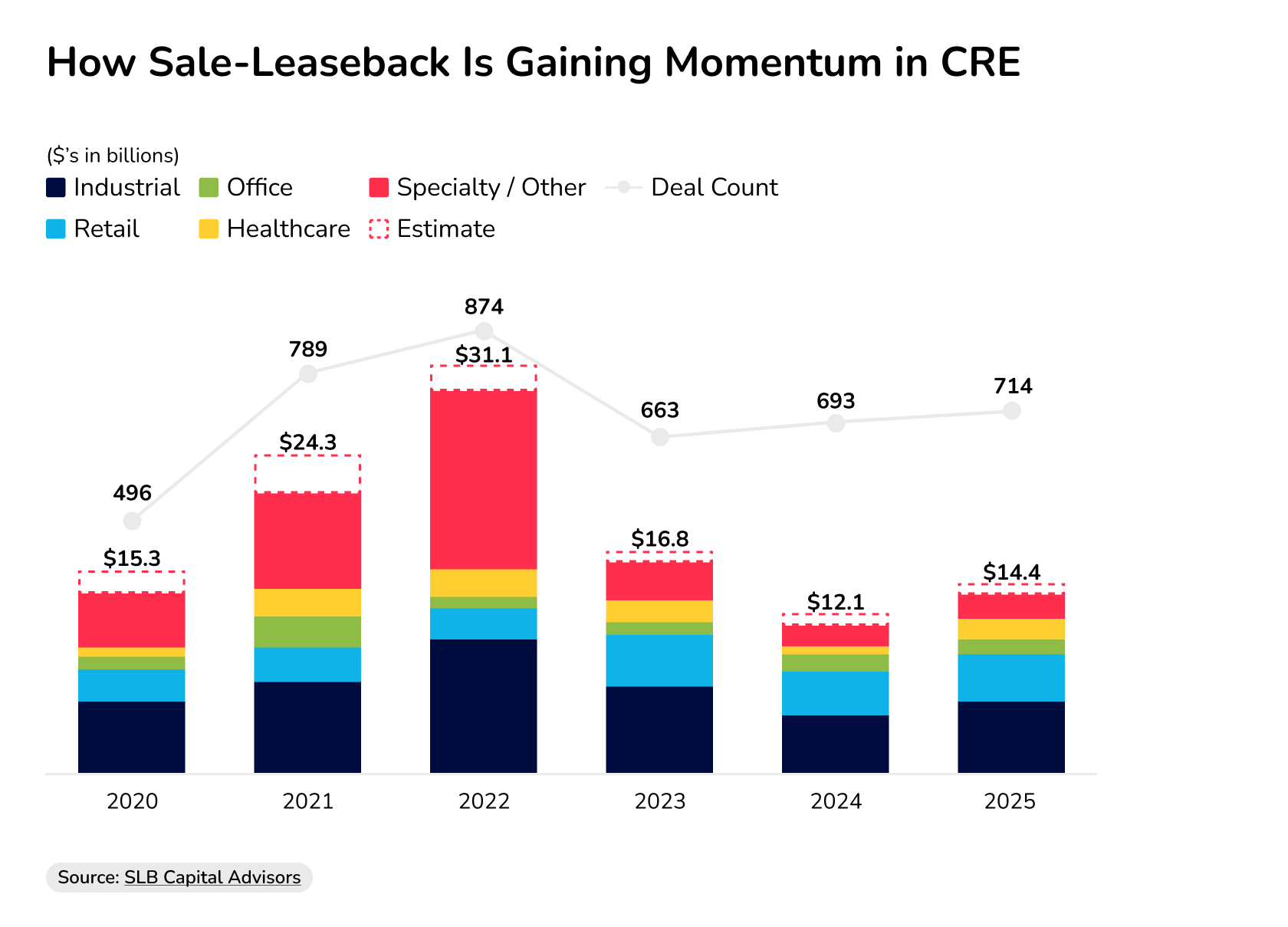
The data is encouraging to CRE investors looking to invest in industrial and retail property, both of which show promising figures, according to the data. However, many are unsure how such a deal works, which is what we’ll cover in the next section.
How does a commercial sale-leaseback work?
A sale-leaseback in commercial real estate typically follows the same three steps: valuing the property, structuring the lease, and closing the sale.
Let’s take a closer look at these in more detail.
1. Valuation
As an investor, you’re buying the property as an income stream, so the best way to price the deal is to use cap rates. This is the annual rent divided by the purchase price, and you should know what a good cap rate is for commercial real estate before you start negotiations.
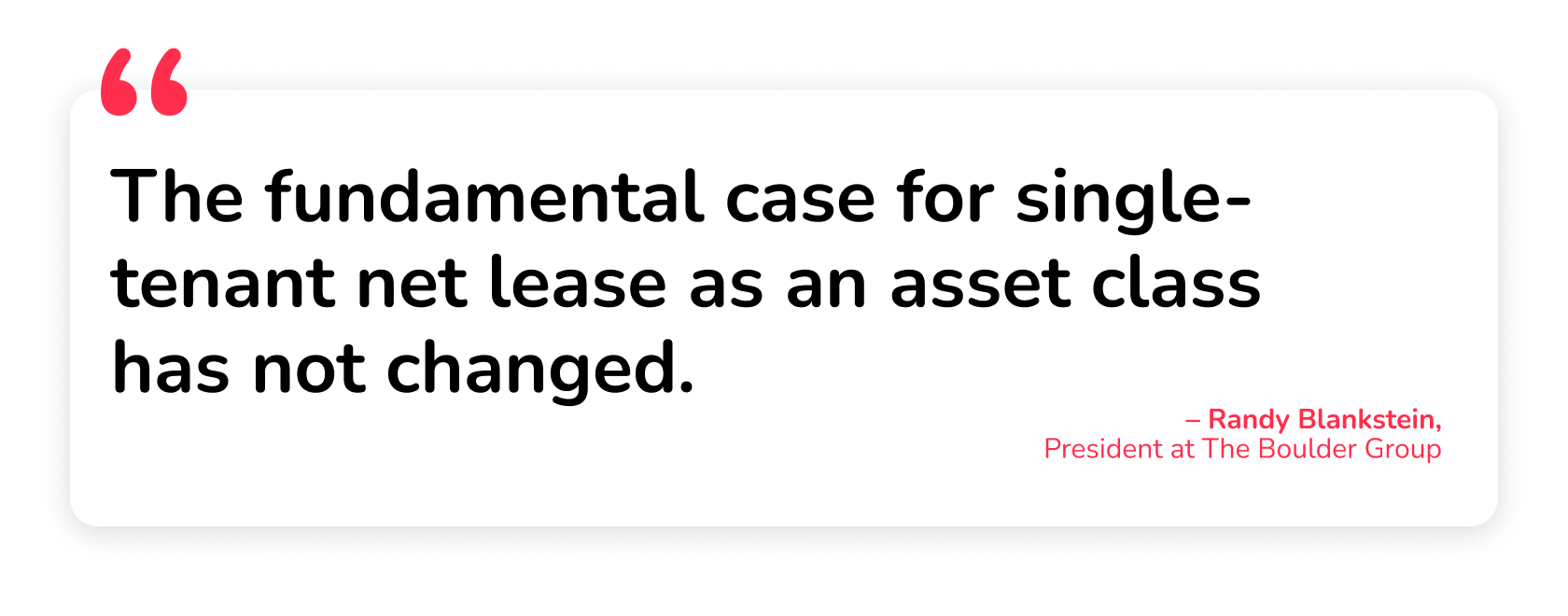
Those rates are under pressure. Randy Blankstein, president of The Boulder Group, says the Fed’s decision to drop its expected 2026 rate cut changes the calculus for net lease investors. Yet he’s clear on the bigger picture: “The fundamental case for single-tenant net lease as an asset class has not changed.”
The tenant’s creditworthiness is important here. A stronger tenant makes the rent more reliable and lowers the risk of default and leaving you with an empty building. This means you might accept a lower cap rate.
If you’re selling, this is your leverage: Clean financial statements that back up a solid credit profile mean you can command a higher price.
2. Lease structure
Most leasebacks use triple-net leases, also known as NNN leases. Here, the tenant pays rent plus property taxes, building insurance, and operating expenses. The plus side for the buyer? Potentially predictable net income with low property management.
Sellers will want terms that keep occupancy costs manageable, while the buyer will need to negotiate the lease to protect their income.
The key terms are:
- A 10- to 25-year term. The longer it is, the longer you lock in income, but only if the tenant’s credit holds up
- The rental rate related to the sale price. The higher the price, the higher the rent, but the buyer should be careful not to set it too far above the market rate, because they’ll struggle to re-lease it should the seller-tenant leave.
- Annual rental increases that are fixed or tied to the CPI. These protect the buyer's returns against inflation, while keeping the rent fair for the tenant.
- The renewal options, including extensions the tenant can trigger at their discretion. Sellers gain occupancy security, while buyers give up some flexibility to reposition or sell.
3. Closing
To close, both parties execute the sale and the lease agreement before the seller receives the proceeds. They must also pay off any existing mortgage or other borrowings.
Why sponsors use sale and leaseback commercial property
CRE sponsors might be seeing more opportunities right now, but they’re often held back by a lack of equity on hand to make a deal work. Instead, it sits trapped inside real estate assets they occupy or operate.
A sale-leaseback is the ideal mechanism for turning this fixed asset into cash without selling it or giving up operational control.
If you’re an investor in this situation, you may find this gives you three practical benefits.
1. New liquidity without the cost of debt
Unlocked commercial real estate equity can go into your next purchase, fund the working capital you need to scale operations, or simply pay down higher-rate loans.
A refinance also comes with higher costs, thanks to high interest rates and selective capital markets.
2. More liquidity on your balance sheet
You get to offload an illiquid building (often marked at well below market value) from your balance sheet and replace it with cash; cash your lenders and LPs want to see when you pitch your next deal. You also remove any associated mortgage or other lending from your liabilities.
The downside is that the lease appears as a liability under the ASC 842 rule, but many sponsors see this as a fair trade for extra liquidity.
3. Rent is tax-deductible
You can generally deduct rent as a business expense, but you also lose depreciation deductions on your building. A good tax advisor will tell you how to best handle this before you sign.
The trade-offs
A sale-leaseback means you must also absorb some hits to your long-term upside.
- You give up any future rise in property values.
- You commit to a long-term lease, and leaving early is expensive.
- The sale may trigger capital gains tax.
- Without renewal options, you lose control of the site when the lease ends.
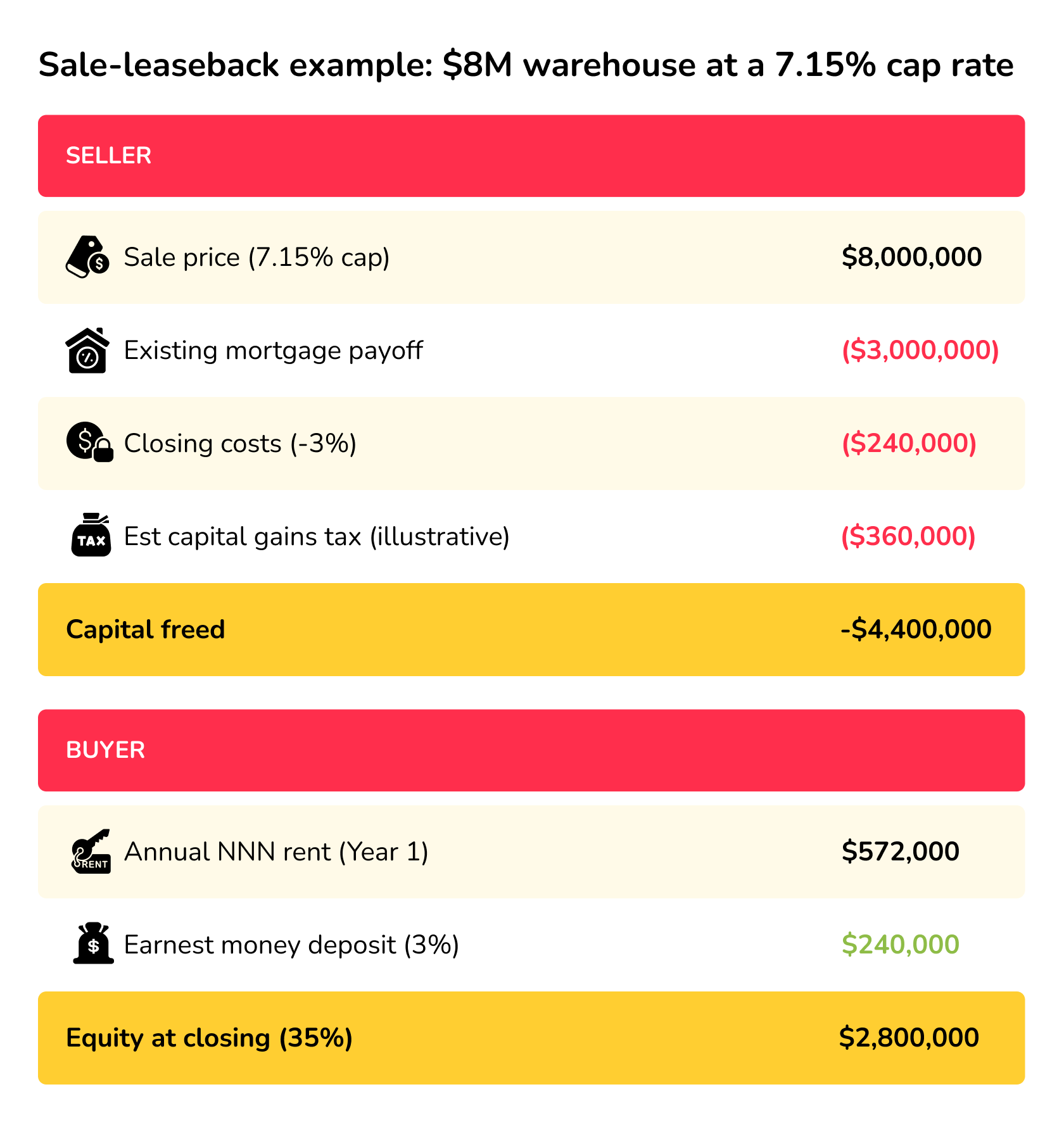
Sale-leaseback example: freeing $4.4M from a warehouse
A successful sale-leaseback brings benefits to both buying and selling parties, but putting a deal into real-world figures is the best way to show this.
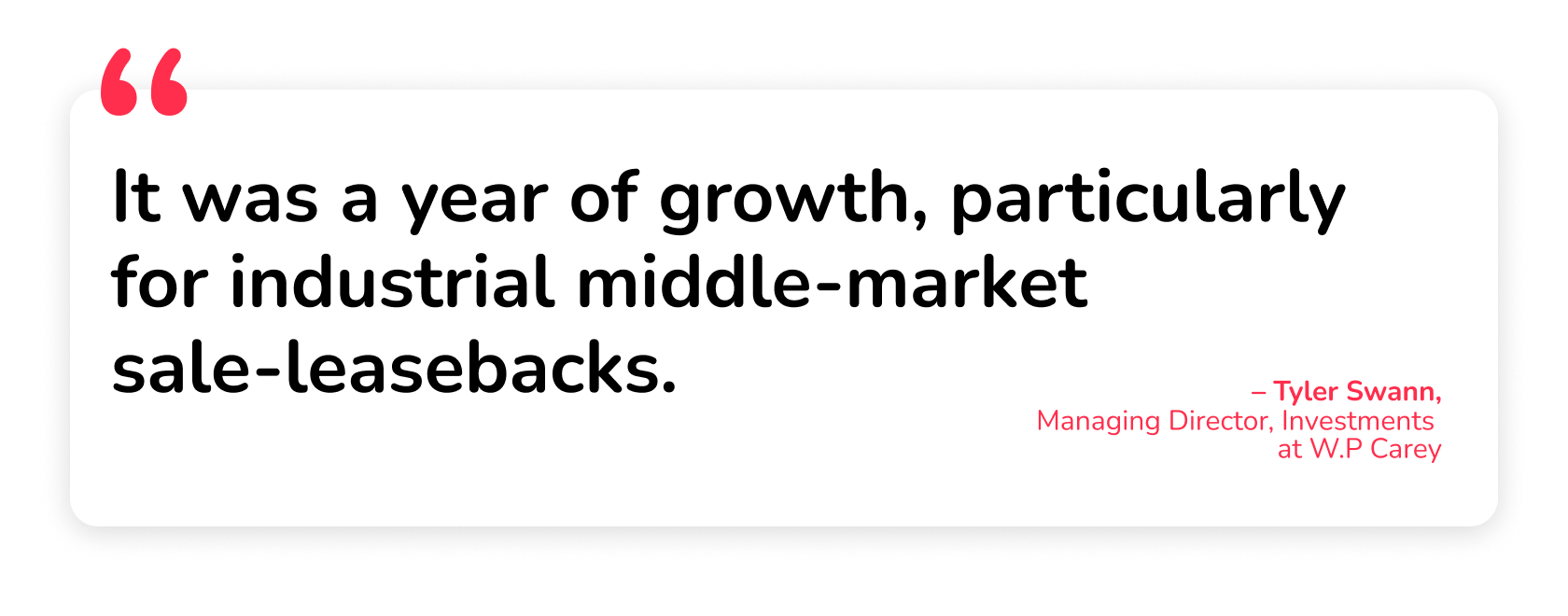
Industrial is a good place to start. “It was a year of growth, particularly for industrial middle-market sale-leasebacks,” says Tyler Swann, Managing Director, Investments, at W. P. Carey.
Let’s take the example of a sponsor who owns and operates a warehouse with a market value of $8M.
Industrial net lease cap rates averaged 7.15% in Q1 2026, according to The Boulder Group, so we can use this as a benchmark to see how the deal worked for both sides.
The buy side: What sale-leaseback investors need to close
A creditworthy tenant and a long-term NNN lease, while the tenant covers real estate taxes and insurance: the benefits for sale-leaseback investors are clear.
However, these upsides also make such deals competitive. A well-credited leaseback in today’s real estate market normally draws multiple bidders, many of whom are net lease REITs and institutional funds that can close quickly with cash to hand.
Putting down a larger earnest money deposit is increasingly becoming one of the most effective ways to stand out.
The key is timing. As a buyer, you must have the deposit, closing costs, and your equity ready before the first rent check comes in. If we take the example above, that’s $240K held in escrow through due diligence and $2.8M at closing.
If your capital is tied up in other deals, gap funding or deposit financing is the best way to bridge this difference.
Bridge the acquisition-stage gap with Duckfund
Like with most CRE deals, sale-leasebacks reward buyers who can move the fastest. Every minute you spend pulling your deposit together is an extra minute for your competitor to swoop in.
Duckfund knows how important it is to be ready for this scenario, which is why we fund your earnest money deposit in 48 hours.
This quick turnaround has helped our partners acquire over $1.5 billion of commercial property, and every deal comes with:
- No collateral, so you never pledge your assets to fund the deposit.
- Fully flexible and refundable EMDs that are held in a sole-order escrow account for your benefit.
- Room to scale so you can work on several leaseback bids at once without freezing cash in escrow.
Our fees are structured as LP soft costs, passed through at closing, with competitive rates that decrease for larger deposits.
Trust Duckfund to make that next leaseback deal yours,while your competitors are still waiting on their bank.
Sign up to Duckfund and lock in your next sale-leaseback before a competitor does, with no collateral and no frozen capital.
FAQs
1. Is a sale-leaseback in commercial property a good idea for the seller?
A sale-leaseback can be a great way to raise capital for commercial real estate deals you have on the horizon,but you should have the credit to support a long lease.
Owners that expect stronger appreciation or need to relocate in the next few years should probably look for other funding options.
2. Who pays property taxes in a sale-leaseback?
The tenant must pay property taxes, building insurance, and maintenance on top of rent, according to a triple-net lease. It is possible for modified gross leases to defer some of these costs to the landlord, so it always pays to check the lease agreement.
3. How long is a typical sale-leaseback lease?
The typical initial term is between 10 and 25 years, with renewal options of five years each.
4. Is rent tax-deductible after a sale-leaseback?
Generally, yes. You can usually deduct rent as a business expense; however, there are also downsides. As a seller, you have to give up depreciation deductions and may owe capital gains tax and depreciation recapture on the sale. It’s always wise to get tax advice on these matters.
5. Is a sale-leaseback treated as a loan for accounting purposes?
Under ASC 842, a qualifying sale removes the building from the seller’s books, and the lease is recorded as an operating lease. If the deal fails sale criteria, for example because of a seller repurchase option, it’s a “failed sale” and accounted for as a financing liability.
Real Estate
Financing

- Approval within 24 hours
- Fund multiple properties at once
- No full deposit upfront — soft deposit only
- Apply in under 2 minutes
Secure your next commercial property acquisition — zero upfront capital required.
Start with Duckfund’s EMD financing program.- No capital commitment
- Close faster
- Scale with confidence
