What Is a Good Cap Rate for Commercial Real Estate? The Key to Great CRE

What is a good cap rate for commercial real estate (CRE)?
Investors keen to make an impact in a competitive CRE market must know the answer to this question.
A cap (capitalization) rate is one of the fastest ways to size up a commercial real estate deal – but in 2025’s uncertain market, knowing what qualifies as a “good” cap rate is more important than ever.
If you’re in this position, then today’s cap rate benchmarks aren’t what they were a few years ago. Higher interest rates, shifting demand, and wide performance gaps between asset classes are all muddying the water when you calculate cap rate estimates.
This guide cuts through the noise to help you understand what is a good cap rate for commercial real estate, what’s driving this metric, and where it’s trending across different CRE property types.
Read on to find out how to use the cap rate – alongside other key metrics – to make smarter investment decisions.
Want to snap up great commercial real estate? You’ll need to know more than the cap rate. Contact Duckfund to find out how we can help you make your next project a success.
Table of contents:
- What is the cap rate in commercial real estate?
- What is a good cap rate for commercial real estate?
- How is the cap rate calculated?
- The 5 factors influencing a commercial real estate cap rate
- How to use cap rates in your investment strategy
What is cap rate in commercial real estate?
The cap rate meaning in real estate eludes a surprising number of investors.
Cap rate, short for capitalization rate, is a key metric used to measure the potential return on a commercial real estate investment.
As an investor or developer, the cap rate gives you a fast, “apples-to-apples” way to compare income-producing properties. Knowing it will help you:
- Assess the risk of your investment
- Benchmark a property’s performance
- Determine whether a deal will get you the return you’re seeking
In short: if you’re in CRE, the cap rate is one number you can’t afford to ignore.
Fund your next real estate deal
- Access fast financing
- Grow your real estate portfolio

What is a good cap rate for commercial real estate?
There’s no one-size-fits-all answer to what a “good” cap rate is.
This depends on the type of property, location, asset class, and overall market conditions. But here’s where things stand in 2025:
By asset class (2025 averages)
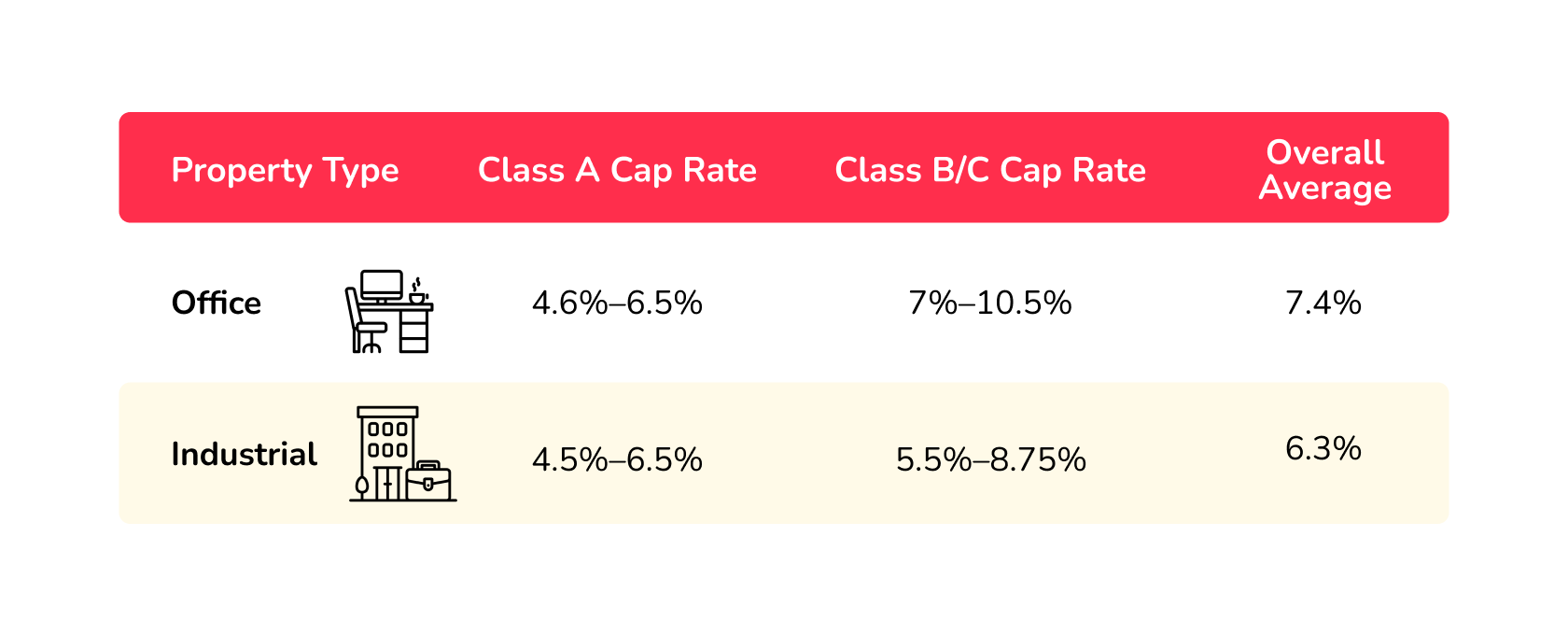
For Prime (Class A) assets, cap rates typically fall between 4.5% and 6.5%, according to CRE Daily, a respected real estate publication.
Think of valuable manufacturing buildings in the industrial real estate market or office buildings in top-tier business markets.
For suburban office / Class B and C industrial properties, you can expect higher cap rates around 7% to just under 9 %, reflecting more uncertainty or less desirable locations.
By asset type
The type of CRE asset also affects the typical cap value.
In early to mid-2025, office properties are averaging around 7.7%, according to Savills, which is a reflection of softer demand and higher vacancy risk. They have also loosely tracked interest rates since early 2019.
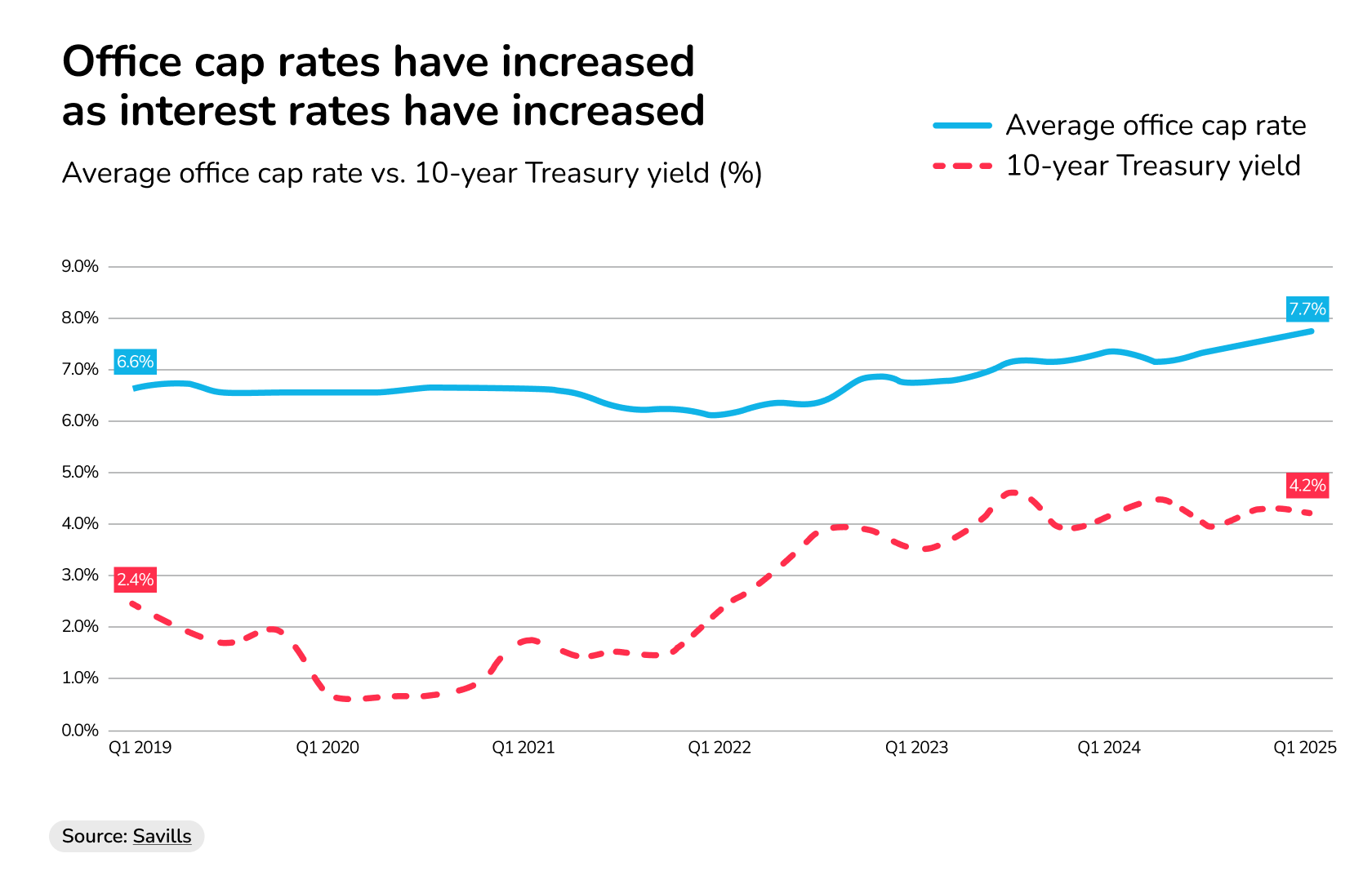
Source: Savills
Industrial and logistics assets, known for steady income, typically trade between 5.0% and 7.5%, with Class A properties at the tighter end.
Here’s a summary of office and industrial property cap rate averages.
- Lower cap rates (4.5%–6%) = these are safer, in-demand locations with stable tenants. They have a lower return, but less volatility.
- Higher cap rates (7%–10%+) = these are more risky, and are often tied to operational complexity or weak demand, but with potentially bigger upside.
In today’s market, 5%–7.5% is a reasonable target cap rate for many U.S. CRE investors. Just make sure it aligns with your risk profile, asset strategy, and local benchmarks.
Remember: cap rate isn’t everything – but it’s one of the fastest ways to size up a deal.
How is the cap rate calculated?
Learning how to figure out the cap rate won’t take up much of your time. You simply need to divide a property’s net operating income (NOI) by its current market value or purchase price. In other words:
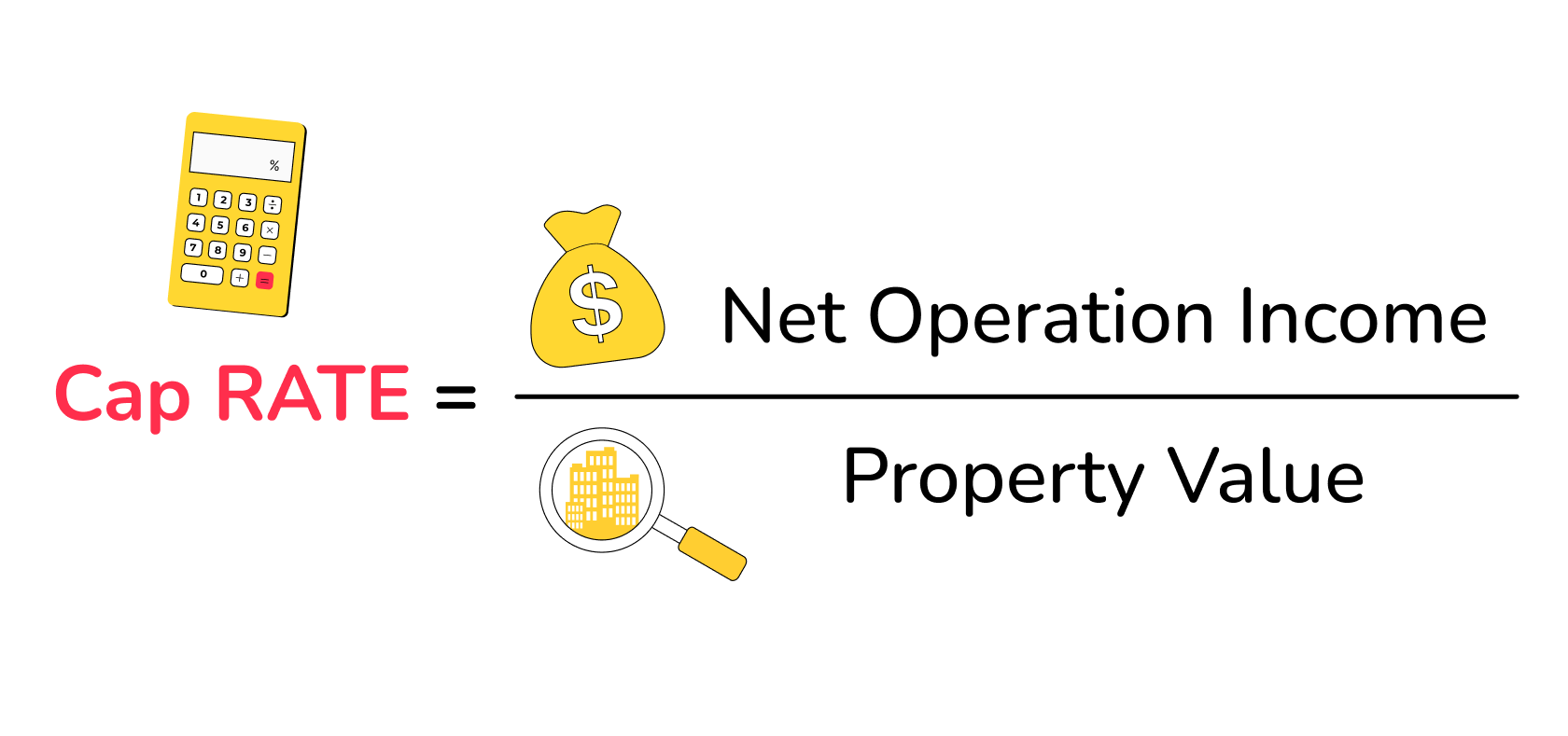
This simple formula offers a snapshot of expected annual returns, excluding debt or taxes.
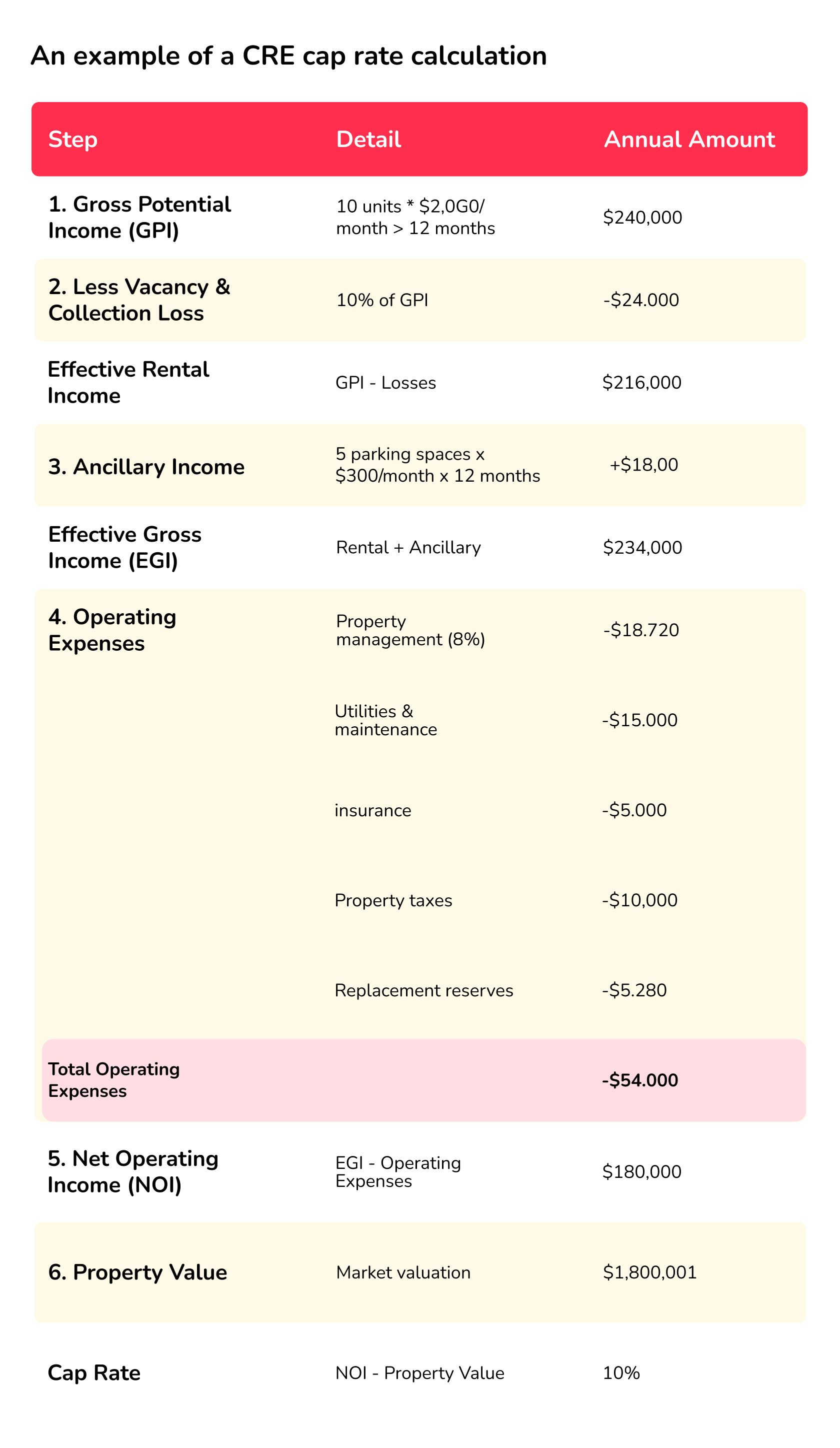
For example, if a property generates $180,000 in NOI and is valued at $1.8 million, the cap rate is 10%.
To get this right, though, you’ll need to make sure you do the following:
1. Calculate Gross Potential Income (GPI)
Start with the maximum rental income the property could generate if fully leased at market rates.
2. Adjust for vacancy and collection losses
Factor in expected vacancies and missed payments to get a realistic income estimate.
3. Add ancillary income
Include revenue from extras like parking, laundry, or signage.
4. Determine Effective Gross Income (EGI)
GPI – losses + ancillary income = your EGI, i.e., the income you’re likely to collect.
5. Take off operating expenses
Deduct your commercial property operating expenses, including maintenance, insurance, management fees, and utilities (excluding mortgage payments), to get your NOI.
Note: Cap rate is only as accurate as the numbers behind it. Avoid common mistakes like
- Counting interest payments as expenses
- Excluding management fees for self-managed properties
- Ignoring vacancy adjustments
Forgetting one-off costs or not accounting for replacement reserves can skew your returns and your investment decisions.
Once you’ve got the NOI, plug it into the cap rate formula. That’s your baseline return– fast, simple, and essential for evaluating any CRE deal.
Calculating your commercial cap rate: An example
Let’s say you’re evaluating the multi-tenant office building in a mid-sized U.S. city, mentioned above. The property currently has a $1.8 million valuation. Here’s a rundown of the figures you would need to include, as outlined above.
The 6 factors influencing a commercial real estate cap rate
We’ve looked at what is a good cap rate for commercial real estate investors, but what are the forces behind these figures?
Here are six factors that will help us get to the bottom of this.
1. Location, location, location
Location is the biggest driver of cap rates in commercial real estate.
Properties in prime areas – think central business districts of major cities – usually have lower cap rates because demand is high and risk is low.
Meanwhile, similar properties in secondary or tertiary markets face less competition and more economic fluctuations, so their cap rates are higher to balance the risk.
For example, a building might yield a 5% cap rate in a prime market but jump to 8% or more in a less established area.
2. Asset class matters
Different property types carry different risks and returns.
As mentioned, industrial properties often have slightly lower cap rates due to stable tenant demand and reliable cash flow.
Office buildings tend to have more variable cap rates. Retail properties, facing shifting consumer habits, usually have higher cap rates reflecting that uncertainty.
Niche assets such as self-storage or data centers have their unique ranges, depending on investor interest and market trends.
3. Property quality and class: A, B, and C
Cap rates also depend on a property’s class. Class A means newer, prime locations that are professionally managed.
Class B and C, meanwhile, are older or less desirable locations with higher cap rates because investors want more return for added risk and potential repair costs.
4. Tenant quality and lease terms
Who’s renting matters. Properties leased to strong, credit-worthy tenants on long-term deals get lower cap rates – they’re seen as safer bets.
Buildings with short leases, weaker tenants, or high turnover face higher cap rates since income is less predictable.
5. Market conditions and economic outlook
Cap rates react to the big picture.
Rising interest rates or economic uncertainty push cap rates up as investors demand more return to cover risk.
However, when the economy is strong and interest rates are low, cap rates tighten as competition grows.
Inflation, local job markets, and new construction also shift supply and demand (and cap rates) across regions.
6. Property-specific factors
Finally, the details count. A well-kept, fully leased property managed by pros will command lower cap rates.
Older buildings with deferred maintenance, high vacancy, or operational headaches need higher cap rates to attract buyers, reflecting the extra risk and capital needed.
How to use cap rates in your investment strategy
Cap rates are a fast way for real estate investors to screen an investment property, compare deals, and negotiate a fair sale price.
The cap rate calculation helps you estimate the potential return on investment at a glance because it’s based on current net operating income and market value.
“Personally, CAP rate has been one of the most important tools in my investment strategy,” says real estate investor Michael Ligon, speaking to Forbes. “When evaluating properties for my portfolio, I always calculate the CAP rate first to quickly gauge if a deal is worth deeper analysis.”
When comparing similar real estate property types – like multifamily properties or class B and class C properties – cap rates help assess relative value, too.
For example, a high cap rate may suggest higher returns but often signals higher risk or lower occupancy. A low cap rate usually indicates lower risk, high-demand areas, or more stable cash flow.
Many investors track average cap rates by asset class and market to spot strong investment opportunities. In markets like San Francisco, where property prices and property taxes are high, cap rates tend to be lower due to lower risk and limited supply.
In contrast, properties in emerging areas with weaker economic conditions or that require renovations may offer high cap rates but come with greater risk.
Lenders may also use the cap rate as part of underwriting, especially when evaluating a property’s location, annual income, and profitability.
Still, cap rates are just one tool. They don’t account for leverage, capital expenses, or future appreciation.
That’s why smart investors always look beyond the cap rate, using metrics like cash-on-cash return, IRR, and rate of return to match their risk tolerance and goals.
This approach provides a clearer picture of an asset’s true potential.
Turn cap rate insights into action with Duckfund
Cap rates can help you assess risk, but speed is what seals the deal.
If you’re eyeing a low-cap-rate property in a prime market or a higher-yield opportunity in a secondary location, timing matters in both scenarios. That’s where Duckfund comes in.
We provide soft deposit financing within 48 hours, so you can move quickly on high-potential deals before the competition catches up.
Instead of letting capital delays derail your plans, secure your earnest money deposit fast and keep negotiations on track.
Ready to act on opportunities with attractive cap rates? Sign up for Duckfund and access innovative financing solutions today.
Real Estate
Financing

- Approval within 24 hours
- Fund multiple properties at once
- No full deposit upfront — soft deposit only
- Apply in under 2 minutes
Secure your next commercial property acquisition — zero upfront capital required.
Start with Duckfund’s EMD financing program.- No capital commitment
- Close faster
- Scale with confidence