Not Sure What a 1031 Exchange Is? Learn This Top CRE’s Investment Strategy
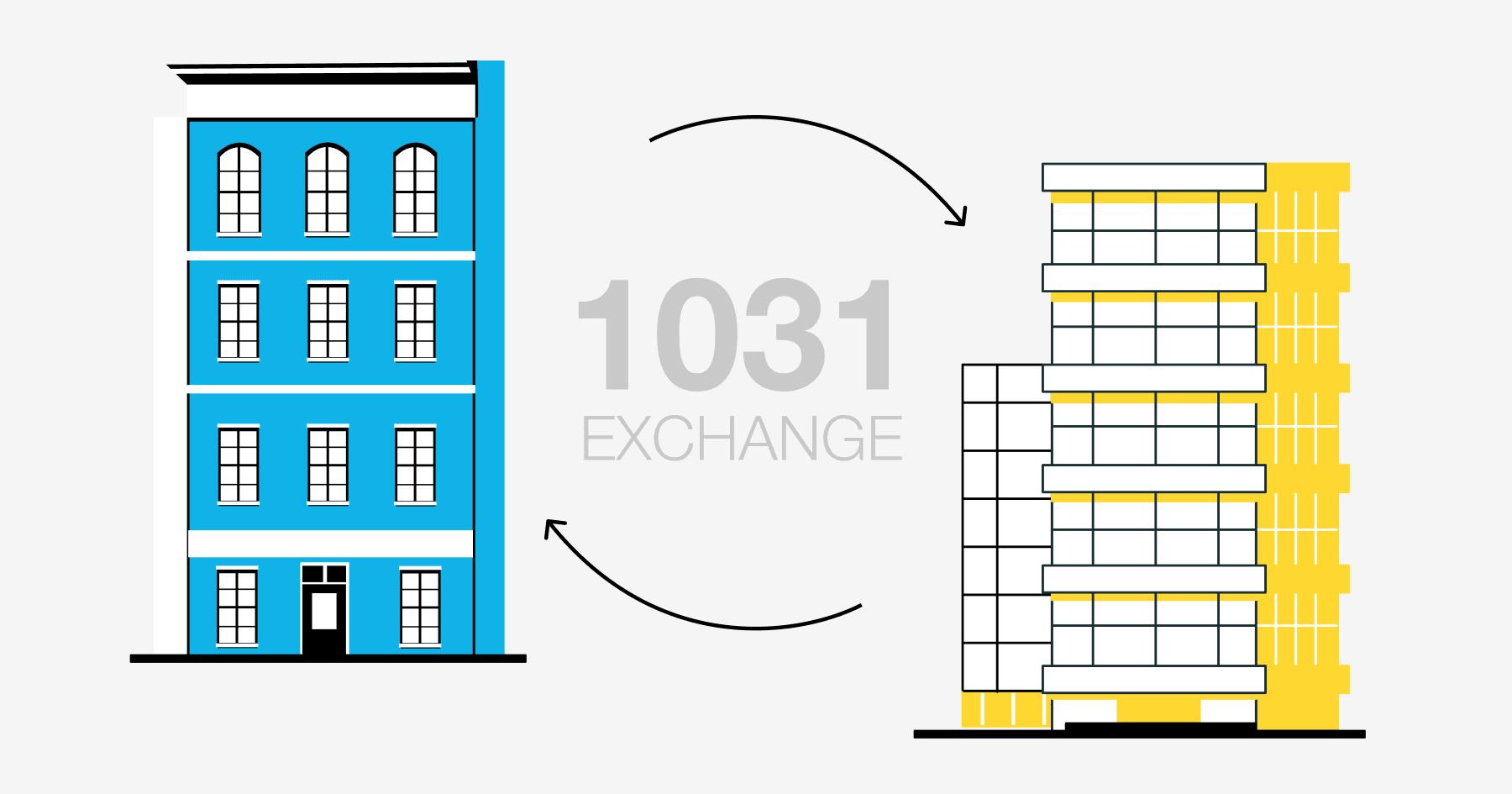
A 1031 exchange is one of the smartest ways commercial real estate (CRE) investors get to grow their portfolios, without getting hit by capital gains taxes.
As the name implies, it has to do with exchanging one investment property with another for tax benefits. Yet, if you find yourself asking “What is a 1031 exchange in commercial real estate?”, the full answer is often clouded thanks to:
- Not fully understanding what qualifies as like-kind property or which assets are eligible for such a deal.
- Confusion around the timeline rules and IRS requirements that govern 1031 exchanges.
- Uncertainty about how a 1031 exchange impacts taxes, cash flow, and long-term investment strategy.
However, knowing this vital strategy can help ambitious CRE professionals scale their portfolio quicker, if done correctly.
This guide explains what a 1031 exchange in commercial real estate is, how it works, what kinds of properties qualify, and what risks to watch out for.
- What is a 1031 exchange in commercial real estate?
- How does a 1031 exchange work?
- What kind of property qualifies for a 1031 exchange?
- What is a reverse 1031 exchange in real estate?
- What Is a 1035 Exchange in real estate?
- The drawbacks and risks of a 1031 exchange
- How long must you hold a 1031 exchange property?
- Grow your portfolio with Duckfund
Want to make CRE deals move quicker?. Contact Duckfund to find out how we can help you land your deal before your rivals.
1. What Is a 1031 Exchange in Commercial Real Estate?
If you’ve ever made money on an investment property only to be hit with capital gains taxes, then you know how quickly profits can shrink.
A 1031 exchange in commercial real estate lets you sell one investment property, like an office building or multifamily rental property, and buy another, without paying capital gains taxes.
Its official name, a tax-deferred exchange, describes it better; however, its appearance under Section 1031 of the Internal Revenue Code (IRC) gives it its popular moniker.
The concept hinges on “like-kind exchanges.” In simple terms, as long as you’re swapping one real property held for investment purposes for another, you can defer capital gains taxes – and speed up cash flow.
“A 1031 exchange allows you to defer taxes, which is the main advantage of doing one”, says Joseph Kimbrough, Founder of Apex, a leading private equity fund. “However, “exchanging" a property with a lower rent potential for a higher rent potential property with more units will immediately increase your cash flow.”
1031 exchanges dropped to a 12-year low in the first half of 2025 due to investor uncertainty and high interest rates, yet it remains a popular tool that powers up to 20% of CRE deals, according to the American Land Title Association.
Used correctly, a 1031 exchange can support everything from estate planning to increasing fair market value exposure – without the tax hit that normally follows the sale of the relinquished property.
2. How does a 1031 exchange work?
A 1031 exchange revolves around a qualified intermediary (QI).
Instead of cashing out and triggering a taxable gain, your sale proceeds go into exchange funds held by a QI.
You then reinvest those funds into a replacement property – often one of greater value – within strict time limits. The aim is to help you grow your portfolio tax-efficiently.
Here’s how a 1031 exchange works in practice:
- Sell your investment property (relinquished property). This could be a rental property, vacant land, or business property – as long as it’s not a primary residence or personal property.
- Hire a qualified intermediary (QI). You’re legally required to use a QI to hold the exchange funds in escrow. You can’t touch the money yourself.
- Identify replacement properties. Within 45 days of the sale, you must identify potential replacement property options.
- Close on a new property. Within 180 days total, you must buy one or more of the identified properties, using the original sale proceeds.
Throughout, you’ll follow exchange rules outlined by the IRS via Form 8824. Timing is strict. If you miss a step or the deadline, the tax deferral disappears and you’ll owe income tax and possibly depreciation recapture.
The result? You swap one CRE asset for another, maintaining investment purposes while deferring taxes. This will help you reinvest in properties with greater value or better cash flow.
3. What kind of property qualifies for a 1031 exchange?
If you’re unsure about whether a property qualifies for a 1031, remember the one key rule: 1031 properties must be held for investment or business use.
This means qualified 1031 exchange property types include:
- Apartment buildings
- Office buildings
- Rental property
- Vacant land
- Retail or industrial business property
The swap must involve "like-kind property." That doesn’t mean identical use, but both must qualify as real property under IRC Section 1031.
For example, you can exchange a vacant lot for a build-to-suit office building.
What’s excluded?
- Primary residences
- Second homes or vacation homes (unless proven rental use applies)
- Personal property (cars, art, equipment—note: some personal property was eligible before 2017, but the current tax code excludes it)
The property’s fair market value and purpose matter more than the exact type. Both must be held primarily for investment purposes – not for resale or personal use.
It’s a smart idea to always verify eligibility before proceeding, as exchange accommodation rules can be nuanced depending on your asset type.
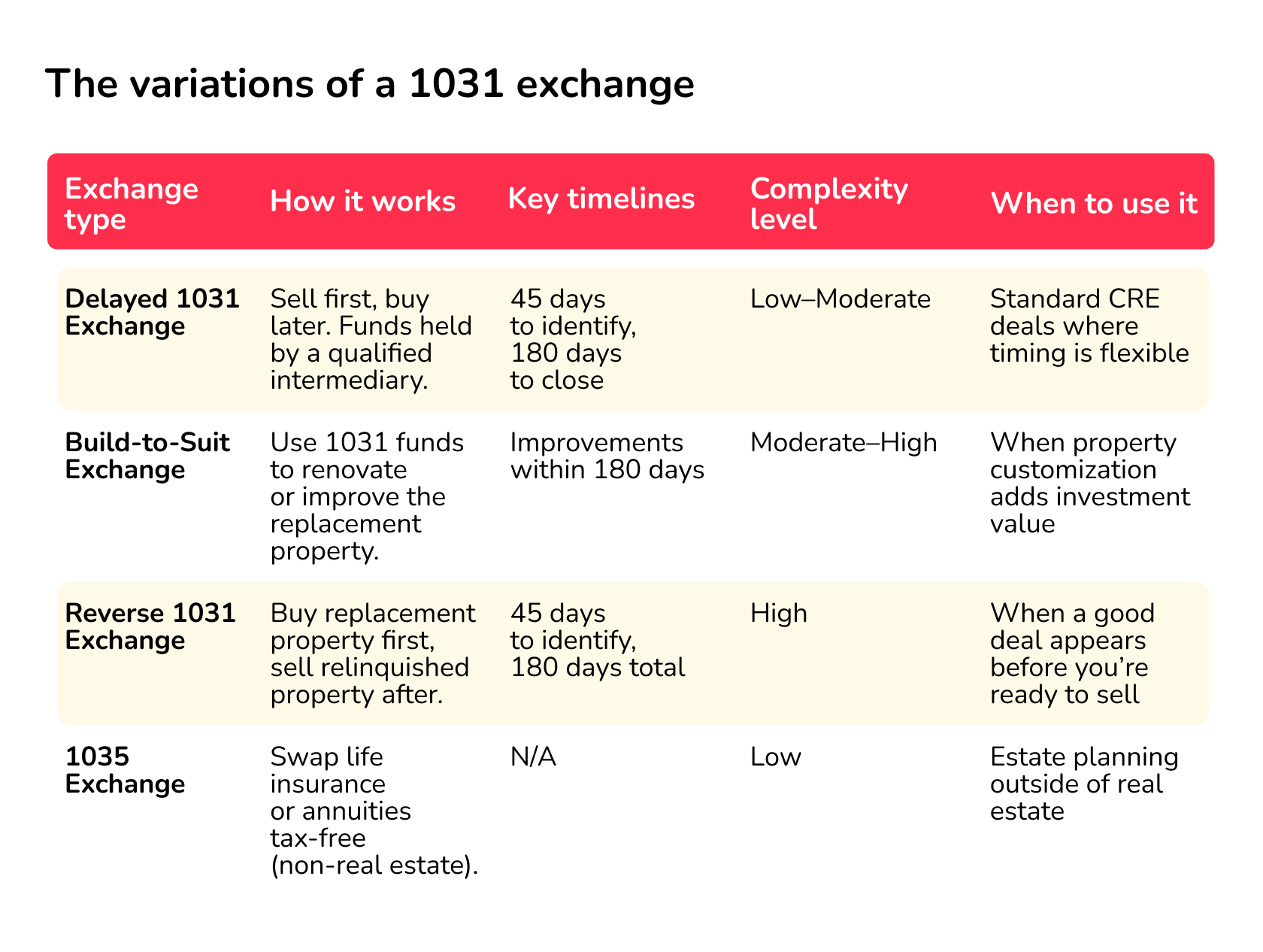
4. What are the variations on the 1031 exchange?
If you’ve search for “What is a 1031 exchange in commercial real estate?”, you may stumble across several related types of exchange.
The traditional 1031 process is the most popular version, but investors can alter the process to fit their objectives.
Here are some examples.
A delayed exchange
The most common variation. In a delayed exchange, the investor sells their relinquished property first, then identifies a replacement property within 45 days, and closes on it within 180 days.
Again, 1031 exchange intermediary holds the funds escrow to maintain IRS compliance. This setup gives you more time to find the right deal while still deferring capital gains taxes.
Build-to-suit exchange
This allows you to use exchange funds to improve or renovate a replacement property as part of the 1031 process.
Here, as the taxpayer, you can customize the property rather than purchasing it ready-to-go. An example might mean adding value to an apartment building or office space before officially buying it.
Strict rules apply, however: all improvements must be completed within the 180-day window, and the fair market value of the improved property must meet the value requirements set by the IRS.
4. What is a Reverse 1031 Exchange in real estate?
A reverse 1031 exchange flips the usual process. Instead of selling first and buying later, you acquire the replacement property before selling the relinquished property.
Why use it? Well, sometimes you find the ideal investment property before you’re ready to sell your existing one. Rather than lose the opportunity, a reverse exchange lets you lock it in.
Here’s how it works:
- Your qualified intermediary sets up an exchange accommodation titleholder (EAT) to temporarily hold either the new or old property.
- You have 45 days to identify the relinquished property and 180 days to complete both transactions.
Reverse exchanges come with added complexity:
- You’ll need more upfront capital, since you’re buying before selling.
- Exchange rules under IRC Section 1031 are stricter.
- Lenders may not always accommodate reverse structures.
That said, for CRE investors facing tight inventory or timing challenges, a reverse 1031 exchange can be an extremely useful solution.
5. What is a 1035 Exchange in real estate?
This is a common question from CRE investors who notice this term in their research. Short answer: It isn’t directly related to real estate investment.
A 1035 exchange applies to life insurance policies and annuities, allowing investors to swap one contract for another without triggering income tax.
Although it is a tax-deferred exchange similar in spirit, 1035 exchanges fall under a different code section of the IRS tax code.
For commercial real estate investors, Section 1031 exchanges are the relevant mechanism, not 1035.
However, some CRE investors use both strategies as part of broader estate planning. Selling a property via a section 1031 exchange while restructuring life insurance via a 1035 exchange, for example, means you create tax efficiencies across both real estate and financial assets.
6. The drawbacks and risks of a 1031 exchange
The tax deferral and other benefits that a 1031 brings are certainly attractive, but it also comes with some real risks, which we can outline here.
- Strict time limits
You only get 45 days to identify potential replacement properties and 180 days to close. Missing either effectively kills your exchange.
- Depreciation recapture
When you eventually sell without an exchange, you get taxed on any deferred depreciation, which may increase your tax liability later.
- Limited property use
You must hold both the old and new property strictly for investment purposes. Use it as a second home or short-term CRE flipping? You risk disqualification from the process.
- Complexity and costs
The nuances of a 1031 deal mean you’ll need a qualified intermediary and legal advice, and may face lender restrictions, especially in a reverse exchange.
That said, the long-term wealth-building potential of a 1031 exchange can easily outweigh these issues. The key is to plan carefully, work with experienced professionals, and follow IRS rules to the letter.
“I recommend working with a tax strategist (for a 1031 exchange),” says Phillippe Schulligen, co-founder of Boost Capital Group. “Find someone who specializes in real estate investments. They can provide guidance on how to optimize your tax benefits.”
7. How long must you hold a 1031 exchange property?
There’s no hard number in the IRC that defines a minimum holding period for a 1031 exchange property, but the general rule is clear:
The property must be held long enough to demonstrate investment purposes, not a quick flip.
Most tax professionals recommend holding:
- At least one to two years to reduce audit risk
- Long enough to report rental income or depreciation on your tax return
The IRS looks at facts and circumstances. If you buy and sell within a few months, they may argue the property wasn’t truly held for income-producing or business use.
Holding periods directly shape your strategy. A 1031 exchange works best for investors focused on long-term growth – using exchange funds to steadily trade up into properties of greater value, not chasing quick flips or short-term gains.
For serious CRE investors, patience is part of the playbook – whether it’s a delayed exchange or building a diverse portfolio through multiple like-kind exchanges over time.
8. How Duckfund helps investors move fast on 1031 exchange properties
The tight timelines in a 1031 exchange can trip up even veteran real estate investors.
In today’s competitive market, locking in a deal fast usually means putting down a soft deposit, also called earnest money deposits.
The problem? Tying up your own capital just to start due diligence can drain time and liquidity, making it harder to chase multiple opportunities.
That’s where Duckfund steps in. We help you bridge the EMD gap so you don’t have to tie up your own cash or scramble for expensive bridge loans.
You secure the property, start due diligence, and still keep your capital flexible for other high-ROI deals.
The process is fully digital, with:
- A 1-minute application
- A 24-hour approval
- Deposits paid within 48 hours
This way, you can act fast, whether you’re navigating a standard or reverse 1031 exchange in real estate – with access to up to $5M in funding.
We even handle signing the Purchase and Sale Agreement (PSA), registering an LLC for the deal, and wiring the deposit to escrow.
It’s a simple way for you to unlock new deals and grow your CRE portfolio faster, without unnecessary capital constraints holding you back.
Move faster, risk less, and keep your capital where it works hardest – with Duckfund on your side.
Want to make 1031 exchanges move faster? Sign up for Duckfund and close your CRE deal quicker than ever before.
Real Estate
Financing

- Approval within 24 hours
- Fund multiple properties at once
- No full deposit upfront — soft deposit only
- Apply in under 2 minutes
Secure your next commercial property acquisition — zero upfront capital required.
Start with Duckfund’s EMD financing program.- No capital commitment
- Close faster
- Scale with confidence