What’s an LOI in Commercial Real Estate? How to Take The First Step

What is an LOI in commercial real estate? More people than you might think aren’t sure of the answer to this question, but a Letter of Intent is the document that kicks off almost every CRE deal.
If you’re an investor tasked with negotiating the terms of an LOI, you may find yourself having similar doubts, and that:
- You’re not sure which parts of the document are legally binding and could be held against you in court
- You don’t know what to include in the LOI, or whether leaving something out might cost you later
- You’re unclear on what happens once you’ve signed the document and how you can close the deal.
All are doubts that can put the brakes on your CRE deal, but they don’t have to. Each one comes down to how you create your Letter of Intent before you proceed.
Read on to find out what an LOI in commercial real estate is in today’s market, including what belongs in a strong one and exactly what comes next.
That way, you can move quicker on your next deal and make sure the terms work for you, instead of against you.
We’ll cover:
- What is an LOI in commercial real estate?
- Is a Letter of Intent legally binding in commercial real estate?
- Do I need a lawyer to draft an LOI?
- What should be included in a commercial real estate LOI?
- What comes after an LOI in a CRE deal?
Ready to move from LOI to closing without freezing your own cash? Contact Duckfund to find out how you can get fully refundable EMD financing, funded in 48 hours.
Fund your next real estate deal
- Access fast financing
- Grow your real estate portfolio

What is an LOI in commercial real estate?
A Letter of Intent (LOI) is a preliminary agreement that lays out the basic business terms of a commercial property deal.
The entry point to the wider process of how to purchase commercial real estate, it comes before anyone drafts the binding contract and normally covers the purchase price, closing date, due diligence period, and key contingencies.
Also often known as a term sheet or Letter of Intent to purchase, many CRE investors treat this as the blueprint for the transaction, a way of putting down the basic terms as a foundation on which the lawyers can build the full purchase and sale agreement (PSA).
LOIs can take many shapes and sizes, but they all follow a similar process in practice:
- The buyer’s side drafts and sends the LOI to show their intent to buy
- Both parties negotiate its terms and sign it once they agree – or abandon the deal if they don’t
- Lawyers use the LOI to guide them on the PSA, as well as the due diligence process and financing.
A well-crafted LOI in real estate can save both the buyer and seller a huge quantity of time and money because it lets them test the waters with a deal without committing to expenditure – it’s a kind of litmus test by which deals live or die.
Is a Letter of Intent legally binding in commercial real estate?
This is something that can catch an investor, particularly a first-timer, off guard and turn into an expensive commercial real estate lesson.
Many of an LOI's provisions are usually non-binding, including core deal terms like purchase price and closing timeline. Contingencies in the LOI also don’t normally commit you to anything on their own.
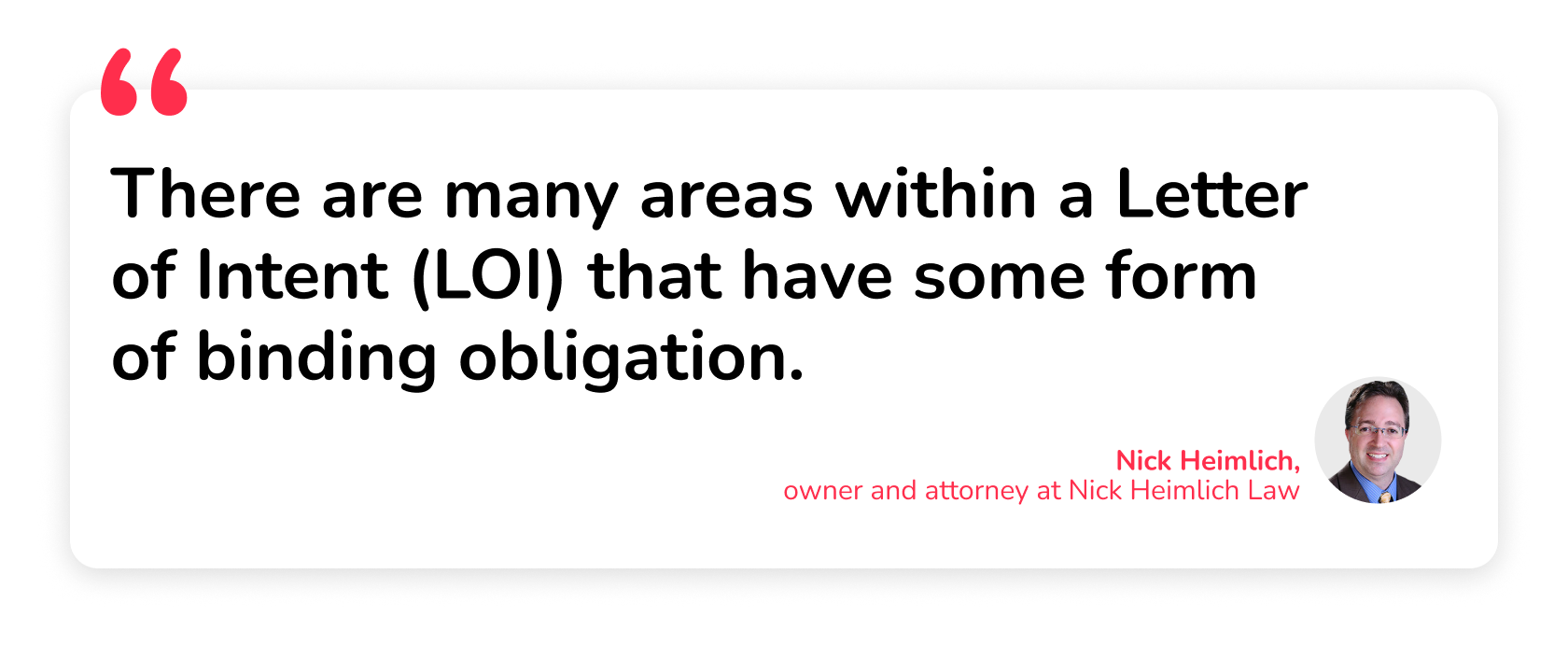
However, it’s dangerous to think that an LOI is legally fireproof. “Many sponsors believe that non-binding refers to 'no-risk’,” says Nick Heimlich, owner and attorney at Nick Heimlich Law. “Yet there are many areas within a Letter of Intent (LOI) that have some form of binding obligation.”
An LOI might have specific clauses that carry legal force, with exclusivity and confidentiality obligations being the most common. “Costs arise if a party negotiates with another potential buyer while still under negotiation (exclusivity),” continues Heimlich. “Disclosing deal information (confidentiality) is also a violation of the obligations stated in the binding LOI and can create leverage issues and increase legal liability.”
Also, just because an LOI might come with the understanding of being “non-binding”, the language inside it can create binding obligations. Courts have treated entire LOIs as enforceable contracts in the past simply because the document contained all the material terms of the transaction.
Often, buyers don’t realize just how closely "expression of interest" is related to "accidental commitment", and this can open up a can of legal worms.
Do I need a lawyer to draft an LOI?
CRE investors don’t “need” a lawyer to draft an LOI, but it’s still a good idea to use one. As mentioned, binding provisions can easily hide inside "non-binding" documents, and these can lead to legal disputes. Sometimes all it takes is to use vague terms like "reasonable time" or "to be agreed” to trigger action.
A good attorney is trained to make sure your exclusivity, confidentiality, and disclaimer language are crystal clear and hold no legal uncertainty. They’ll also show you what important info you’re leaving out – zoning approvals, for example, can lock you into a property you can't use as planned, with no clean way out. Due diligence and financing gaps can also add pressure to a deal.
Lawyers may charge considerable money, but a few hours of legal review is cheap compared to losing a six-figure deposit.
What should be included in a commercial real estate LOI?
A strong LOI for a commercial real estate purchase should include several key details that provide the foundation of a CRE deal. With these, it performs an important balancing act between guiding the upcoming PSA and not being so detailed that it becomes the contract itself.
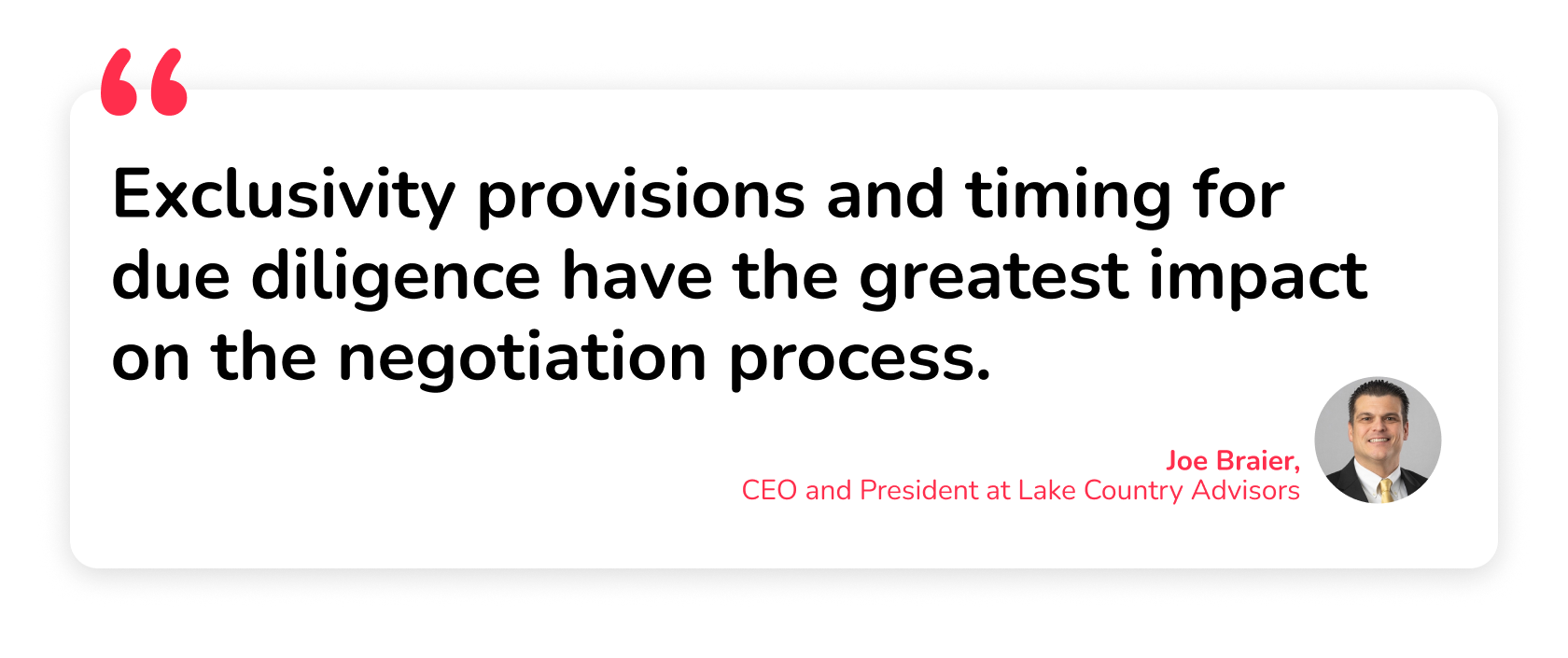
"Exclusivity provisions and timing for due diligence have the greatest impact on the negotiation process," says Joe Braier, CEO and President of Lake Country Advisors, a mergers and acquisitions advisory firm. "These items establish who has control at a time when there are no definitive agreements in place."
With this in mind, most Letters of Intent include the following:
- Parties and property description, including legal address, size, and any special features it may have
- Purchase price and deposit terms
- Due diligence period and contingencies ( like financing, inspection, title, zoning)
- Closing date and key timelines
- Exclusivity clause to lock the seller in while you work
- Binding-effect disclaimer. This spells out which sections are legally binding. Leave this out, then it may come down to a judge deciding which parts are enforceable.
The above may be tedious, but missing out on crucial contingencies like these, or using vague terms, often leads to disputes. As an investor, you might feel pressure to agree to unfavorable terms or close prematurely to get the deal done – both of which can put a deposit, like earnest money, at risk.
The requirements differ slightly for an LOI for a commercial lease, where you’ll need to add extra details to cover the rental side of things, including lease terms, security deposit, operating expenses (CAM), tenant improvement allowance, and renewal options. In short, nothing material should be left open.
What comes after an LOI in a CRE deal?
The signing of a Letter of Intent in real estate is a big moment. It represents the switch from the buyer’s intent to buy to their commitment to buy.
Here’s how it sets up the rest of the process.
- Your non-binding LOI terms become the binding terms of the drafted purchase and sale agreement.
- Both parties sign the PSA.
- The buyer wires the earnest money deposit (EMD) into escrow to make their commitment concrete.
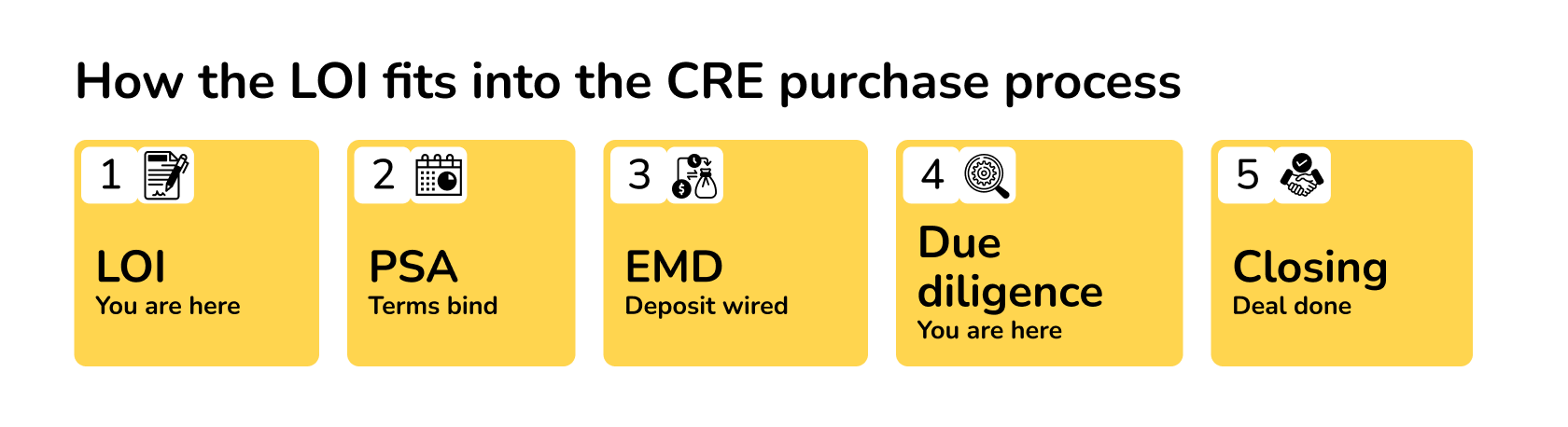
The third step is where the deal starts to get expensive for the buyer. Depending on where you are, the expected earnest money figure is usually between 1% and 5% of the property purchase price. This can reach up to 10% in very competitive markets, like New York, which means a six-figure EMD for one commercial real estate transaction.
Many investors find this a formidable barrier that blocks a deal from completing. They simply don’t have this kind of capital free at the right moment, or they don't want it frozen in escrow when it could be working across other deals.
Earnest money financing providers like Duckfund are stepping in to fill this funding gap. Built to meet the pressure of swift CRE deals, we fund a fully refundable EMD within 48 hours of your application, so that investors can keep the deal moving without dipping into their own funds. Our fees are structured as LP soft costs, which are passed through at closing, at competitive rates that decrease for larger deposits.
Not only does this type of funding keep your own capital free to pursue the next opportunity, but it also saves all the time and effort put into the LOI and PSA beforehand and ensures you don’t lose a deal you’ve already won on paper.
Your LOI is signed – don't let the deposit be what stalls the deal. Sign up for Duckfund and unlock fast, flexible EMD funding in minutes, so you stay liquid and free to move on to the next one.
FAQs
What is an LOI in commercial real estate?
In commercial real estate, an LOI is the foundation of the purchase and sale agreement (PSA). It lays out the basic business terms of the deal, including purchase price, completion date, and due diligence process.
Can a seller back out of an LOI?
Potentially yes, but it depends on the terms of the LOI and how legally binding they are. A buyer who drafts the LOI well and includes an exclusivity clause gives themself extra legal protection.
Is an LOI the same as a term sheet?
Broadly, yes. Both outline a deal's basic terms before the legally binding contract that follows. "LOI" is more common in property purchases and leases; "term sheet" appears more in financing and M&A, but the function is the same.
How long should a commercial LOI be?
Usually one to three pages. This makes it long enough to capture price, timelines, contingencies, and binding provisions clearly, but short enough that it stays a blueprint rather than turning into the PSA itself.
Real Estate
Financing

- Approval within 24 hours
- Fund multiple properties at once
- No full deposit upfront — soft deposit only
- Apply in under 2 minutes
Secure your next commercial property acquisition — zero upfront capital required.
Start with Duckfund’s EMD financing program.- No capital commitment
- Close faster
- Scale with confidence